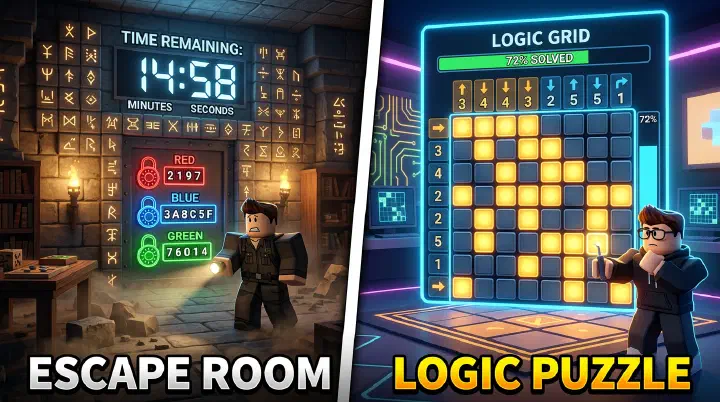
It’s 1:47 AM. My friend and I are on our third attempt at The Asylum. We’ve been stuck in the same room for 45 minutes. There’s a painting on the wall, a desk with a locked drawer, and a bookshelf with 27 books. We’ve tried everything. We’ve clicked every object twice. We’ve read every note. We’re arguing about whether the clock is a clue or just decoration.
Then I notice it. One of the books is slightly tilted. Not obviously — just a degree or two. I click it. A hidden compartment opens. Inside, a key. We look at each other. We both feel stupid and brilliant at the same time.
That’s the magic of a good puzzle game. The feeling when something clicks — when you see what the designer was doing — is unlike anything else in gaming. But the wrong puzzle game? It’s just frustration. You don’t feel stupid in a good way. You feel stupid in a “this game is poorly designed” way.
After playing through 20+ Roblox puzzle games with different groups of friends, I’ve learned that picking the right puzzle game is the most important puzzle of all. The best game for a solo player is the wrong game for a group of four. The best game for logic thinkers will bore observation players to tears. And the most popular game on the platform is actively hostile to beginners.
This guide is everything I wish I’d known before I spent 45 minutes staring at a bookshelf.
How We Evaluate Roblox Puzzle Games
Puzzle games are the most subjective genre on Roblox. A game one person calls “brilliant” another person will call “cheap and unfair.” We evaluate across five specific dimensions to cut through that subjectivity:
- Difficulty fairness — Not “how hard is it” but “does it teach you what you need to know?” A hard puzzle with good signposting is fair. A medium puzzle with zero context is just annoying.
- Puzzle variety — Does it recycle the same five puzzles, or does it introduce new mechanics? The best puzzle games keep surprising you.
- Replayability — Once you know the solution, is there any reason to come back? Randomization, multiple endings, and speedrun modes all add value.
- Group compatibility — Does it actually work with different group sizes? Some games say “1-4 players” but are impossible solo. Others are great solo but boring with friends.
- Quality of life — Checkpoints, hint systems, save progress. These sound boring but they’re the difference between a fun night and a rage quit.
We also have three disqualification rules:
- No “find the tiny key” as the only mechanic. That’s not a puzzle game — that’s a pixel scavenger hunt.
- No untelegraphed instant death. Losing 20 minutes of progress because you stepped on the wrong tile isn’t difficulty. It’s disrespect.
- No puzzles requiring external knowledge. If the solution is “know Morse code” and the game doesn’t give you a reference chart, that’s bad design.
The Ranked List at a Glance
| Rank | Game | Puzzle Type | Difficulty | Best Group Size | Replayability |
|---|---|---|---|---|---|
| 1 | DOORS | Pattern recognition + timing | Hard | 1-2 players | Medium |
| 2 | Escape Room (DevUltra) | Communication + logic | Medium | 3-4 players | Low |
| 3 | The Asylum | Observation + atmosphere | Very Hard | 2-3 players | Low |
| 4 | Puzzle Doors | Logic + math + patterns | Easy-Medium | 1-4 players | Low-Medium |
| 5 | Tower of Hell | Spatial + timing | Medium-Hard | Solo | Very High |
Honorable mentions: Regretevator (weird elevator-based puzzles, great with friends), Breaking Point (social deduction puzzle hybrid), Flee the Facility (not pure puzzle but has puzzle elements).
Wait — Tower of Hell? The obby? Yes. And before you close the tab, hear me out in the full breakdown below.
1. DOORS — The Gold Standard That Hates Beginners
DOORS is the most popular puzzle-horror game on Roblox. It’s also the worst possible introduction to puzzle games if you’re new. Here’s the counter-intuitive truth: the most popular puzzle game on the platform is actively hostile to beginners, and that’s exactly why it works for experienced players.
What makes it a puzzle game, not just horror. The horror is the packaging. The actual game is pattern recognition. Every entity has a specific behavior with specific audio and visual cues. Your job is to identify the cue fast enough and respond correctly. Rush = hide. Ambush = hide, exit, hide again. Eyes = look away. Figure = crouch, don’t run.
It’s essentially a flashcard deck with jump scares. Once you memorize the patterns, the horror mostly goes away and you’re left with a pure skill game. That’s why players sink hundreds of hours into it — the progression is personal. You’re not unlocking items. You’re getting better.
Difficulty curve. Brutal start. New players die constantly to things they couldn’t have predicted. The game doesn’t explain anything. But around rooms 20-30, it clicks. You’ve seen most of the common entities. You know the basic patterns. From there, it’s about refinement — faster recognition, better resource management, solo vs. team strategy.
Group size paradox. DOORS says it’s 1-4 players, but more players doesn’t make it easier — it makes it different. With 4 players, you have more revives but also more chances for someone to trigger an entity incorrectly. Solo is actually the purest puzzle experience because every mistake is yours and every win is earned.
Best for. Players with patience who don’t mind dying to learn. People who enjoy pattern recognition and rhythm games. Solo players or pairs where both are at a similar skill level.
Skip if. You get frustrated easily, you hate jump scares, or you want to play with a big group of casual friends.
2. Escape Room (by DevUltra) — The Social One
This is the game you play when you’ve got a group that actually talks to each other. Escape Room is built around communication in a way no other Roblox puzzle game really nails.
The core design insight. Most escape room puzzles on Roblox are solo puzzles that happen to be in a multiplayer game. You solve them together by having one person do everything and the rest watch. Escape Room designs puzzles that require multiple people doing different things at the same time.
One person reads a symbol chart and describes it over voice chat. Another navigates a laser maze they can’t see the pattern for. A third solves a color sequence while the first person feeds them information. Everyone has a role. Nobody’s just standing around.
Where it falls short. Once you’ve played it, you’ve played it. Solutions are fixed. There’s no procedural generation, no alternate routes, no replay value beyond showing it to new friends. But for that first run with a new group? It’s one of the best social experiences on Roblox.
Difficulty curve. Steady and fair. The first room teaches you the game’s language. Each subsequent room adds a new layer. By the final room, you’re combining everything you’ve learned. It’s a masterclass in puzzle game pacing.
Best for. Friend groups of 3-4 people with voice chat. Game nights. Players who want to beat something in one sitting.
Skip if. You’re playing solo (it’s doable but much harder and not really designed for it). You want replayability. You’re looking for a serious challenge.
3. The Asylum — Pure Observation, Zero Hand-Holding
The Asylum is for players who notice everything. It’s the game you recommend to the friend who always finds the hidden detail in movies.
What makes it unique. The “puzzles” aren’t logic puzzles. They’re environmental details. A slightly open drawer. A bloodstain shaped like a number. A whispered audio cue you only hear if your volume is above 70% and you’re standing in exactly the right spot. A clock showing a specific time that corresponds to a safe combination.
The game doesn’t tell you what to look for. It barely has a UI. There are no quest markers, no hint systems, no “you’re getting warmer” audio. You’re in a room. Something in it is wrong. Find it.
Why it’s polarizing. Observation puzzles are the most divisive type of puzzle. If you’re good at them, The Asylum feels like a masterpiece of subtle design. If you’re bad at them, it feels like the game is trolling you. There’s no middle ground.
Group size sweet spot. Two players. One to scan the room methodically. One to theorize about what the clues mean. With three or more, people talk over each other and miss the quiet audio cues. Solo is possible but exhausting — you have to be both the scanner and the theorist.
Best for. Detail-obsessed players. People who enjoy “I spy” and hidden object games. Atmospheric horror fans who want puzzles instead of jump scares.
Skip if. You’re impatient. You prefer logic puzzles to observation. You’re playing with more than three people.
4. Puzzle Doors — The Honest Beginner Option
Puzzle Doors is what DOORS would be if it actually wanted you to succeed. Same hallway-door format. Much gentler difficulty curve. No jump scares.
What it does well. It teaches you the vocabulary of Roblox puzzle design. Math riddles. Pattern matching. Logic gates. Hidden codes. Environmental clues. You’ll see all the classic puzzle types here, presented in a way that’s fair and learnable.
The puzzles are straightforward but not trivial. They make you think but they don’t make you feel stupid. When you get stuck, it’s usually because you missed something obvious, not because the game is being deliberately obscure.
Where it falls short. It’s generic. Once you’ve cleared it, you’ve seen basically everything it has to offer. It doesn’t have DOORS’s atmosphere or Escape Room’s creative co-op design. It’s a training wheel game — useful, but not the main event.
Group dynamics. Works with any group size from 1 to 4. Mixed skill levels are fine because experienced players can help beginners without the game punishing them for it. It’s the puzzle game equivalent of a party game — everyone can participate at their own level.
Best for. Complete beginners to puzzle games. Mixed-skill groups. Players who hate jump scares but like solving things.
Skip if. You’re an experienced puzzle game player — you’ll breeze through it and be done in an hour. You want atmosphere or story.
5. Tower of Hell — Not a Puzzle Game, Except It Is
Wait. Tower of Hell? The obby where you jump up a tower of randomly generated obstacles? How is that a puzzle game?
Because the “puzzle” isn’t a riddle or a hidden code. It’s route optimization and pattern recognition. Every section of Tower of Hell has a trick. Some jumps are harder than they look. Some sections can be skipped entirely if you know the shortcut. Some obstacles have consistent patterns you can memorize.
Players who grind Tower of Hell develop three skills that transfer directly to every other puzzle game:
- Pattern recognition under pressure — When you’re falling and you have half a second to figure out where to land, you get fast at seeing patterns.
- Methodical observation — Good Tower of Hell players don’t just jump. They stop, look at the next section, and plan their route. That’s exactly how you solve escape rooms.
- Iterating on failure — You die a lot in Tower of Hell. Good players don’t get frustrated — they learn from each death. That’s the exact same mindset you need for hard puzzle games.
I first noticed this when I got back into DOORS after a week of playing Tower of Hell. My reaction times were faster. I was spotting patterns immediately. I was calmer under pressure. I didn’t just get better at obbies — I got better at puzzle games.
Best for. Players who want to build general puzzle-solving skill. People who enjoy rhythmic, skill-based games. Solo players.
Skip if. You specifically want logic puzzles or escape rooms. You hate platforming.
Failure Retrospective: The DOORS Newbie Wall
I mentioned earlier that DOORS is hostile to beginners. Let me tell you just how hostile — from personal experience.
My first time playing DOORS, I made it to room 27 on my first run. I thought I was doing great. Then I died to Halt because I didn’t know you had to turn around. On my second run, I died to Eyes because I looked at them. Third run, Screech got me because I didn’t know what the “psst” sound meant.
I died 11 times in row. Eleven. I didn’t make it past room 40 in any of those runs. I almost quit. I thought the game was just random and unfair.
Then I did something that changed everything: I watched a 3-minute “beginner tips” video. Not a walkthrough. Just the basics — what each common entity does, how you respond.
On my 12th run, I made it to room 80.
Here’s what I learned from that experience — and it applies to every puzzle game, not just DOORS.
Lesson 1: “Hard but fair” is a lie without context
People say DOORS is “hard but fair.” But fair to who? Fair to someone who’s already played 50 hours and knows every entity? Or fair to a new player who has no idea what any of the sounds mean?
A truly fair game teaches you what you need to know. DOORS doesn’t teach you — it makes you die to learn. That’s a valid design choice (and clearly a successful one), but let’s call it what it is: learning by punishment. It works for some people. It bounces others off the game entirely.
Lesson 2: The 3-minute rule
Before you play any puzzle game, spend 3 minutes reading or watching a beginner’s guide. Not a full walkthrough — just the basics. What are the controls? What are the common mechanics? Is there anything the game doesn’t tell you?
This doesn’t spoil the game. It gives you the vocabulary you need to actually play it. You wouldn’t try to solve a crossword puzzle without knowing what “abbr.” means. Don’t try to solve a Roblox puzzle game without knowing the basic language.
Lesson 3: Dying is part of the game — but only if you learn from it
The difference between someone who quits DOORS after 10 deaths and someone who beats it is not skill. It’s whether they’re actively learning from each death or just repeating the same mistakes.
Every time you die in a puzzle game, ask: “What did I just learn?” If you can answer that question, the death was useful. If you can’t — if you died to something you couldn’t have predicted — then it’s the game’s fault, not yours. And you should probably play a different game.
Quick Pick: If-Then Decision Table
Don’t have time to read the full breakdown? Use this table to pick your next puzzle game in 10 seconds.
| If you want… | Then play… | Why it’s the right pick |
|---|---|---|
| The best overall puzzle experience | DOORS | Most polished, highest skill ceiling, most replayable |
| You’re a total beginner | Puzzle Doors | Gentle curve, fair puzzles, teaches the basics |
| Game night with 3-4 friends | Escape Room (DevUltra) | Built for communication, everyone has a role |
| The hardest possible challenge | The Asylum | Pure observation, zero hand-holding, no hints |
| You want to get better at all puzzles | Tower of Hell | Builds transferable pattern-recognition skills |
| Solo player, skill-based | DOORS or Tower of Hell | Both reward practice and personal improvement |
| You hate jump scares | Puzzle Doors or Escape Room | Pure puzzles, no horror elements |
| You have 2 friends who love puzzles | The Asylum | 2-3 players is the sweet spot for observation games |
| You want replayability | Tower of Hell then DOORS | Both have effectively infinite skill progression |
| You want to beat something in one sitting | Puzzle Doors or Escape Room | Clearable in 60-90 minutes |
How to Actually Get Better at Puzzle Games
Reading this guide won’t make you better at solving puzzles. But deliberate practice will. Here’s what actually works.
The Four Puzzle Skills
Every puzzle game tests a combination of four skills. Train all four and you’ll get better at every puzzle game you play.
Skill 1: Observation — The ability to notice things that are out of place. Clues, patterns, anomalies. This is the core skill for The Asylum and hidden-object style puzzles.
Drill: The room scan. Before you touch anything in a new puzzle room, spend 60 seconds just looking. Scan every wall, every piece of furniture, every object. Note anything that looks even slightly unusual. Don’t try to solve anything yet. Just build a mental map. Do this for every room and you’ll stop missing obvious clues.
Skill 2: Logical deduction — The ability to take information you have and figure out what it means. If the note says “the code is the number of chairs times the number of paintings,” and you see 4 chairs and 3 paintings, the code is 12. This is the core skill for math puzzles, logic gates, and pattern matching.
Drill: The “what do I know?” list. When you’re stuck, stop trying random things. Instead, write down (or say out loud) everything you know for certain. Then look at that list and ask: “What else must be true based on this?” You’ll often find the answer is just one deduction away.
Skill 3: Spatial reasoning — The ability to mentally rotate objects, visualize paths, and understand how things fit together. This is the core skill for Tower of Hell, maze puzzles, and 3D spatial challenges.
Drill: Route planning before moving. In any spatial puzzle (platforming, mazes, tile puzzles), plan your entire route before you start moving. Visualize each step. If you can’t visualize it, you probably don’t understand it yet. This slows you down at first but makes you much faster overall.
Skill 4: Calm under pressure — The ability to think clearly when a timer is counting down or a monster is chasing you. This is the skill that separates good solo players from good group players.
Drill: The 5-second pause. When you feel panicky — timer running low, entity chasing, heart racing — stop. Take a 5-second breath. Remind yourself what you’re trying to do. Then act. Most puzzle game mistakes happen because people rush when they feel pressured. A 5-second pause saves more time than it costs.
The Cross-Training Method
Just like with FPS games or fighting games, playing multiple puzzle genres makes you better at all of them. Here’s the optimal rotation:
- Tower of Hell (2 days/week) — Spatial reasoning and calm under pressure. Your gym.
- DOORS (2 days/week) — Pattern recognition and timing. Your main game.
- A different puzzle type (1-2 days/week) — Something you’re bad at. Logic puzzles if you’re an observation player. Observation puzzles if you’re a logic player.
- Escape Room / social puzzles (1 day/week) — Play with friends. Communication is a puzzle skill too.
This rotation works because each game trains a different muscle. Tower of Hell builds speed and pattern recognition that transfer to DOORS. Logic puzzles train deduction that helps with The Asylum. You get the idea.
The Plateau Breaker
If you’ve been stuck at the same skill level for weeks, here’s what to do: play a puzzle game you’re terrible at for one week.
If you’re stuck on DOORS room 70, go play The Asylum for a week. It will force you to slow down and observe details you’d normally miss. When you come back to DOORS, you’ll notice cues you never saw before.
If you’re stuck on The Asylum, go play Puzzle Doors for a week. It will remind you how logical puzzle structure works. When you come back, you’ll start seeing the logic behind the environmental clues.
The worst thing you can do when you plateau is grind the same game harder. You’re not getting worse — you’ve just learned everything you can from that game’s specific patterns. You need a different perspective.
Counter-Intuitive Truths About Puzzle Games
These sound wrong until you’ve solved enough puzzles. Then they’re obvious.
The hardest puzzles are usually the simplest ones. When you’re stuck on a puzzle, your instinct is to look for a complex solution. But 9 times out of 10, the answer is something simple that you’re overthinking. The classic example: a locked door with a key sitting on a table in plain sight. People spend 10 minutes looking for hidden clues because they assume the solution must be clever. It’s just on the table.
Walking away is the most powerful puzzle-solving technique. When you’re truly stuck, the best thing you can do is nothing. Take a 5-minute break. Get a drink. Stretch. Your brain keeps working on the problem in the background. More than half the time, the answer will pop into your head while you’re doing something completely unrelated. This isn’t magic — it’s incubation, and it’s a well-documented psychological effect.
Good puzzle players aren’t smarter — they’re more systematic. I used to think people who were good at puzzles were just smarter than me. Then I realized they just have methods. They scan rooms systematically. They eliminate possibilities one by one. They make lists. They test hypotheses. Anyone can learn these methods. You don’t need a high IQ. You just need to stop guessing and start being methodical.
The best puzzle games make you feel smart, not the game designer. When you solve a good puzzle, you think “I’m so clever!” When you solve a bad puzzle, you think “That was stupid.” The difference is whether the solution is earned or arbitrary. A good designer gives you all the information you need and trusts you to figure it out. A bad designer hides information to make themselves feel clever.
Frequently Asked Questions
What is the best Roblox puzzle game in 2026?
DOORS is the most popular and most polished, but it’s also the hardest for new players. For beginners, Puzzle Doors is the best starting point. For groups of friends, Escape Room by DevUltra has the best cooperative design. For detail-obsessed players, The Asylum offers the purest observation puzzles. The right answer depends on your skill level, group size, and what kind of thinking you enjoy most.
Which Roblox puzzle game is best for beginners?
Puzzle Doors is the best starting point for new players. It has a gentle difficulty curve, fair puzzles, and teaches the basic vocabulary of Roblox puzzle design — hidden codes, environmental clues, locked doors. After clearing Puzzle Doors, you’ll have the skills and confidence to tackle harder games like Escape Room and eventually DOORS. Just don’t start with DOORS — it will bounce 80% of new players off the genre entirely.
Can you play Roblox escape rooms solo?
It depends on the game. DOORS is fully playable solo and many players prefer it that way — you learn faster without teammates and every win is earned. Puzzle Doors works great solo. The Asylum is doable solo but harder because you only have one set of eyes and one brain to both scan and theorize. Escape Room by DevUltra has some puzzles that are much harder solo because they’re designed for communication and teamwork — you can beat it alone, but it’s not the intended experience.
What’s the hardest Roblox puzzle game?
The Asylum is generally the hardest because its puzzles are purely environmental observation — there are no hints, no UI, and nothing telling you what to look for. You’re in a room with 30 objects and one of them is slightly different. Good luck. DOORS is also very hard but at least gives you clear audio cues and patterns you can learn. The Asylum just drops you in and expects you to notice everything.
How do I get better at Roblox puzzle games?
Three things make the biggest difference: slow down — most players miss clues because they’re rushing through rooms. Spend 60 seconds observing before you touch anything. Play different types of puzzles — logic games train deduction, observation games train attention, timing games train pattern recognition. Cross-training makes you better at all of them. Take breaks when stuck — your brain solves puzzles in the background. Walk away for 5 minutes and the answer often comes to you. Also, Tower of Hell (the obby) surprisingly builds transferable pattern-recognition and timing skills that help with every puzzle game.
Why do some puzzle games feel cheap and unfair?
Bad puzzle design usually falls into a few predictable categories: requiring external knowledge the game doesn’t provide (like Morse code or binary), no checkpoints so one mistake wipes 20 minutes of progress, pixel-hunt puzzles where the clue is literally invisible unless you click the exact right pixel, untuitive leaps in logic where the solution makes sense to the designer but nobody else, and hidden group-size requirements so you can’t beat it solo but the game doesn’t tell you that. Good puzzle games are hard but fair — when you see the solution, you think “of course,” not “how was I supposed to know that?”
More game comparisons and rankings in the Related Guides section below, or browse our full Best Roblox Games of 2026 list.
Disclaimer: Puzzle games receive frequent updates — new rooms, new mechanics, new floors. This guide reflects the state of Roblox puzzle games as of September 2026. Difficulty can shift significantly with major updates. Always check recent patch notes and player reviews before diving into a new game.
Related Guides
- Best Roblox Games of 2026 — All genres ranked and compared
- Best Roblox Horror Games — More horror-focused puzzle and atmospheric games
- Best Roblox Survival Games — Survival horror with resource management
- Best Roblox Obby Games — More spatial puzzle-platformers like Tower of Hell
- DOORS Hub — Complete DOORS strategy library and entity guides