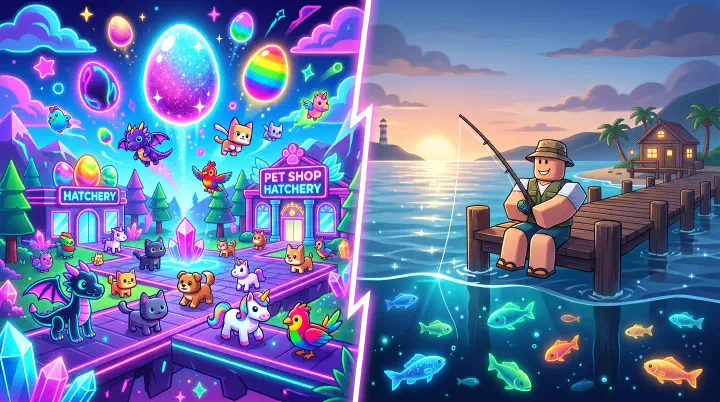
You just spent 200 hours hatching eggs in Pet Simulator 99. You joined a clan. You did every event. You unlocked every area. Your pets list spans 200 entries. Your damage number is in the trillions.
And you hate it.
The loop was never the issue. The genre isn’t the issue. The problem is that you picked the biggest simulator instead of the one that matches how you actually like to play. PS99 is great — for the kind of player who enjoys optimizing spreadsheets while the game runs in the background. If you want to be actively engaged, making decisions, testing skill, you’re grinding 200 hours of the wrong game.
This guide ranks the five biggest Roblox simulator games across the dimensions that actually matter: grind style, free-to-play fairness, engagement level, progression depth, and what kind of player each game rewards. Not a “which is biggest” list. A fit guide.
Most people pick one based on YouTube popularity rankings. Then they grind 100+ hours of the wrong game before realizing the loop doesn’t fit them. Some collectors call this genre “the simulator trap” — games are designed to keep you playing through sunk cost, collection momentum, and event pressure, even after you’ve stopped enjoying the core loop.
This guide exists to short-circuit that trap. Read it before you sign a clan. Read it before you buy a gamepass. The five games below are all good. The question is which one fits the player you actually are.
How We Evaluate Roblox Simulator Games
There’s no single “best” simulator — there’s only the best simulator for you. We use six specific dimensions to figure out which fits which player:
- Grind style — Is the loop AFK-friendly or fully active? Does progress happen while you sleep, or do you have to be at the keyboard?
- Free-to-play fairness — Can a player who spends zero Robux realistically progress? Or is the game gated behind gamepasses?
- Engagement level — How much of your attention does the game need? Are you actively making decisions, or passively watching numbers go up?
- Progression depth — How long until you hit the ceiling? Days, weeks, months, or years?
- Social economy — Does the game have player trading, clans, co-op, or is it purely solo?
- Update pacing — How often does new content drop? Weekly events vs. quarterly overhauls vs. something in between.
The highest-ranked game isn’t necessarily the one you should play. Use this guide to find your fit, not the consensus pick.
The Ranked List at a Glance
| Rank | Game | Grind Style | Engagement | F2P Grade | Best For |
|---|---|---|---|---|---|
| 1 | Pet Simulator 99 | Semi-AFK | Low | B | Collectors, optimizers, background grinders |
| 2 | Fisch | Fully active | High | A | Skilled players, atmosphere seekers, short sessions |
| 3 | Bee Swarm Simulator | Semi-active | Medium | A | Cozy players, completionists, long-term progression |
| 4 | Tower Defense Simulator | Session-based | High | B+ | Strategy fans, challenge seekers |
| 5 | Anime Adventures | Session-based | Medium-High | B- | Anime fans, gacha enjoyers, team builders |
1. Pet Simulator 99 — The Numbers Go Up King
Pet Simulator 99 is the biggest simulator on Roblox by player count, content volume, and update frequency. It’s the genre’s flagship title — and the reason most people think “simulator” means “hatch eggs, collect, prestige, repeat.”
Why it’s #1. The collection depth is unmatched. Hundreds of pets, dozens of egg tiers, enchantments, rebirth mechanics, clan wars, trading economy, seasonal events, exclusive pets. There is always something new to chase, and the developer ships content faster than you can consume it. If you want a game where the ceiling is “months from now,” PS99 is the answer.
The semi-AFK grind philosophy is also a feature, not a bug. You set up auto-hatching, walk away, come back to a stronger team. This works beautifully for players who want a “background game” running while they do other things — work, school, watching a show. The numbers go up either way.
The trading economy is a game within the game. Learning to value pets, spot manipulation, and time your trades is a skill set that pays off in actual game progression. Some players make their entire PS99 experience about trading and never touch the gameplay.
Why it’s not for everyone. If you hate AFK grinding, PS99 will feel like pulling teeth. The active layer (events, clan battles, min-maxing) is fun, but it’s a thin layer over a passive foundation. You can sit there watching your pets farm for hours — and if that’s not your idea of fun, you’ll burn out fast.
Best for: Players who love spreadsheet-style optimization, collection depth, and the satisfaction of seeing numbers climb. People who want a “background game.”
Skip if: You hate AFK grinding. You want fully active gameplay. You don’t care about collection mechanics.
2. Fisch — The Skill-Based Breakout
Fisch launched in 2024 and immediately became one of the most-played Roblox games of all time. It’s a fishing RPG with weather systems, seasonal rotations, mutation mechanics, and skill-based minigames. The opposite of PS99 in almost every way.
Why it’s #2. The engagement is the highest of any game here. Every minute you cast a line, you stay active, making decisions about bait, location, weather, and timing. The fishing minigame tests your real-time skill. Catching a rare fish in Fisch feels genuinely rewarding because you were there, paying attention, when it happened.
The atmosphere is also unmatched among Roblox simulators. The oceans feel alive. The weather changes the fish you can catch. The seasons rotate. New areas unlock. It’s a game you can play for the experience, not just the progression.
The free-to-play experience is the most generous in the genre. Every rod and upgrade is purchasable with in-game currency. You don’t need Robux to progress, and you don’t need to grind hundreds of hours to feel powerful. The progression is honest.
Why it’s not #1. The grind is shorter than PS99’s. Once you’ve caught the rarest fish and unlocked the best rods, the long-term motivation drops. It’s a fantastic first 100 hours but can feel thin after that.
Best for: Players who want fully active gameplay, skill-based progression, and atmospheric immersion. Short to medium sessions (20-60 minutes).
Skip if: You want endless progression depth. You want a game to run in the background. You hate fishing as a theme.
3. Bee Swarm Simulator — The Cozy Classic
Bee Swarm Simulator launched in 2018 and is still going strong. You collect bees, build a hive, gather pollen, make honey, and unlock new fields. It’s the grandparent of Roblox simulators — and the one that proved the genre could last.
Why it’s still top 3. The hidden depth is genuinely impressive. Bee personalities, nectar types, weather effects, bear quests, gifted bee bonuses — the game doesn’t tell you half of what it does. Discovering how everything fits together is half the fun, and it takes months to fully understand the systems.
The cozy pacing makes it perfect for winding down. There’s no pressure. No leaderboard stress. No competitive meta. You play, you progress, you come back tomorrow. The game rewards consistency over intensity — players who log in for 30 minutes every day get more out of it than players who binge for 10 hours and disappear.
The free-to-play generosity matches Fisch. Almost everything is unlockable through gameplay. The premium currency (Tickets, Royal Jelly) helps but isn’t required.
Why it’s not higher. The update pace is slow. Big content drops come quarterly. If you want constant new content, Bee Swarm will feel stagnant by month two.
Best for: Cozy players. Completionists who love discovering hidden systems. Players who want a game they can casually play for a year without burning out.
Skip if: You want fast progression. You hate slow updates. You want competitive or social gameplay.
4. Tower Defense Simulator — The Strategy Sim
Tower Defense Simulator breaks the “collect things, watch numbers go up” mold. You build tower loadouts, defend against waves, and unlock harder modes. It’s a strategy game first, simulator second — but the progression system (unlocking towers, upgrading, beating harder difficulties) fits the genre pattern.
Why it’s top 4. The strategy depth is the highest in this list. Tower placements, loadout synergies, wave patterns, economy management — every decision matters. Beating Fallen mode or Hardcore mode after weeks of attempts feels genuinely earned.
The co-op is the best in the genre. Playing tower defense with friends is more fun than playing it solo. The team coordination adds a social layer most simulators lack.
The challenge is real. Most simulators are low-stress — you progress no matter what. TDS will beat you, repeatedly, until you learn the patterns. That’s a feature for challenge-seekers and a turn-off for casual players.
Why it’s not higher. The progression is shorter than pure sims. Once you’ve beaten the hardest modes, the long-term motivation drops. There’s no endless grind layer to fall back on.
Best for: Strategy fans. Challenge seekers. Tower defense veterans. Friend groups who want co-op gameplay.
Skip if: You want AFK grinding. You hate losing repeatedly. You want endless progression.
5. Anime Adventures — The Gacha Hybrid
Anime Adventures combines tower defense with gacha-style unit collection. You summon anime characters, build teams, and defend waves. Each unit has unique abilities and rarities, and the meta shifts with every update.
Why it’s on the list. The gacha element hits the same dopamine button as hatching Huge pets in PS99, but the units actually change how you play the game. It’s like if PS99’s pets had unique abilities instead of just being stat sticks.
The anime aesthetic pulls in a dedicated audience. If you love anime and gacha games, this is your simulator.
The meta is constantly evolving. New updates shift which units are top-tier, forcing players to adapt their teams and strategies. This keeps the game fresh but can feel exhausting if you want a stable meta.
Why it’s #5. The RNG-heavy gacha can be frustrating for players who prefer skill-based progression. The anime aesthetic alienates players who don’t care for it. And the meta shifts make long-term planning difficult.
Best for: Anime fans. Gacha enjoyers. Team-building theorycrafters.
Skip if: You hate RNG. You’re allergic to anime aesthetics. You want stable meta.
Failure Retrospective: The 200-Hour AFK Mistake
I made the worst simulator mistake you can make: I picked the biggest one without asking if it fit me.
Mistake 1: I Picked the Most Popular One Without Checking the Loop
When I first got into Roblox simulators, PS99 was everywhere — YouTube thumbnails, TikTok clips, friend recommendations. It was the biggest one. So I downloaded it and started grinding.
I spent 200 hours on it. I hatched thousands of eggs. I joined a clan. I did every event.
And I was miserable.
The problem wasn’t PS99. It was me. I hate AFK grinding. I hate sitting around watching numbers go up. I want to be actively playing, making decisions, testing skill. PS99’s semi-AFK loop was like pulling teeth for me, but I kept going because “it’s the best simulator” and “everyone plays it.”
Lesson: Popularity doesn’t equal fit. The biggest simulator is the biggest because it has the most reach — it appeals to many players in many moods. That doesn’t mean it’s the right fit for your mood.
Mistake 2: I Pushed Through Dislike Instead of Quitting
A normal person quits a game they’re not enjoying after 5-10 hours. I pushed through 200.
Why? Because of sunk cost fallacy. “I’ve already invested 200 hours. If I quit now, those hours are wasted.” But they’re not wasted — they’re the cost of learning what I don’t enjoy. That’s valuable information.
I should have quit PS99 at hour 10 and tried Fisch. I would have saved myself 190 hours of grinding a game I hated and found a game I loved 190 hours sooner.
Lesson: Set a “fit check” hour count. If a game doesn’t click after 10-20 hours, quit. Don’t let sunk cost keep you grinding something that isn’t working.
The Right Way to Use the Failure
My 200 hours in PS99 weren’t wasted. They taught me three things I now treat as simulator gospel:
- The 10-hour fit check is sacred. If a simulator doesn’t click after 10-20 hours, quit. Don’t bargain.
- The mood question matters more than the popularity question. Ask “what do I want to feel” before asking “what’s the best one.”
- Two or three rotating fits beat one obsessive main. Cross-train deliberately.
If I could redo those 200 hours, I’d spend 60 in PS99 to confirm it wasn’t for me, then move to Fisch and Bee Swarm for the rest. Same time investment. Radically different enjoyment outcome.
Mistake 3: I Didn’t Cross-Train
I was a PS99 purist. Other simulators were “lesser games” and “not worth my time.” This was wrong.
When I finally tried Fisch, my PS99 enjoyment actually went up. Why? Because I stopped needing PS99 to be everything. I could play PS99 for AFK grinding when I wanted background play, Fisch for active sessions when I wanted skill testing. Each game got better because I wasn’t forcing either one to fill roles it wasn’t designed for.
Lesson: Play 2-3 simulators in rotation. Each one fits a different mood. The combination beats any single game.
The Three-Game Rotation Setup
After 200 hours of PS99 misery and a happy accident with Fisch, I landed on a setup that’s worked for two years. Most experienced simulator players use something similar.
Game 1: The AFK Grinder (PS99 or similar)
This is your background game. It runs while you work, watch a show, or play something else. The core loop should be passive-friendly — auto-hatching, auto-collecting, auto-progressing.
PS99 is the canonical example, but there are others (Mining Simulator 2, Arm Wrestle Simulator). Pick one you genuinely enjoy checking in on, not one you feel obligated to grind.
Game 2: The Active Game (Fisch or TDS)
This is your focused-session game. It needs your full attention. The progression happens through skill, not time.
Fisch is the most accessible active game. Tower Defense Simulator is the most strategic. Pick whichever fits your play style — both reward skill over time investment.
Game 3: The Cozy Wildcard (Bee Swarm or Anime Adventures)
This is your mood-shifter. The game you play when neither AFK grinding nor active competition feels right. Something low-pressure, atmospheric, or aesthetically pleasing.
Bee Swarm Simulator fits the cozy bill. Anime Adventures fits if you love anime and gacha. The wildcard doesn’t need to be deep — it just needs to feel different from your other two.
This three-game rotation covers every mood. AFK grinding for passive time. Active play for skill sessions. Cozy play for winding down. You won’t burn out on any single game because each fits a different context.
Quick Pick: If-Then Decision Table
Don’t have time to read the full breakdown? Find your situation and pick accordingly.
| If you want… | Then play… | Why it’s the right pick |
|---|---|---|
| The biggest, most-updated simulator | Pet Simulator 99 | Largest player base, weekly content drops, deepest collection |
| Fully active skill-based gameplay | Fisch | Engages your attention, skill-rewarding, atmospheric |
| A cozy game to wind down with | Bee Swarm Simulator | The most relaxing simulator, deep hidden systems |
| A real challenge with strategy depth | Tower Defense Simulator | Genuine difficulty, co-op, strategic loadouts |
| Anime-themed gacha collection | Anime Adventures | Hundreds of characters, meta shifts, team building |
| The best free-to-play experience | Fisch | Most generous F2P, every upgrade purchasable with in-game currency |
| A game you can play with friends | Tower Defense Simulator | Best co-op in the genre, team coordination |
| A background game for passive grinding | Pet Simulator 99 | Set-and-forget auto-hatching, progress while AFK |
| Endless long-term progression | Pet Simulator 99 | Months of content, always something new to chase |
| A simulator you can play for a year without burning out | Bee Swarm Simulator | Hidden depth, slow updates, cozy pacing |
How to Get Into Simulator Games Without Burning Out
Most simulator players quit within 30 days. Not because the games are bad — because they burn out. Here’s how to avoid that.
The 10-Hour Fit Check
When you start a new simulator, give it 10 hours of focused play. Not 10 hours of AFK grinding — 10 hours of actual gameplay where you’re making decisions, progressing, engaging.
If after 10 hours you find yourself logging in because you feel obligated rather than because you want to play, quit. The game isn’t for you. Move on.
This is the most important rule in simulators. Games in this genre are designed to keep you playing through sunk cost and collection momentum, not through genuine enjoyment. The 10-hour fit check breaks that cycle.
The One-Game-at-a-Time Rule (Until You’re Stable)
Don’t start three simulators at once. The temptation is to AFK one in the background while actively playing two others, but that leads to half-progress in all three and satisfaction in none.
Start with one. Play it for 2-4 weeks until you understand its systems and reach a point where progression feels comfortable. Then add a second game. Then a third.
This staged approach lets you build genuine engagement with each game before adding complexity. It also helps you figure out which games you actually enjoy versus which ones you enjoy the idea of.
The Event Calendar Awareness
Most simulators run events. PS99 has weekly events. Fisch has seasonal rotations. Anime Adventures has bi-weekly drops. Knowing the event calendar lets you prioritize your active play during high-reward windows and save low-reward days for AFK background grinding.
Players who play during events get 3-5x the progression per hour. Players who ignore events grind the same rates forever and burn out wondering why they’re not progressing.
The Trading Economy Literacy
PS99, Anime Adventures, and most modern simulators have player-driven economies. Learning basic trading literacy — how to value items, spot market manipulation, time your trades — gives you a huge progression advantage over players who just grind.
You don’t need to be a “trader” to benefit from this. Even basic literacy — knowing which pets are overvalued, which events shift the market — compounds into major long-term gains.
Counter-Intuitive Truths About Simulator Games
These sound wrong until you’ve put enough hours in. Then they’re obvious.
You should play multiple simulators, not main one. Almost every experienced simulator player has 2-3 games they rotate between. Simulators hit different moods. Sometimes you want to zone out and watch numbers go up (PS99). Sometimes you want to focus and feel skillful (Fisch). Sometimes you want to think strategically (TDS). Playing one exclusively leads to burnout.
The biggest simulator is the best fit for the fewest players. PS99 has the biggest reach because it appeals to many moods — AFK grinding, trading, events, clans. That breadth means it’s never the best fit for any specific playstyle. If you know your mood, you’ll enjoy a more focused simulator more.
Free-to-play simulators respect your time more than paid ones. Fisch and Bee Swarm Simulator are more generous to free players than PS99 and Anime Adventures. The reason: paid games are designed to make spending money feel valuable, which means slowing free progression. Generous free-to-play means the game is confident enough in its design to let you progress at full speed.
AFK grinding is a feature for some players, a dealbreaker for others. There’s no objectively “correct” way to play simulators. If you enjoy AFK grinding, it’s a feature. If you don’t, it’s a dealbreaker. The mistake is assuming one is the “right” way and the other is wrong.
Quitting a simulator at hour 15 is smarter than grinding it to hour 200. Sunk cost fallacy ruins more simulator experiences than bad game design. If a game doesn’t click after 10-20 hours, the smartest move is to leave and find one that does. The hours weren’t wasted — they taught you what you don’t enjoy.
Frequently Asked Questions
What is the best Roblox simulator game in 2026?
Pet Simulator 99 is the biggest and most popular by player count and update frequency. But “best” depends on what you want. Fisch if you want active skill-based gameplay. Bee Swarm Simulator if you want cozy, deep progression. Tower Defense Simulator if you want strategy and challenge. There is no single best game — only the best game for you.
Which simulator is most beginner-friendly?
Fisch is the most beginner-friendly. The fishing loop is immediately intuitive — cast, reel, sell, repeat. Within 10 minutes you understand the whole game. Pet Simulator 99 has many more systems (enchantments, trading, rebirth, clans) and takes 2-3 hours to really click. Start with Fisch if you want instant gratification; pick PS99 if you enjoy mastering complex systems.
Which has the best free-to-play experience?
Fisch and Bee Swarm Simulator are the most generous to free players. Every upgrade is purchasable with in-game currency, and progression feels earned rather than gated. PS99 is viable free-to-play but slower — Huge and Titanic pets are rare without gamepasses or trading skill. All five games on this list are fully enjoyable without spending Robux — some just respect your time more than others.
Can I play multiple simulator games at once?
Absolutely — they complement each other perfectly. Most experienced players run an AFK grinder (like PS99) in the background while actively playing another game (Fisch, TDS, or Bee Swarm). The best setup is 2-3 games in rotation: one for background play, one for focused sessions, and one wildcard for when you want something different. They never compete for your attention.
Which has the best updates and events?
Pet Simulator 99 has the fastest pace — weekly content drops, bi-weekly events, and a constant stream of new pets. Fisch updates monthly with seasonal rotations and new areas. Bee Swarm Simulator updates less frequently, but each update is massive and adds entirely new systems. Pick PS99 if you hate running out of things to do; pick Bee Swarm if you want big, meaningful content drops.
Are simulator games pay-to-win?
Most Roblox simulators have pay-to-speed-up elements (gamepasses, Robux currency) but aren’t strictly pay-to-win. You can get nearly everything in Fisch and Bee Swarm Simulator for free. In PS99, free players can earn Huge pets through trading and events. The difference between free and paid is usually speed, not access — though some limited-time exclusive pets are locked behind Robux purchases.
The Roblox simulator genre is enormous and constantly changing. Five years ago, Bee Swarm Simulator was king. Today it’s Pet Simulator 99. Next year, it could be something completely new.
The best strategy isn’t to pick one game and grind it forever. It’s to find 2-3 games that fit different moods, play them casually, and try new ones when they come out. The genre’s strength is its variety — use it.
For more on the best games across every genre, check out the Best Roblox Games of 2026 guide. Or dive deep into a specific game from our full Roblox Game Guides library.
Disclaimer: Game popularity, update pace, and balance change constantly. This guide reflects the state of Roblox simulators as of October 2026. New games launch, meta shifts happen, and today’s top game could be yesterday’s news by next quarter.
Related Guides
- Best Roblox Games of 2026 — All genres ranked and compared
- Best Roblox Cozy Games Compared — Cozy simulator alternatives
- Best Roblox Adventure Games Compared — Exploration-focused games
- Pet Simulator 99 Complete Guide — Strategy, pets, and trading tips
- Tower Defense Simulator Complete Guide — Towers tier list and strategies