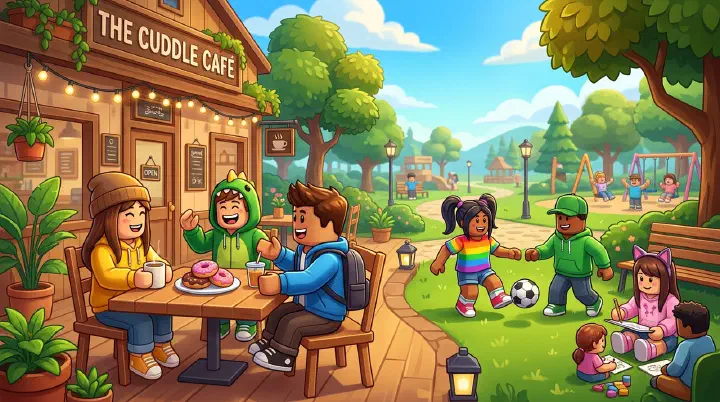
It’s 9 PM on a Saturday. Four friends in a Discord call. No agenda. No grinding. No competitive pressure. Just somewhere to hang out and talk.
We tried Brookhaven first — everyone spawns together, easy. Ten minutes in, a random player drives a sports car through the wall of the café we were sitting in. Funny the first time. The fifth time, not so much.
We tried Berry Avenue. Someone immediately got “adopted” by a stranger and spent 20 minutes trying to politely escape the roleplay family. The rest of us stood around watching.
We tried Bloxburg. The friend who suggested it spent the entire two-hour session building a kitchen and never said more than three sentences at a time. The rest of us watched them place cabinets and pretended it was a hangout.
By the time we got to Livetopia, we were exhausted. And that’s when I realized: the problem wasn’t the games. The problem was that we kept treating “social games” like they’re all the same thing. They’re not. “Hanging out” isn’t one activity — it’s a dozen different moods, and each game is built for a specific one.
This guide is what I wish I’d known before that night. It ranks the five biggest Roblox social games not by player count or thumbnail quality, but by what kind of hanging out they’re actually good for.
How We Evaluate Roblox Social Games
Social games are the hardest genre to rank because “good” depends entirely on what you want. We evaluate across six specific dimensions:
- Friction to hangout — How long between clicking “play” and actually talking with friends? Zero setup is best for casual groups.
- Customization depth — Avatar, house, world. How much can you express yourself? More isn’t always better — sometimes depth gets in the way of socializing.
- Roleplay intensity — How much does the game push you into character? Light RP is good for casual groups. Heavy RP is great for dedicated roleplayers, terrible for people who just want to be themselves.
- Group size fit — How many friends can you comfortably bring? Some games fall apart past 4 players. Others thrive with 10+.
- Troll resistance — How easy is it for random players to ruin your session? Public servers vs. private servers, moderation tools, privacy settings.
- Replay value — Will you still be playing this in a month, or is it a one-and-done experience?
There’s no universal “best” social game. There’s only the best one for your group on your specific night.
The Ranked List at a Glance
| Rank | Game | Core Vibe | RP Intensity | Best Group Size | Setup Time |
|---|---|---|---|---|---|
| 1 | Brookhaven | Pure hangout, zero friction | Very Light | 2-8 people | None |
| 2 | Livetopia | Activity-packed open world | Light | 3-10 people | Low |
| 3 | Welcome to Bloxburg | Creative builder’s sandbox | Optional | 2-4 people | High |
| 4 | Berry Avenue | Life-sim roleplay | Heavy | 2-6 people | Medium |
| 5 | Club Roblox | Family-friendly casual | Medium-Light | 2-6 people | Low |
Honorable mentions: Adopt Me! (the OG family RP, great for younger players), Royale High (fantasy school RP with deep customization), MeepCity (classic social hub with minigames).
1. Brookhaven — The Zero-Barrier Hangout King
Brookhaven is the most popular social game on Roblox for one simple reason: it gets out of your way. You spawn, you grab a car, you’re socializing. No tutorial. No job. No currency. No progression. Just a map and a chat box.
That emptiness is the feature, not a bug. Without objectives competing for attention, the conversation becomes the main event. You and your friends can sit on a couch, drive around, pretend to rob a bank — whatever. The game doesn’t judge your activity level because it doesn’t track activity at all.
The chaos problem. Public Brookhaven is a warzone. Radio spam, car griefers, players running around screaming. If you walk into a public café expecting a quiet chat, a sports car will probably fly through the wall within 90 seconds.
This is why private servers are non-negotiable for Brookhaven. A private server with 4-8 friends is the single best hangout experience on Roblox. A public server with 200 strangers is the worst. Same game, completely different experience.
Customization: functional but shallow. Clothes, house templates, basic furniture. You won’t be building anything from scratch. The houses are pre-made shells. For groups who care more about conversation than decoration, this is fine — maybe even good, because nobody gets distracted by decorating.
Best for: Large friend groups (6-8 people). Drop-in casual hangouts. Voice chat companion sessions. Private server owners.
Skip if: You want deep customization or structured activities. You enjoy roleplay. You need systems to give you things to talk about.
2. Livetopia — The Activity-Packed Open World
Livetopia is the biggest social game on this list — literally. Its map is massive: commercial districts, residential neighborhoods, beaches, a stadium, an airport, hidden secrets. The density of things to do means awkward silences basically never happen. The world hands you the next activity before the last one ends.
Why it’s great for mixed groups. Some friends want to race cars? There’s a track. Others want to go shopping? There’s a mall. Someone wants to chill at the beach? There’s a whole coastline. You can split up and reconvene, or stick together and wander. The game supports both styles.
The phone teleport system is the unsung hero here. Friends scattered across the map? Teleport to each other in 2 seconds. It doesn’t solve the “everyone goes separate ways” problem entirely, but it makes it manageable.
Roleplay: fully optional. You can get a job, buy an apartment, live a virtual life. Or you can just run around doing random stuff. Nothing forces you into character. This neutrality makes Livetopia the safest pick for groups where some people like RP and some don’t.
The navigation issue. The downside of a big map is that it can feel empty. You can walk for minutes without seeing another player in a public server. And with a group of friends, someone always gets lost. The trick is to pick one district and agree to stay there for the session, rather than trying to see everything at once.
Best for: Medium to large groups (3-10 people). Friends who get bored easily. Mixed groups where some like RP and some don’t.
Skip if: You want intimate, focused conversation. You prefer small, cozy spaces. You hate having to use teleport tools to stay together.
3. Welcome to Bloxburg — The Builder’s Social World
Bloxburg is the deepest game on this list, and it’s not close. The building system is genuinely impressive — walls, roofs, terrain sculpting, lighting, furniture placement detailed enough to rival games like The Sims.
The unique social magic of Bloxburg is that you hang out in spaces you actually built. You spend two hours making a café, invite friends over, they work as baristas or sit as customers. The whole experience feels personal because the world is yours. It’s not a pre-made corporate hangout space — it’s your creation.
The productivity trap. This is the biggest danger in Bloxburg, and I’ve fallen for it dozens of times. A friend logs on to chat. You’re in the middle of building. You say “give me five minutes” but it’s actually 45. They get bored. They start building their own thing. Two hours later, neither of you have said more than 10 words. You were both “in Bloxburg together” but you weren’t hanging out.
The rule I’ve learned: Bloxburg is social only when the building is done. Host a party in a finished house. Run a shift at a completed restaurant. Visit the city center together. If someone’s mid-project, meet in a different game instead.
The work system. Bloxburg has actual jobs — pizza delivery, cashier, doctor, mechanic — that earn you money to build bigger houses. It’s the only major social game with a real economy and progression loop. For some people, this makes it feel like a “real game.” For others, it’s just a chore that gets in the way of hanging out.
Best for: Creative friends who love showing off their builds. Small groups (2-4 people). Players who enjoy having a project to work on together.
Skip if: You want drop-in casual hangouts. You hate building. Your group is larger than 4 people.
4. Berry Avenue — The Life-Sim Roleplayer
Berry Avenue is the most roleplay-focused game on this list. It wraps a full life simulation framework around the social experience — jobs, housing, family, relationships. The RP isn’t optional flavor text. It’s the architecture of the game.
The customization is incredible. Layered clothing, detailed face sculpting, accessory stacking, home decoration. If you care about avatar fashion, Berry Avenue has the deepest customization of any Roblox social game. You can genuinely craft a unique identity.
The job system gives groups structured activities that generate conversation naturally. You’re not just sitting in a room talking — you’re running a salon together, or a police station, or a restaurant. The shared task gives you something to talk about without forcing it.
The RP intensity trap. Here’s the problem: Berry Avenue’s roleplay systems are so strong that they can take over. You log in wanting casual chat with friends, and suddenly a random stranger wants to adopt you, or someone starts a dramatic family argument in the street, and you feel like you have to go along with it because that’s what you do in this game.
This is great if you came for heavy RP. It’s terrible if you just wanted to hang out with your actual friends. The fix is simple but easy to forget: set RP boundaries before joining. “Light RP tonight, no adoptions, no family drama” — say it out loud, stick to it, and Berry Avenue becomes one of the best social games on Roblox.
Best for: Dedicated roleplayers. Fashion and avatar customization lovers. Groups who enjoy structured pretend play.
Skip if: You want to be yourself, not a character. You hate forced RP situations. Your group is larger than 6 people (logistics break down).
5. Club Roblox — The Casual Family-Friendly Option
Club Roblox is the coziest, most low-stakes game on this list. Adopt pets, decorate your house, play minigames at the plaza. The atmosphere is deliberately wholesome and gentle.
What it does well: It’s accessible. The mechanics are simple. The progression loop — earn coins, buy furniture, adopt pets, expand your home — gives you something to work toward without being overwhelming. It’s the kind of game you can zone out to while chatting.
The pet collection system is actually surprisingly addictive. There are dozens of pets to find, trade, and raise. If your group likes collecting things together, this can be a real hook.
The adoption dynamic. Club Roblox’s biggest feature is also its most divisive. You can adopt kids, be adopted, have pets — the whole family RP thing. For younger players or groups that enjoy that vibe, it’s perfect. For teen or adult friend groups, it can feel weird and juvenile.
The good news: you can totally ignore the adoption mechanics and just use Club Roblox as a cozy hangout space. The houses are cute, the minigames are fun, and the low-stakes atmosphere is genuinely relaxing.
Best for: Younger players. Mixed-age groups. Players who like collecting and casual progression. Cozy, low-energy hangouts.
Skip if: You’re a teen or adult group looking for a cool hangout spot. You want deep systems or serious roleplay. The “family RP” vibe turns you off.
Failure Retrospective: The Hangout Night That Didn’t Happen
Let me go back to that Saturday night I mentioned in the opening. Four friends. Four different games. Zero actual hanging out.
That night failed for three specific reasons — reasons I see repeat every time a group picks the wrong social game.
Mistake 1: We Picked the Game First, the Vibe Second
We said “let’s hang out on Roblox” and then tried to find a game. That’s backwards. The first question should never be “which game?” It should be “what kind of hanging out do we want?”
Are we catching up and talking about real life? → Brookhaven (no distractions) Are we bored and want to mess around? → Livetopia (lots to do) Are we in a silly mood and want to be dumb? → Berry Avenue (RP chaos) Are we showing off a project we’ve been working on? → Bloxburg (creative)
When you pick the vibe first, the game choice is obvious. When you pick the game first, you’re gambling on whether the vibe matches.
Mistake 2: We All Picked Our Own Favorite Game
Each of us picked the game we liked best, without considering what the group needed. The builder picked Bloxburg. The fashion lover picked Berry Avenue. The person who hates RP picked Brookhaven. The explorer picked Livetopia.
Nobody was wrong about their own preference. We were wrong about assuming our personal favorite would work for everyone.
The fix: the group’s vibe beats individual preference every time. If 3 out of 4 people want casual chat and 1 person wants to build, you don’t play Bloxburg. You play Brookhaven, and the builder can show off their Bloxburg house another time.
Mistake 3: We Didn’t Use Private Servers
Three of the four games we tried had public server issues — trolls, randoms, RP intrusions. We kept getting derailed by strangers.
Private servers cost Robux, I know. But think about it this way: the point of social games is the social experience. If public servers make the experience worse, you’re not saving money — you’re wasting time. A few hundred Robux for a private server that you and your friends use every week is one of the best values on Roblox.
After that terrible Saturday, we pooled our Robux and bought a Brookhaven private server. We use it every week. It’s been the best Roblox purchase we’ve ever made.
Quick Pick: If-Then Decision Table
Don’t have time to read the whole breakdown? Use this table to pick the right game in 10 seconds.
| If your group wants… | Then play… | Why it’s the right pick |
|---|---|---|
| Just talk and vibe | Brookhaven | Zero systems, zero friction — conversation is the whole game |
| Activities and exploration | Livetopia | Biggest map, most things to do, never a dull moment |
| Build something together | Bloxburg | Deepest building system by far |
| Roleplay and character drama | Berry Avenue | Deepest life-sim RP mechanics, jobs, families |
| Casual cozy fun with pets | Club Roblox | Low stakes, wholesome, pet collection |
| Large group (6-8 people) | Brookhaven (private server) | Everyone spawns together, no one gets lost |
| Mixed RP / no-RP group | Livetopia | RP is fully optional — do your own thing |
| Younger players / family-friendly | Club Roblox | Safe, wholesome, appropriate for all ages |
| You have 30 min and want immediate fun | Brookhaven | Spawn in and go — zero setup |
| You want a project to work on together | Bloxburg | Build a house, start a business, collaborate |
How to Actually Have a Good Hangout on Roblox
The game matters, but how you use it matters more. Here’s what I’ve learned from hundreds of Roblox hangout sessions — the stuff that actually makes them good.
Rule 1: Pick the Vibe First, Game Second
I already said this, but it’s worth repeating. Before you even open Roblox, figure out what kind of hanging out you’re doing:
- Catching up — deep conversation, real-life updates
- Vibing — casual, low-energy, background chat
- Messing around — being silly, trying dumb stuff
- Doing something together — a shared activity or project
- Showing off — someone has a build or achievement to share
Each vibe maps to a different game. Matching game to vibe is the #1 predictor of whether your hangout will be good.
Rule 2: Use Private Servers
I cannot overstate this. Public Roblox social servers are designed for chaos. Random players, trolls, edgy kids, people trying to get reactions. That’s fine if you want chaos. It’s terrible if you want to actually hang out with your friends.
Cost-wise, most private servers are 50-200 Robux per month. That’s $0.63-$2.50. If you use it once a week, that’s pennies per session. Split it between friends and it’s basically nothing.
Rule 3: Have an Exit Plan
The worst hangouts are the ones that drag on because nobody wants to be the first to say “I’m tired.” Set an end time, or at least check in every hour: “Is everyone still having fun, or should we wrap up?”
Better yet, have a natural ending point. “Let’s hang out until the pizza arrives” or “one more hour and then I’m going to bed.” It sounds silly, but a clear ending takes the pressure off and makes the whole session better.
Rule 4: Rotate Games (Sometimes)
Playing the same game every week gets stale. Every few weeks, try something different. One week Brookhaven, next week Livetopia, next week Bloxburg for a build night. Variety keeps it fresh.
But don’t rotate too much. The whole point of a regular hangout is the routine and the comfort. Find a default game that works for your group, then mix in alternatives when you want something different.
Rule 5: If It’s Not Working, Change It
This sounds obvious, but most groups don’t do it. You’ll be 30 minutes into a boring hangout, and everyone will just keep going because switching feels like admitting failure.
It’s not failure. It’s course correction. If the game isn’t working, switch. If the vibe is off, do something different. The point is to have fun together, not to stubbornly stick with whatever you first picked.
Rule 6: Mix Passive and Active Time
The best hangouts have a rhythm. 20 minutes of focused activity (exploring a new Livetopia district, working on a Bloxburg room together), then 10 minutes of just sitting somewhere and talking. Then another activity. Then more chatting.
All activity and no chat feels like a work session. All chat and no activity feels like just a voice call — which is fine, but then why are you in a game? The balance is what makes Roblox hangouts better than just calling each other on Discord.
Rule 7: Have a “Warm-Up” Activity
The first 10 minutes of any hangout are the awkwardest. People are logging in, adjusting settings, catching up on the week. Don’t jump straight into something complicated. Start with something low-stakes — drive around Brookhaven, mess around at the Livetopia beach, walk through a Bloxburg neighborhood — and let the conversation warm up naturally before you try to do something specific.
This sounds like a small thing, but it makes a huge difference in how the rest of the session feels.
Counter-Intuitive Truths About Roblox Social Games
These sound wrong until you’ve hosted enough hangouts to see the pattern. Then they’re obvious.
The game with the least to do is usually the most social. Brookhaven has no jobs, no quests, no progression. That emptiness is the feature. Without objectives competing for attention, the conversation becomes the main event. Games that give you more systems often hurt the social experience because everyone is focused on the game instead of each other.
Deeper customization doesn’t make a better hangout game. Bloxburg’s building system is incredible, but it can turn hosts into project managers and friends into spectators. The most creative game on the list is sometimes the worst for actual friendship time. Tools get in the way of talking.
Smaller spaces feel more social than big ones. Livetopia’s massive open world is impressive, but it spreads people out. A small room in Brookhaven with 4 friends feels warmer and more connected than a huge city where everyone’s in a different neighborhood. Density creates social energy. Size creates distance.
Roleplay is a filter, not a feature. Berry Avenue’s deep RP systems attract dedicated roleplayers and push away casual hangout groups. The same mechanic that makes the game “deep” also makes it exclusionary. More systems = more boundaries. Know which side of the boundary your group is on.
The best social game is the one your group actually uses. You can read all the rankings and reviews in the world, but at the end of the day, what matters is that your friends show up. If everyone already plays Brookhaven, play Brookhaven. The “best” game on paper doesn’t matter if nobody wants to download or learn it.
Frequently Asked Questions
What is the best Roblox hangout game overall?
Brookhaven is the best overall for most groups because it has zero friction, works for all group sizes, and stays out of the way of actual conversation. But “best” depends entirely on what you want: Livetopia for activities and exploration, Bloxburg for building, Berry Avenue for roleplay, Club Roblox for casual family-friendly fun. There’s no universal answer — only the right game for your specific vibe.
Which Roblox social game has the best avatar customization?
Berry Avenue leads for avatar fashion with layered clothing, accessories, and detailed face customization — it’s the best if you care about how your character looks. Welcome to Bloxburg wins for environmental customization since you build literally everything around you. Brookhaven has the weakest customization of the major games, but that’s part of why it’s so fast to jump into.
Can you play these games without roleplaying?
Yes, mostly. Brookhaven and Livetopia work perfectly without any RP — treat them as chat rooms with scenery. Bloxburg is also neutral since roleplay happens in player spaces, not enforced by the game. Berry Avenue and Club Roblox are harder because their UI and systems assume you’re playing a role (jobs, families, adoption). You can still use them for casual hangouts — you just have to actively ignore the RP mechanics.
What’s the best social game for a group of 6-8 friends?
Brookhaven private servers handle large groups best — the map is compact enough that everyone stays visible, everyone spawns together, and there’s no complex logistics. Livetopia also works for large groups, but you’ll rely heavily on the phone teleport system to keep everyone together. Bloxburg struggles past 4 players because houses have practical player limits. Berry Avenue and Club Roblox cap out around 6 before the RP logistics become unmanageable.
How do you avoid trolls and random players ruining your hangout?
Four steps. First, use a private server — it costs Robux but eliminates 100% of random player interference. Second, lock your house/home to friends-only in every game. Don’t let strangers follow you inside. Third, block immediately — don’t argue with trolls, don’t engage, just block and move on. Engagement is what they want. Fourth, disable friend requests in game settings if you’re getting spammed.
Is Bloxburg worth playing if you hate building?
You can play Bloxburg as a visitor — work jobs at other players’ businesses, attend parties, explore the city — and never place a single wall. But you’re missing about 70% of what makes the game unique. If you truly hate building, you’ll have a better time in Brookhaven or Livetopia, where the socializing doesn’t require construction.
More game comparisons and rankings in the Related Guides section below, or browse our full Best Roblox Games of 2026 list.
Disclaimer: Social game experiences vary wildly depending on who you play with and whether you use private servers. This guide reflects the general experience as of September 2026. Popularity, update frequency, and community culture can change quickly in social games.
Related Guides
- Best Roblox Games of 2026 — All genres ranked and compared
- Best Roblox Cozy Games Compared — Relaxing, low-pressure games
- Best Roblox Tycoon Games Compared — Creative building with economic progression
- Best Roblox Simulator Games Compared — Casual progression loops
- Best Roblox Obby Games Compared — When your group wants friendly competition