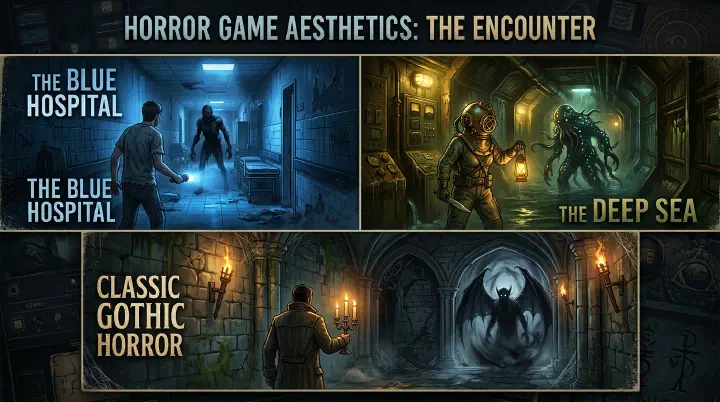
Your flashlight dies on room 47. You fumbled the battery swap and now Rush is roaring somewhere three doors behind you. There are no closets in sight. You know the pattern — Rush passes through, you hide, it’s fine. But without light you can’t find the closet. The screen shakes. You die for the seventh time this run and slam your desk.
That was my first real survival horror loss streak on Roblox. I’d beaten DOORS Hotel once with friends, figured I was good, and jumped straight into solo Pressure. I didn’t make it past the first airlock. Four hours in, I was convinced the game was cheap and unfair.
It wasn’t cheap. I was just terrible at the survival part. I’d been treating every horror game like a pattern-memorization puzzle, but survival horror is about resource management, decision-making under pressure, and knowing when to run vs. when to conserve. Different games test different skills, and I was using DOORS muscles in a Pressure world.
This guide is the framework I wish I’d had back then. It ranks and compares the five best Roblox survival horror games not by popularity, but by what kind of survival they test. It covers the failure modes that trap new players, a decision table to pick the right game in 30 seconds, and a training method for actually getting better — not just dying more.
How We Evaluate Survival Horror Games
Not all horror is survival horror. A lot of Roblox “horror” games are just jump-scare simulators — cheap frights with no real decision-making. That’s fine if you want thrills, but it’s not survival.
For this ranking, we look at six specific factors:
- Resource management depth — Batteries, oxygen, keys, inventory. Can you run out and die because you were wasteful?
- Decision consequence — Do your choices (to hide, to run, to fight) meaningfully change the run?
- Stealth or avoidance quality — Is hiding actually skill-based, or just a button you press?
- Enemy variety and AI — Do enemies behave differently each run, or are they scripted?
- Progression or mastery curve — Can you genuinely get better at it, or is it just memorization?
- Replayability — Does a second run feel different from the first?
We also have one disqualification rule: if the game’s primary scare tactic is just loud noises and jump scares with no underlying systems, it’s not survival horror — it’s a haunted house walkthrough. Those are fun, but they’re a different category.
The Ranked List at a Glance
Here’s how the major games stack up. Each one is good at something specific — the “rank” is overall, but the right pick depends on what you want.
| Rank | Game | Core Survival Skill | Difficulty | Sessions | Best For |
|---|---|---|---|---|---|
| 1 | DOORS | Pattern recognition + audio cue reading | Medium | 15-60 min | Most players — fair, accessible, deep |
| 2 | Pressure | Resource management + calm under pressure | Very Hard | 20-40 min | Hardcore survival fans who want a challenge |
| 3 | 3008 (SCP-3008) | Base building + long-term resource planning | Easy-Medium | 1-3+ hours | Builders and casual survivors |
| 4 | The Mimic | Psychological tension + co-op coordination | Medium | 30-90 min | Story-driven horror with friends |
| 5 | Dead Rails | Wave defense + scavenging combat | Medium-Hard | 20-60 min | Players who want to fight back |
Honorable mention: Lethal Company on Roblox (fan version) — the co-op scavenging survival formula is fantastic, but the Roblox port doesn’t match the original Steam version’s polish. Play it on PC if you can.
1. DOORS — Pattern Recognition Under Pressure
DOORS is the most popular Roblox horror game for a reason. It drops you and up to three teammates into a hotel with 100 numbered rooms. Your goal: reach door 100 without dying. The horror comes from entity encounters that trigger when you open doors or break hidden rules.
What makes it survival horror, not just horror. The survival layer is inventory and knowledge. You carry a limited number of items — lockpicks, vitamins, lighters, crucifixes — and choosing what to bring vs. what to leave is a real decision. A player who knows what’s in every drawer and which items matter survives longer than a player who hoards everything.
Core loop. Open a door, loot drawers for coins and items, solve light puzzles, and listen. Every major entity has a distinct audio cue — Rush roars, Ambush shrieks, Figure thuds, Seek’s music swells. The game is less about reflexes and more about memory and pattern recognition. Once you learn the cue, the encounter becomes a known script.
Threat types. DOORS uses three categories:
- Chase entities (Rush, Ambush) — require hiding in a closet or behind furniture. Timing matters.
- Search entities (Figure, Seek) — force stealth or environmental navigation. You can’t just hide.
- Rule-break punishments (Eyes, Halt, Jack) — kill you for looking at them, moving when told to stop, or opening the wrong thing.
The variety keeps you paranoid. You can’t coast on one strategy. Every new room is a mini-decision: do I search thoroughly (risking more spawns) or rush through (risking missing items)?
Difficulty curve. Early rooms (1-20) are forgiving. Entities spawn rarely and closets are everywhere. Around room 40-50, spawn rates climb and the Figure library encounter wipes teams that haven’t learned crouch-walking. Rooms 75-100 is where solo runs separate from group carries — resource scarcity kicks in, and one mistake ends the run.
Best fit. DOORS is the best all-around pick for most players. It’s fair once you learn the rules, has high replayability through modifiers and the Backdoors update, and teaches you the fundamentals that transfer to every other survival horror game. Skip it only if you hate pattern-based games and want pure improvisation.
2. Pressure — Resource Management and Brutal Timing
Pressure swaps the hotel for an underwater research facility and trades DOORS’s pattern-learning for stricter resource limits and faster entity timers. You’re not just avoiding death — you’re managing oxygen, batteries, and door codes while the facility floods behind you.
What makes it harder than DOORS. Three things:
- Resources are genuinely scarce. Your flashlight battery drains. Your oxygen depletes. Finding a spare feels like winning the lottery.
- AI roams, not spawns. The Diver doesn’t appear on script — it patrols. You can walk into it around any corner. Memorization doesn’t help as much.
- Hiding isn’t always possible. Some rooms have no lockers. Some encounters force you to sprint through timed airlocks before they seal. You have to think your way out, not just press hide.
Core loop. Each section gives you an objective: find a keycard, reroute power, unlock a door, reach the airlock. You search lockers and shelves while listening for the heavy breathing that means The Diver is nearby. The tension comes from never knowing if turning a corner puts you face to face with the entity.
Threat types. Pressure leans on:
- Proximity hunters (The Diver, The Depths entities) — track sound and line of sight. Sprinting draws them.
- Environmental hazards (flooding rooms, electrified water, crushing doors) — punish bad pathing.
- Resource gates — running out of batteries in a dark corridor is effectively a death sentence.
Difficulty curve. The first two sections teach you oxygen and flashlight management. Then the game layers in code puzzles under time pressure, followed by multi-floor sequences where one mistake locks you out of the exit. Solo Pressure is considered one of the hardest Roblox horror experiences because you can’t split tasks or get revived.
Best fit. Pressure is for players who beat DOORS solo and want something that actually tests them. It rewards calm decision-making and resource conservation. Skip it if you get frustrated by frequent restarts or if you hate managing meters in games.
3. 3008 (SCP-3008) — The IKEA Sandbox Survival
3008 is based on the SCP Foundation story about an infinite IKEA. You spawn in a procedurally generated furniture store with no exit. During the day, you build a base out of sofas, tables, and bookshelves. At night, the employees turn hostile and hunt you down.
What makes it unique. It’s the only major Roblox survival horror game that’s a sandbox. There’s no win condition, no final door, no story ending. The goal is simply to survive as many nights as you can. Every run is different because the store layout, loot spawns, and base location change.
Core survival loop. Daytime: explore, gather building materials and food, find a good base location. Nighttime: hunker down, defend your base from employees, fix any damage. Repeat until you die or get bored.
The real skill ceiling is base design. A well-built fortress with layered defenses and multiple escape routes can survive dozens of nights. A bad base gets breached on night 3.
Difficulty curve. Gentle at first. Early nights have few employees and they’re slow. By night 10+, employees spawn in packs and can break through walls. The difficulty ramps up continuously, which means even veteran players eventually die — it’s just a question of how long you last.
Best fit. 3008 is perfect for builders, tinkerers, and anyone who likes base defense. It’s also the most casual game on this list — you can join, build for 20 minutes, and leave without feeling like you wasted a run. Skip it if you want a narrative or a clear end goal.
4. The Mimic — Psychological Co-op Horror
The Mimic is story-driven survival horror with four chapters (books) set in Japanese folklore-inspired locations. You and up to three teammates explore haunted temples, schools, and forests while being hunted by entities from Japanese mythology.
What makes it different. The Mimic is less about mechanical survival and more about atmospheric survival. The horror comes from the environment, the sound design, and the sense that something is always just out of sight. The survival layer is mostly about not getting lost and not getting separated from your team.
Core loop. Explore the map, find items or solve puzzles to progress, and run when something chases you. Puzzles often require coordination — one player holds a switch while another activates a door. Playing solo is possible but harder because you miss co-op-only shortcuts.
Difficulty curve. Steady but not punishing. Each chapter introduces a new entity with a new behavior pattern, but once you learn it, encounters become manageable. The challenge is more about endurance — long, tense walks in the dark — than mechanical skill.
Best fit. The Mimic is for players who want a story and atmosphere over systems. It’s best with 2-3 friends and a voice chat. Skip it if you prefer solo play or if you want deep resource management — the survival mechanics here are lighter than DOORS or Pressure.
5. Dead Rails — Wave-Based Survival with Combat
Dead Rails is set on a moving train traveling through a monster-infested wasteland. At each station, you scavenge for resources and build defenses. When night falls, entities board the train and you have to fight them off.
What makes it unique. It’s the only game on this list where you can fight back. Most survival horror forces you to hide or run. Dead Rails gives you weapons, traps, and turrets. The survival skill is resource allocation — do you spend scrap on a better gun or on base defenses?
Core loop. Station phase (day): gather resources, build, upgrade. Travel phase (night): defend the train from waves of enemies. Each run gets progressively harder. The game has roguelike elements — you unlock permanent upgrades between runs.
Difficulty curve. Starts easy and ramps up fast. Early waves are trivial with a basic gun. By wave 10+, you need layered defenses, good aim, and smart resource management. Solo runs are significantly harder than co-op because you can’t cover the whole train.
Best fit. Dead Rails is for players who like the survival part but don’t love the horror part — or who want to fight back instead of just hiding. If you enjoy tower defense or wave shooters, this is your game. Skip it if you want pure psychological horror.
Failure Retrospective: The Pressure Solo Streak That Broke Me
I mentioned earlier that I died a lot in Pressure. Let me be specific: 27 consecutive failed solo runs. Twenty-seven. I got past the first airlock maybe five times. I blamed the game. I blamed lag. I blamed bad spawns.
Then I watched a speedrun and realized I was making three fundamental mistakes that apply to every survival horror game, not just Pressure.
Mistake 1: Treating Every Game Like DOORS
In DOORS, you hide from everything. You hear a sound, you jump in a closet, it works. That muscle memory killed me in Pressure because Pressure doesn’t give you closets everywhere — and even when it does, hiding wastes oxygen you might need later.
The fix: I stopped defaulting to “hide” and started asking: can I walk away from this? Most of the time, the answer was yes. The Diver has a detection range. If you’re calm and you walk instead of sprinting, you can often just leave the area. I went from dying on every encounter to avoiding 60% of them without ever hiding.
Mistake 2: Wasting Resources on “Safety”
I kept my flashlight on full brightness 100% of the time because I was scared of the dark. I used lockpicks on every locker “just in case” there was something useful inside. I carried three batteries “for safety” but never used the other two because I kept finding more.
Then I ran out of batteries in the dark reactor section — twice — because I’d burned through them in well-lit rooms. I’d spent all my safety budget on comfort and had nothing left for actual danger.
The fix: the 30% rule. In any safe or well-lit area, I turn my flashlight brightness to 30% or off entirely. I only go to 100% in dark rooms where I need to search for something specific. My battery life tripled overnight.
Mistake 3: Going Solo Without a Routine
In DOORS, you can wing it. Rooms are random but the pattern is the same: open door, loot, listen. Pressure has multiple objectives per section, and if you don’t have a routine, you waste time backtracking. Time wasted is oxygen wasted is death.
The fix: I developed a search order for every section. Lockers first (keycards and batteries), then desks (codes and notes), then shelves (miscellaneous). I know exactly where I’m going before I enter a room. No hesitation, no wandering, no wasted steps.
After fixing these three mistakes, I beat Pressure solo on my 31st run. It wasn’t pretty — I finished with 8% oxygen and zero batteries — but I did it. And the lessons I learned made me better at DOORS and 3008 too. Survival horror is a skill set, not a game-specific talent.
Quick Pick: If-Then Decision Table
Don’t have time to read the whole breakdown? Use this table to pick your next run in 10 seconds.
| If you want… | Then play… | Why it’s the right pick |
|---|---|---|
| The best all-around experience | DOORS | Fair, accessible, deep — everyone should play it |
| The hardest possible challenge | Pressure (solo) | Resource scarcity + roaming AI = brutal skill test |
| Casual fun with building | 3008 | No pressure, infinite replayability, sandbox freedom |
| Scary story with friends | The Mimic | Best co-op narrative horror on Roblox |
| Combat instead of hiding | Dead Rails | Weapons, traps, wave defense — fight back |
| You’ve never played survival horror before | DOORS first | Teaches the fundamentals, difficulty curve is gentle |
| You beat DOORS solo and want more | Pressure next | The natural step up in difficulty |
| You have 15 minutes | DOORS quick run | Jump in, reach room 30-40, leave |
| You have 2+ hours | 3008 | Build a base, survive the night, lose track of time |
| You get scared easily | 3008 or Dead Rails | Less jump-scare focused, more about planning |
How to Get Better at Roblox Survival Horror
Reading guides helps, but the real improvement comes from deliberate practice. Here’s a training method that works across all five games.
The Three-Skill Foundation
Every survival horror game tests the same three core skills. Train them and you’ll get better at every game simultaneously.
Skill 1: Audio cue recognition. In almost every Roblox survival horror game, sound is your most important tool. Entities make noise before you see them. Doors creak. Floors squeak. If you can identify a sound and react correctly before you see the threat, you survive.
Drill: The 5-second preview test. Load up DOORS or Pressure. Every time you hear an unfamiliar sound, pause (if you can) and identify it before looking. Do this for 20 minutes per session. After a week, you’ll recognize every entity cue instantly.
Skill 2: Resource conservation. Batteries, oxygen, ammo, keys — whatever the game gives you, the default instinct is to use it when you feel unsafe. The survival instinct is to save it for when you actually need it.
Drill: The 30% challenge. Play a run where you never use more than 30% of any resource in a safe area. Flashlight off in lit rooms. Only sprint when being chased. Only use healing items when below 30% health. This forces you to distinguish between “I’m scared” and “I’m in danger.”
Skill 3: Decision-making under pressure. The #1 killer across all games is panic. You hear a sound, you sprint, you run into another threat or a dead end. Panic turns small problems into run-ending mistakes.
Drill: The walk-only challenge. Play an entire run where you never sprint unless you’re actively being chased. No preemptive running. No “I think I heard something” sprints. Just walk. You’ll be amazed how much calmer you play and how many fewer mistakes you make.
The Cross-Training Rotation
Just like FPS games, different survival horror games train different skills. Play multiple games and you’ll improve faster than sticking to one.
- DOORS (2 days/week) — Pattern recognition and audio cue training. This is your fundamentals gym.
- Pressure (1 day/week) — Resource management and calm under pressure. This is the hard mode that makes everything else feel easy.
- 3008 or your main game (2-3 days/week) — Where you apply what you’re learning and have fun.
This rotation works because each game stresses a different survival muscle. DOORS builds recognition speed. Pressure builds resource discipline. 3008 builds long-term planning. Put them together and you get a complete survival horror player.
The Plateau Breaker
If you’ve been playing the same game for weeks and you’re not improving, here’s the fix: switch to a harder game for one week.
If you’re stuck on DOORS room 75, go play Pressure for a week. When you come back, DOORS will feel slow and generous. The difficulty gap makes your original game’s challenges feel trivial. It’s the survival horror equivalent of swinging a heavy bat before stepping to the plate.
I first tried this when I was stuck at DOORS room 80 solo. I spent a week dying repeatedly in Pressure, then came back and beat DOORS floor 100 on my third attempt. It wasn’t that I’d magically gotten better at DOORS — it was that Pressure had raised my baseline for “tense” and “difficult.”
Counter-Intuitive Truths About Survival Horror
These sound wrong until you’ve put enough hours in. Then they’re obvious.
The scariest games aren’t the hardest — they’re the most atmospheric. A game with great sound design and slow build-up will scare you more than a game with cheap jump scares and high difficulty. The Mimic is less mechanically hard than Pressure, but it gets under your skin in a way Pressure never does.
You die more from panic than from enemies. This is true across every survival horror game on Roblox and off it. Most deaths are self-inflicted: you run into a dead end, you waste a resource, you hide from the wrong thing. The enemy just delivers the final blow. Calm players survive longer than skilled players.
Solo play makes you better at co-op, not the other way around. Most players start with friends and think teamwork makes the game easier. It does — but it also hides your weaknesses. When you play solo, every mistake is yours. You learn faster because you can’t blame your teammate for triggering the entity or wasting the keycard.
The best players use the fewest items. It’s counterintuitive — you’d think good players use lots of items strategically. But actually, the best players use almost nothing because they don’t need to. They avoid encounters through knowledge and pathing, saving items for actual emergencies. A player who uses a crucifix on every DOORS run is worse than a player who never needs one.
Frequently Asked Questions
What is the best Roblox survival horror game in 2026?
DOORS is the most popular and most accessible, but the “best” depends on what you want. DOORS for pattern-recognition horror with fair mechanics. Pressure for resource management survival at maximum difficulty. The Mimic for story-driven psychological horror with friends. 3008 for sandbox base-building survival. Dead Rails for wave-based survival with combat. There’s no single best — there’s the best for your preferences.
Which survival horror game is hardest?
Pressure is generally the hardest due to strict resource management (oxygen, batteries), tight entity timing windows, and roaming AI that can’t be fully memorized. Solo Pressure is considered one of the hardest Roblox horror experiences. DOORS is challenging but fair once you learn the patterns — it’s a puzzle you can solve. Pressure is more like juggling chainsaws in the dark.
Which is better for beginners: DOORS or Pressure?
DOORS is more beginner-friendly by a wide margin. The first 20 rooms gently introduce mechanics one at a time. Visual and audio cues are clear. Patterns are consistent. There are frequent checkpoints. Pressure throws you into the deep end with resource scarcity, less obvious tells, and no hand-holding. Start with DOORS, beat the Hotel floor, and then try Pressure when you want to test yourself.
Can you play Roblox survival horror games solo?
Yes, all the major ones support solo play. DOORS and Pressure are fully playable alone and many players consider solo runs the true skill test. The Mimic has some co-op-only puzzle shortcuts but most chapters work solo. 3008 and Dead Rails are built around solo play with co-op as an option.
What’s the difference between survival horror and regular horror on Roblox?
Survival horror adds resource management and decision-making on top of scares. You’re not just running and hiding — you’re managing batteries, oxygen, keys, inventory, and base defenses. Regular horror games (the pure jump-scare ones) are more about reflexes and memorization. Survival horror makes you think, not just react. If you can beat a game just by memorizing a script, it’s not really survival horror — it’s a haunted house.
Which survival horror game has the most replayability?
3008 has the most replayability by far. Procedurally generated IKEA stores and sandbox base-building mean no two runs are the same. You can build a different base every time, try new strategies, and keep playing indefinitely. DOORS has high replayability through modifiers, multiple floors, badges, and speedrunning. Pressure has 50+ badges and an endless mode. Dead Rails is the most linear but has build variety and roguelike progression to keep runs fresh.
More game comparisons and rankings in the Related Guides section below, or browse our full Best Roblox Games of 2026 list.
Disclaimer: Game balance and entity behaviors change with every update. This guide reflects the state of Roblox survival horror as of September 2026. New floors, entity reworks, and mechanic patches can shift the meta significantly. Always check recent patch notes before investing in a new game.
Related Guides
- Best Roblox Horror Games Ranked — Pure horror and atmospheric games (not just survival)
- Best Roblox Games of 2026 — All genres, full rankings
- DOORS Hub — Complete DOORS strategy library
- Pressure Hub — Everything about the underwater survival horror
- Lethal Company Hub — Co-op scavenging survival on a different platform