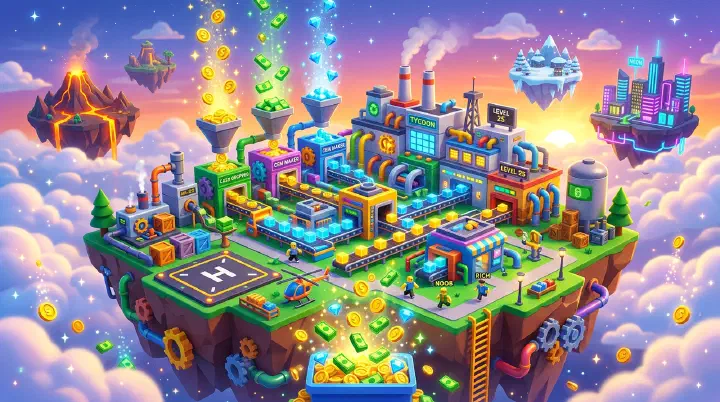
It’s 2 AM. You’ve been playing “Mega Mansion Tycoon” for six hours. Your mansion has three floors, a helicopter pad, and a pool shaped like a dollar sign. You just unlocked the gold-plated elevator. You feel accomplished.
Then you realize: there is nothing to do with the mansion. No customers, no management, no decisions. The entire game is just walking from one dropper to the next, waiting for numbers to go up so you can buy the next upgrade that makes numbers go up faster. It’s a hamster wheel with better graphics.
That was my first Roblox tycoon experience. I spent an entire weekend on a game that had the depth of a puddle. I thought that was just how tycoons worked — bright colors, big numbers, zero substance.
Then I tried Theme Park Tycoon 2. I spent three hours building a single roller coaster. It crashed on its first test run. I rebuilt it. It worked. I watched the first virtual riders cheer. And I realized: the best tycoon games aren’t about watching numbers go up. They’re about building something.
If you’ve ever felt empty after grinding a Roblox tycoon for hours, this guide is for you. It ranks the best tycoon games not by popularity or flashy thumbnails, but by actual depth, fairness, and long-term satisfaction.
How We Evaluate Roblox Tycoon Games
Tycoons are the most hit-or-miss genre on Roblox. For every genuinely deep game, there are twenty copy-paste dropper simulators designed to sell you gamepasses. Here’s what we look for:
- Progression depth — Does the game have 10 hours of content or 100? Can you keep finding new things to do after the first weekend?
- Monetization fairness — Are Robux purchases cosmetic only, or do they skip core progression? Can a free player compete?
- Decision-making — Do your choices (layout, upgrades, strategy) actually matter, or is the path linear?
- Active development — When was the last update? Tycoons die fast without developer attention.
- Skill ceiling — Is there something to master, or is it just waiting for timers?
And one disqualification rule: if the core loop is “click dropper, collect money, buy better dropper, repeat” with no other systems, it’s not a real tycoon. It’s an idle game with 3D graphics. Those are fine for ten minutes of mindless fun, but they don’t belong in a “best tycoons” ranking.
The Ranked List at a Glance
| Rank | Game | Core Loop | Depth | Monetization | Best For |
|---|---|---|---|---|---|
| 1 | Theme Park Tycoon 2 | Build & manage a theme park | Infinite | None (cosmetics only) | Creative builders, long-term players |
| 2 | Lumber Tycoon 2 | Chop, transport, process wood | Extreme | None | Hardcore grinders, skill-based players |
| 3 | Restaurant Tycoon 2 | Run a restaurant | High | Low | Social players, steady progression |
| 4 | Retail Tycoon 2 | Manage a store | High | Low | Strategy & logistics fans |
| 5 | Car Dealership Tycoon | Collect & race cars | Moderate | Moderate-High | Casual players, short sessions |
Honorable mentions: Pizza Factory Tycoon (great idle-tycoon hybrid), Clone Tycoon 2 (creative concept, decent progression), Miner’s Haven (the classic — still good but largely abandoned).
1. Theme Park Tycoon 2 — The Builder’s Infinite Canvas
Theme Park Tycoon 2 is the best tycoon on Roblox, and it isn’t particularly close. You start with an empty field and a few thousand dollars. You build rides, lay paths, place food stands, hire staff, and watch guests flood in.
But here’s the thing: the money part is almost secondary. The real game is building.
Why it stands out. The ride system is physics-based. You design roller coasters from scratch — track pieces, bank angles, drops, inversions. The game calculates excitement, intensity, and nausea ratings based on your design. Build a coaster that’s too intense and nobody rides it. Build one that’s boring and nobody rides it. Nail the balance and you have a park centerpiece.
This creates effectively infinite depth. You could spend 100 hours building a single park and still find ways to improve it. The community builds things that look like real theme parks — themed lands, detailed scenery, custom ride supports built out of basic blocks.
Progression curve. The first hour: you place a few simple rides, lay some paths, and figure out how money works. Hours 5-10: you unlock bigger rides, start experimenting with coaster design, and learn to manage staff and guest happiness. Hours 20+: you’re doing architecture — building themed areas, custom scenery, multi-layered coasters. There is no endgame. You just keep building.
Monetization. Nearly zero. There are cosmetic gamepasses (custom signs, extra terrain tools) but nothing that makes you earn more money or unlock rides faster. A completely free player has access to 100% of the core gameplay. This is almost unheard of for a popular Roblox tycoon.
Developer support. Den_S, the creator, still updates the game regularly — usually every few months with new rides, features, or quality of life improvements. The game has been out for years and is still growing.
Who should play it. If you enjoy building, designing, or creating — this is the best tycoon on Roblox. Period. If you need constant dopamine hits and fast progression, it will feel slow and frustrating.
Who should skip it. Players who want clear number-go-up progression or who get bored by open-ended sandbox games.
2. Lumber Tycoon 2 — The Hardcore Skill Grind
Lumber Tycoon 2 is the Dark Souls of Roblox tycoons. It doesn’t explain anything. It doesn’t hold your hand. You will lose your first truck to a river. You will buy the wrong axe and waste hours of savings. You will get lost in the woods at night and wonder why you’re even playing.
And then it clicks. And it’s the most satisfying tycoon experience on Roblox.
Why it stands out. Everything is physics-based. Chopping a tree isn’t a click-to-collect animation — you swing an axe, the tree falls in the direction you’re cutting, and you have to figure out how to get it to your sawmill. You build trucks piece by piece — chassis, wheels, engine, trailer — and how you build them affects handling and capacity.
The progression is skill-based, not just upgrade-based. A veteran player with a basic axe can out-earn a new player with the best axe because they know which trees to cut, how to transport them efficiently, and how to negotiate prices with other players.
The player economy. This is the secret sauce. Lumber Tycoon 2 has a genuine player-driven economy. Rare wood types sell for premium prices. Players build shops. They haggle. They scam each other (watch out for the “blue wood” scam). It feels alive in a way no other Roblox tycoon does.
Progression curve. Brutal start. Hour 1: you’re hitting trees with a basic axe, carrying logs by hand, earning pennies. Hour 5: you have a basic truck and sawmill, you’re starting to understand wood values. Hour 20+: you’re running a full operation — multiple trucks, rare wood runs, a base with automated processing. The skill ceiling is effectively infinite.
Monetization. Zero pay-to-win. No gamepasses give you better axes, faster trucks, or more money. Everything is earned. This is both its greatest strength and biggest barrier to entry — there’s no way to skip the early game grind.
Who should play it. If you love mastery, skill-based progression, and earning every dollar. If you enjoy games where knowledge = power.
Who should skip it. If you want instant gratification or get frustrated by harsh early games. The first 5-10 hours are genuinely painful.
3. Restaurant Tycoon 2 — The Social Progression Engine
Restaurant Tycoon 2 is the most “balanced” tycoon on this list. It’s deep enough to keep you engaged for weeks, accessible enough to play with casual friends, and fair enough that free players never feel gimped.
Why it stands out. The core loop is simple: cook food, serve customers, earn money, unlock better recipes and furniture. But the execution is polished and satisfying. Customer AI actually pathfinds through your restaurant — bad layout = slow service = bad reviews = less money.
The social layer is what makes it special. You can hire friends as chefs, waiters, or musicians. They earn money by working in your restaurant. It’s the only major tycoon where playing with friends genuinely enhances the core loop instead of just being “same game but with more people.”
Progression curve. Steady and satisfying. Hour 1: hot dog stand, one table, barely scraping by. Hour 10: full restaurant with multiple menu items, staff, decent ratings. Hour 30+: multi-floor fine dining empire with VIP lounges, valet parking, and five-star ratings. There’s always a clear next goal, and the game is good at doling out rewards at just the right pace.
Monetization. Light and fair. Gamepasses are mostly plot expansions and cosmetic uniforms. No pay-to-win income multipliers or exclusive recipes. A free player has access to the full game.
Who should play it. If you want a tycoon you can play with friends, or if you like steady, satisfying progression without the harsh learning curve of Lumber Tycoon 2.
Who should skip it. If you want maximum depth or skill-based progression. The loop is simple and doesn’t evolve much — it just gets bigger.
4. Retail Tycoon 2 — The Pure Business Strategy Game
Retail Tycoon 2 is for people who enjoy spreadsheets. You manage a store: buy inventory, set prices, hire staff, arrange shelves, and watch customers navigate your aisles. It’s slow, it’s methodical, and it’s the most strategically deep tycoon on Roblox.
Why it stands out. The simulation is detailed. Aisle width matters — narrow aisles cause congestion, which makes customers leave. Product placement matters — impulse buys by the checkout actually work. Pricing matters — too high and nobody buys, too low and you lose money. Overstocking ties up capital. Understocking loses sales.
If you’ve ever played a game like RimWorld or Factorio and enjoyed the optimization aspect, this is the Roblox tycoon version.
Progression curve. Slow start. The first few hours are about figuring out the basics: what sells, how to price it, how many employees you need. Once you master the formula, the game becomes about scaling — bigger store, more departments, better inventory management. The depth is in the systems, not the content volume.
Monetization. Minimal. Mostly plot expansions and cosmetics. No pay-to-win.
Who should play it. Strategy gamers, logistics nerds, and anyone who enjoys optimizing systems. If you get lost for hours tweaking a layout, this is your game.
Who should skip it. If you want fast action, creative building, or social play. This is a solo, slow, number-crunching experience.
5. Car Dealership Tycoon — The Casual Collection Game
Car Dealership Tycoon is the most “modern” Roblox tycoon on this list, and that’s both good and bad. It’s polished, it’s popular, and it’s great for casual sessions. But it’s also the shallowest game in the top 5 and has the heaviest monetization.
Why it made the list. It does what it does well. You buy cars, display them in your dealership, race them for extra cash, and unlock better cars. The collection aspect is satisfying — who doesn’t like collecting cool cars? The racing minigame is surprisingly decent for a tycoon side activity.
Where it falls short. The tycoon loop is shallow. There’s not much strategy — better cars earn more money, which buys better cars. The dealership layout barely matters. Staff management is minimal. It’s more of a collection game with tycoon dressing.
Monetization. Moderate to heavy. Gamepasses for income multipliers, exclusive cars, and faster progression. You can enjoy the base game for free, but there’s a constant pressure to spend Robux to keep up.
Who should play it. Casual players who like cars, want something to play for 20-30 minutes at a time, or enjoy collection-based progression.
Who should skip it. If you want deep tycoon mechanics, fair monetization, or long-term depth.
Failure Retrospective: 6 Wasted Hours on a Shallow Tycoon
Let me go back to that Mega Mansion Tycoon story. Six hours. Three floors. Helicopter pad. Gold elevator.
I don’t regret those six hours because the game was bad. I regret them because I kept playing despite knowing it was bad, and I didn’t understand why I couldn’t stop.
Looking back, there were three specific psychological tricks the game used to keep me hooked that deeper tycoons don’t need.
Trick 1: The Front-Loaded Reward Curve
The first 30 minutes are amazing. You unlock a new room every two minutes. Every upgrade feels like a big jump. The game showers you in cash. It feels like you’re winning.
Then, around hour two, the curve flattens. Upgrades that used to take two minutes now take twenty. But by then you’re invested. You’ve built something. You want to see it through. That’s the trap.
In a good tycoon like Theme Park Tycoon 2, the first 30 minutes are the hardest part. You have to learn the systems. The rewards come slowly but they’re earned. And because they’re earned, they mean something.
Trick 2: The “Almost There” Effect
Shallow tycoons are designed so the next upgrade always feels just out of reach. You’re 80% there. Just five more minutes. Just one more round. You can almost taste it.
This is a mobile game trick — the “energy” system that lets you play almost long enough before cutting you off. Roblox tycoons do it with upgrade prices that scale just a little faster than your income. You’re always almost there.
In Lumber Tycoon 2, the next axe costs 20x more than the last one. It doesn’t feel “almost there” — it feels like a goal. A project. Something you work toward over days, not minutes. That difference is huge.
Trick 3: Visual Progress Without Gameplay Progress
The mansion looked impressive. Three floors, gold trim, helicopter. But what did I do? Nothing. I walked from point A to point B and pressed E. The visual progress masked the total absence of gameplay progress.
In Restaurant Tycoon 2, when you upgrade from a hot dog stand to a full restaurant, the visual upgrade comes with gameplay upgrades — new recipes, better staff, more complex management. The visuals match the depth.
The lesson. When a tycoon looks too good too fast, that’s a warning sign, not a feature. The best tycoons are slow starters because they’re busy teaching you systems instead of showing you flashy lights.
Quick Pick: If-Then Decision Table
Don’t have time to read the full breakdown? Use this table to pick your next tycoon in 10 seconds.
| If you want… | Then play… | Why it’s the right pick |
|---|---|---|
| The best overall tycoon | Theme Park Tycoon 2 | Infinite depth, zero P2W, active dev — the complete package |
| Maximum challenge & skill | Lumber Tycoon 2 | Physics-based, player economy, no hand-holding — pure mastery |
| Playing with friends | Restaurant Tycoon 2 | Hire friends as staff, build together, social progression |
| Strategy & optimization | Retail Tycoon 2 | Pure business sim, inventory management, layout optimization |
| Casual fun with cars | Car Dealership Tycoon | Collection gameplay, racing minigame, short sessions |
| You’ve never played a tycoon before | Restaurant Tycoon 2 first | Gentle learning curve, clear progression, always satisfying |
| You hate pay-to-win | Theme Park Tycoon 2 or Lumber Tycoon 2 | Both are 100% fair — zero Robux advantage |
| You want to build something impressive | Theme Park Tycoon 2 | Roller coaster physics, custom scenery, unlimited creativity |
| You have 15 minutes | Car Dealership Tycoon | Jump in, do a few races, leave — no setup time |
| You have an entire weekend | Lumber Tycoon 2 | Enough depth to fill weeks, not just hours |
How to Actually Get Better at Tycoon Games
Most people think “getting better at tycoons” just means playing more. But that’s not true — I’ve seen players with 100 hours in Lumber Tycoon 2 who still earn less than someone with 20 hours who knows the right strategies.
Here’s the fastest way to improve at any Roblox tycoon.
The Optimization Mindset
The difference between a casual tycoon player and a good one is that good players constantly ask: what’s my bottleneck?
In Restaurant Tycoon 2, if your customers are leaving angry, don’t just buy more food — figure out why. Is it slow service? Hire more waiters. Is it bad decor? Buy better furniture. Is the kitchen backed up? Hire more chefs. Throw money at the wrong problem and you waste it.
Drill: The bottleneck check. Every 10 minutes, pause and ask yourself: “If I could only fix one thing right now, what would give me the biggest improvement?” Write it down. Fix it. Repeat. This habit alone will make you twice as efficient.
Layout Mastery
Layout is the most underrated skill in tycoon games. A good layout can double your income without a single upgrade.
In Theme Park Tycoon 2, path layout determines how guests move through your park — put the most popular rides at the back and guests will walk past everything else, spending money on food and games along the way.
In Retail Tycoon 2, the classic trick is to put essentials at the back of the store and impulse buys near the entrance. It works in the game exactly like it works in real supermarkets.
Drill: The redesign challenge. Once you’ve been playing a tycoon for 10+ hours, start a new save and redesign your layout from scratch using everything you’ve learned. You’ll be shocked by how much better your second build is.
The “No Upgrades” Challenge
Here’s a counter-intuitive training method: try to earn as much money as possible without buying any major upgrades. Force yourself to optimize what you have.
This teaches you more about the game’s systems than any amount of normal play. When you can’t just buy your way to more income, you have to actually understand how the economy works.
I did this in Lumber Tycoon 2 — I refused to buy a better axe until I could afford the best axe with my basic axe. It took forever. But I learned wood values, transport routes, and trading strategies that I never would have discovered if I’d just upgraded normally.
Cross-Training Between Tycoons
Different tycoons train different skills:
- Lumber Tycoon 2 teaches resource allocation and risk/reward decisions
- Theme Park Tycoon 2 teaches layout optimization and creative problem-solving
- Retail Tycoon 2 teaches economic systems and supply/demand management
- Restaurant Tycoon 2 teaches service chain optimization
Playing multiple tycoons makes you better at all of them because you start seeing patterns. A layout trick you learn in Retail Tycoon 2 might improve your Restaurant Tycoon 2 floor plan. An optimization mindset from Lumber Tycoon 2 might change how you build in Theme Park Tycoon 2.
Counter-Intuitive Truths About Tycoon Games
These sound wrong until you’ve put enough hours in. Then they’re obvious.
The best tycoons are the slowest starters. Shallow tycoons shower you with rewards in the first hour because they need to hook you fast. Deep tycoons take time to get going because they’re teaching you systems. If a tycoon feels amazing in the first 30 minutes, it probably gets boring by hour three. If it feels slow and confusing at first, it might have 100+ hours of depth.
Spending Robux makes tycoons less fun, not more. This is the biggest secret in Roblox tycoons. The point of a tycoon is the journey — earning money, building something, progressing. When you buy a gamepass that doubles your income, you’re not making the game better — you’re cutting its lifespan in half. You hit the endgame faster, and then what? The best tycoon players spend zero Robux because they know the grind is the game.
More features ≠ more depth. A tycoon with 15 currencies, a crafting system, combat, pets, and a battle pass might actually be shallower than a simple game with one well-designed core loop. The more features a tycoon has, the more likely it is that none of them are deep. The best tycoons do one thing and do it extremely well.
The community is part of the game. A tycoon with 100 concurrent players and an active Discord might have more longevity than a game with 10,000 players and no community. Why? Because players create content — builds, tutorials, trade servers, challenges. Lumber Tycoon 2 has survived for years on this principle: the players are the endgame content.
Frequently Asked Questions
What is the best Roblox tycoon game in 2026?
Theme Park Tycoon 2 is the best overall for most players — infinite creative depth, zero pay-to-win mechanics, and an active developer who still updates it years after launch. But the right answer depends on what you want: Lumber Tycoon 2 for skill-based mastery, Restaurant Tycoon 2 for social progression, Retail Tycoon 2 for business strategy, and Car Dealership Tycoon for casual collection fun.
Which tycoon has the deepest progression system?
Lumber Tycoon 2 has the deepest progression with physics-based mechanics, tool upgrades, vehicle assembly, and a player-driven economy. The skill ceiling is nearly unmatched — veteran players can do things new players wouldn’t believe possible. For creative players, Theme Park Tycoon 2 offers effectively infinite depth through building and park design.
Which tycoon games have no pay-to-win mechanics?
Theme Park Tycoon 2 and Lumber Tycoon 2 are completely fair — zero Robux gives you gameplay advantages. Restaurant Tycoon 2 and Retail Tycoon 2 have very light monetization (cosmetics, plot expansions) that doesn’t affect core gameplay or progression speed. Car Dealership Tycoon and most modern dropper tycoons have heavier pay-to-win elements like income multipliers and exclusive items.
Is Lumber Tycoon 2 still worth playing for new players?
Absolutely. While updates are less frequent, the core systems are so deep that the community remains active and the skill ceiling is nearly unmatched. New players should expect a steep learning curve — there’s no tutorial, you will lose trucks to the river, and you’ll feel lost for the first few hours — but the payoff is worth it if you enjoy mastery-based progression. Watch a 10-minute beginner guide before you start and you’ll save yourself hours of frustration.
What’s the best tycoon for casual players who don’t have much time?
Car Dealership Tycoon or Restaurant Tycoon 2. Car Dealership Tycoon has fast, satisfying sessions — jump in, do a few races, expand your dealership, and leave. Restaurant Tycoon 2 works in both short and long sessions because progression is steady and you can always find something small to work on. Avoid Lumber Tycoon 2 if you only have 15 minutes — setup alone (loading your truck, driving to the woods, etc.) takes 20+ minutes.
Why do most Roblox tycoons feel boring after 3 hours?
Because they’re designed that way. Shallow tycoons front-load all the rewards to hook you quickly — fast upgrades, satisfying early progression, big numbers everywhere. Then they hit a wall: either the grind becomes impossibly slow, or the real progression is locked behind Robux gamepasses. The developers don’t want you playing for 100 hours — they want you to spend Robux in those first 3 hours and then move on. Deep tycoons scale for weeks because their systems are built for long-term engagement, not short-term monetization.
More game comparisons and rankings in the Related Guides section below, or browse our full Best Roblox Games of 2026 list.
Disclaimer: Tycoon game balance and monetization change constantly. New gamepasses, economy reworks, and progression resets happen with major updates. This guide reflects the state of Roblox tycoons as of September 2026. Always check recent patch notes and reviews before investing significant time in a new tycoon.
Related Guides
- Best Roblox Games of 2026 — All genres ranked and compared
- Best Roblox Simulator Games Compared — Similar progression-focused genre
- Best Roblox RPG Games Compared — Deep progression in a different format
- Best Roblox Cozy Games Compared — Relaxing, low-pressure games
- Best Roblox Fighting Games Compared — Skill-based games with high skill ceilings