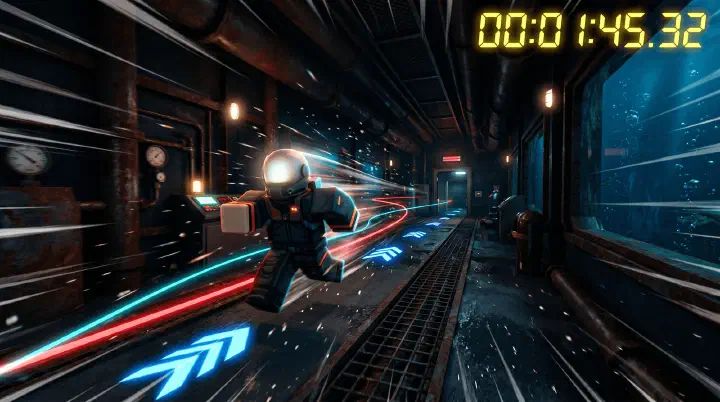
The timer on your phone says 18:47. You’re on floor 47, heart hammering, and the world record pace is still within reach. Three minutes left to clear the final stretch. You round a corner, spot the exit glow, and then you hear it — Rush. Your brain screams “locker,” but the nearest one is seven studs behind you. You freeze for half a second. That’s all it takes. The run dies. You slam your desk, reset, and queue up again.
That’s Pressure speedrunning in a nutshell. It isn’t just about knowing the fastest route. It’s about executing under pressure when one wrong turn, one greedy loot check, or one panicked hesitation turns a personal best into another reset. This guide breaks down the exact routes, item choices, and micro-decisions that separate a casual fast clear from a true speedrun.
Speedrun Categories
Pressure speedrunners compete in a few distinct categories. Each one demands different preparation and route knowledge.
- Hotel Any% — Clear floor 50 by any means necessary. The flagship category. World record sits around 18:30.
- Hotel 100% — Clear floor 50 and collect every item on the run. Much slower, around 28:00 at the top level.
- Blacksite Any% — Clear the Blacksite variant to floor 50. Brutal RNG, world record near 35:00.
- Endless Sprint — Reach floor 30 in Endless mode. Top times hover near 12:00.
- No Items — Clear Hotel without buying anything. Roughly 25:00 for the best runners.
Most players should start with Hotel Any%. It has the most consistent room generation, the best documentation, and the fastest feedback loop for improving your splits.
Speedrun Item Loadout
Every item in your inventory is a time choice. Pre-buy everything so the run starts the moment the elevator opens.
- Standard Flashlight + 2 Batteries — Pre-purchased, zero animation downtime. Avoids 15+ seconds of fumbling in dark rooms. Net benefit: +15 seconds.
- Sprint Potion x2 — Pre-purchased. Each potion saves roughly 25 seconds during Seek chases and long corridor stretches. Net benefit: +50 seconds.
- Code Breacher — Pre-purchased. Skips the locked door search phase entirely, saving about 45 seconds. Net benefit: +45 seconds.
- Gummy Flashlight — Avoid. The crank animation burns 1.5 seconds per recharge. Over a full run that adds up to 30+ seconds lost. Net benefit: negative.
- Medkit — Bring one as a safety net, but plan to never use it. If you’re healing, the run is already off pace.
- Lockpicks, lanterns, extra gadgets — Skip entirely. They clutter your inventory and slow menu navigation.
The optimal loadout is tight: Standard Flashlight, 2 Batteries, 2 Sprint Potions, 1 Code Breacher. Nothing else.
Floor-by-Floor Time Benchmarks
These splits assume a sub-30 minute pace. If you’re consistently behind these numbers, identify the floor range where you’re bleeding time and drill it.
- Floors 1-10 — Target under 3 minutes total. Sprint through, ignore containers, identify the nearest exit instantly. These floors are free if you don’t get greedy.
- Floors 11-20 — Cumulative target 6 minutes. Conserve your Sprint Potions. Start recognizing dead-end room layouts so you don’t waste steps.
- Floors 21-30 — Cumulative target 10 minutes. Seek spawns here. Pop Sprint Potion the instant the chase begins. That alone saves 15 seconds over walking.
- Floors 31-40 — Cumulative target 15 minutes. Locked door appears around here. Use Code Breacher immediately. Don’t hunt for the code.
- Floors 41-49 — Cumulative target 21 minutes. Hardest stretch. Use your second Sprint Potion if the corridor layout is brutal. Do not heal unless you’re below 20 HP.
- Floor 50 (Library) — Cumulative target 26-29 minutes. Figure encounter. This is where runs live or die. Walk efficiently, don’t crouch when Figure is far away, and collect two books per trip if you can handle the risk.
Key Speed Techs
Instant Room Exit Recognition
This is the number one time save across an entire run. When you enter a room, you have under one second to locate the exit door. Exit frames carry a faint glow. Train your eyes to scan left-to-right immediately on entry. Over 50 rooms, saving 3 seconds per room adds up to two and a half minutes.
Dead-End Skip
Dead-end rooms have no exit door. They only spawn loot containers. Learn the telltale signs: they’re smaller than standard rooms and always have a single entrance door. The instant you recognize one, pivot and leave. Don’t step inside. That single habit saves 5-10 seconds per dead-end, and you’ll hit three to five of them per run.
Seek Chase Optimization
Sprint Potion during Seek cuts the chase duration by roughly 40 percent. Pop it the frame the chase begins. Guiding Light’s blue glow shows the correct path — never hesitate at a junction. Hesitation costs more time than taking the wrong path once and correcting. The best Seek chases look reckless because they are. Trust the glow and move.
Figure Room Efficiency
Floor 50 is where personal bests turn into resets. The Figure encounter can range from 3 minutes to 15 minutes depending on your execution. Speedrun strats:
- Use Sprint Potion to move between shelves faster. Walking speed only matters when Figure is within 15 studs.
- Don’t crouch when Figure is on the opposite side of the library. Walking is silent enough at 30+ studs, and crouching burns precious seconds per shelf.
- Collect 2 books per trip instead of 1. It’s riskier, but it cuts the total trips in half. Most top runs use this strat.
Locker Skip for Rush
If you’re near a side room with a door, enter it and close the door behind you. That’s faster than entering and exiting a locker by about one second. Side rooms with doors block Rush just as effectively as lockers, and the animation is shorter.
Time Loss Traps
Even experienced speedrunners bleed time to these habits. Cut them out and your splits will drop immediately.
- Checking every container — Each container costs 3-5 seconds. Over 50 rooms that’s minutes lost. Only open containers directly in your path.
- Backtracking for a missed item — A single backtrack burns 10-30 seconds. The item isn’t worth it. Keep moving forward.
- Healing at full or high HP — The Medkit animation is 3-5 seconds. Only heal below 40 HP in a guaranteed safe room.
- Waiting for Ambush outside a closet — Ambush double-backs. If you exit early, you die. That’s a run reset, not just time lost. Stay inside, count the passes, and only exit when you’re certain.
- Freezing when Rush audio cues — Panic freezes cost 2-3 seconds per room. Pre-identify the nearest closet or side room the instant you enter any room. That way the decision is already made before Rush spawns.
Failure Analysis: Why Speedruns Die
Most failed runs don’t end because of bad luck. They end because of predictable mistakes that compound over 50 floors.
Greed on skips. A runner sees a shiny container just off the optimal path and thinks, “It’s just two seconds.” It’s never just two seconds. It’s two seconds to reach it, three seconds to open it, one second to process what dropped, and another two seconds to reorient toward the exit. Seven seconds per container, four containers per run, that’s nearly half a minute gone. Sub-20 runs do not tolerate greed.
Not accounting for entity RNG. You memorized a perfect route for floors 30-35, but then Seek spawns early and Screech appears in the same corridor. Panic sets in. You abandon your pathing and improvise. Improvisation in Pressure speedrunning almost always loses time. The fix isn’t better RNG — it’s drilling contingency paths. Know what to do when your primary route gets blocked by an entity spawn.
Panic healing. You’re at 60 HP, Figure is in the next aisle, and your brain says “heal to be safe.” The Medkit animation plays. Figure hears it. Now you’re at 60 HP anyway and Figure is sprinting toward your shelf. Most healing in speedruns is psychological comfort, not tactical necessity. If you’re above 30 HP and not in immediate danger, don’t touch the Medkit.
Over-crouching in the Library. New speedrunners crouch everywhere on floor 50 because they’ve been conditioned to fear Figure. But crouching halves your movement speed. When Figure is 40 studs away, walking is completely silent. Crouch only when Figure is within 15 studs or when you’re crossing open gaps. Every unnecessary crouch costs 1-2 seconds, and you make thirty-plus movements in the Library.
Decision Framework: When to Risk It vs. Play Safe
Speedrunning Pressure isn’t about taking every risk. It’s about taking the right risks at the right moments. Here’s the risk-reward breakdown for the major decisions you’ll face.
Sprint Potion usage. Pop it immediately on Seek. That’s automatic. For long corridors without Seek, only use Sprint Potion if the corridor has no side rooms and you can see the exit door. Using it blindly into an unknown room is dangerous — you might sprint straight into a dead-end or an entity spawn.
Two-book pickups in the Library. Take this risk only if your run is ahead of pace and you have buffer time to recover from a mistake. If you’re behind pace, play single-book safe. One bad two-book grab that alerts Figure can cost 2-3 minutes. The math only works when you’re already fast.
Container checks on the main path. Check them if the container is literally on your direct line to the exit and you don’t need to rotate your camera. If you need to turn more than 30 degrees, skip it. The best runs feel like the runner ignored 90 percent of the loot. Because they did.
Rush dodges vs. locker hides. If you’re within 5 studs of a locker or side room, hide. If you’re in an open stretch with nowhere to go, try the diagonal dodge. But here’s the thing: a failed dodge is a run reset. A successful hide costs 4 seconds. In a 30-minute run, 4 seconds is nothing. Take the hide unless you’re doing a No Items run and have no choice.
Code Breacher vs. code hunt. Always use Code Breacher on speedruns. The only exception is if you forgot to buy one. Hunting the code manually takes 30-60 seconds and often forces backtracking. That’s a category-killing mistake.
Counter-Intuitive Advice
Some of the best time saves in Pressure look wrong at first glance.
Sometimes waiting five seconds for an entity to pass is faster than dodging it. A diagonal Rush dodge looks flashy, but the setup, execution, and recovery take 6-8 seconds if you do it perfectly. Hiding in the nearest locker for five seconds and walking out clean is faster and 100 percent consistent. The leaderboard doesn’t award style points. It awards clear times.
Walking is faster than running in the Library. Sprint Potion is amazing for crossing open floor, but if you’re near Figure, walking is already silent. Running risks audio detection. The counter-intuitive part? Most players crouch everywhere. Walking at normal speed is faster than crouching and still safe at most distances. The real pro move is knowing exactly when to walk, when to sprint, and when to crouch — not defaulting to the slowest option.
Don’t look at your timer during the run. Checking your splits mid-run creates pressure that causes mistakes. The best speedrunners in Pressure run entirely on muscle memory and only check their final time at the exit. If you’re ahead of pace, you get cocky and greedy. If you’re behind, you panic and force risky skips. Ignoring the timer keeps your decision-making clean.
FAQ
What’s the world record speedrun for Pressure Hotel?
The current verified world record for a full Hotel clear (floor 50) sits at roughly 18 minutes 30 seconds as of mid-2026. That’s an extreme outlier — only the top 10 speedrunners on the leaderboard break the 20-minute barrier. If you’re serious about speedrunning, aim for sub-30 first. For beginners just learning the routes, shoot for sub-45, then grind down to sub-35 before worrying about the leaderboards.
What’s the best item loadout for speedrunning Pressure?
Run Standard Flashlight (not Gummy — the crank animation burns 1.5 seconds every recharge), two Sprint Potions for Seek chases and long corridors, one Code Breacher to skip the locked door search phase, and a Medkit only as an emergency crutch. Hand-Cranked and Gummy Flashlights feel safer but the animation downtime kills your split. Leave the lockpicks and lanterns at the shop — they’re inventory clutter that slows menu navigation.
How do you skip floors in Pressure?
You can’t truly skip floors, but you can compress time per floor to almost nothing. The biggest gains come from memorizing common room layouts so you never hunt for exits (saves 3-5 seconds per room), popping Sprint Potion the instant Seek spawns (cuts chase time by 40%), and refusing to backtrack for missed loot. The single largest time save is instant dead-end recognition — if the room’s small and has one door, turn around immediately.