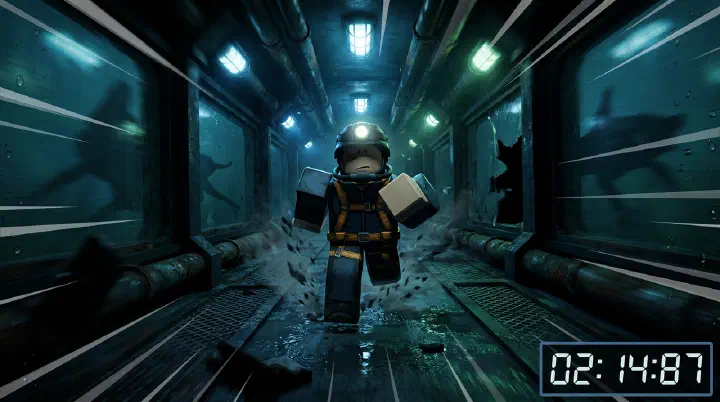
The lobby clock reads 31:47. You have run this Hotel forty-three times this week. Your personal best is 28:12. The sub-25 barrier feels like a brick wall. Every time you try to push faster, you die at floor 34 to a Rush you heard but could not reach in time. Every time you play safe, you finish at 29:30 and wonder where the other four and a half minutes went.
You have watched the world record runs. You know the loadout. You have memorized the floor benchmarks. But there is a gap between knowing the route and executing an optimized run. That gap is made of micro-decisions. Which side rooms to ignore. When to pop Sprint Potion versus saving it. Whether that cabinet near the exit is worth the two-second rotation. The leaderboard does not reward knowledge. It rewards elimination — the systematic removal of every action that does not move you closer to the exit.
This guide is not an introduction to speedrunning Pressure. It is the optimization layer. The adjustments you make after you already know the routes. The items you permanently delete from your shopping list. The room-by-room micro-tricks that compound into minutes. If your PB has been stuck for two weeks, the problem is not your hands. It is your decision tree.
The Optimization Mindset: What Sub-25 Runs Actually Look Like
A sub-25 Hotel Any% run does not feel fast. It feels empty. The runner passes through rooms like they are not there. No hesitation. No camera swings. No inventory fumbling. The movement looks almost boring because every decision was made before the door opened.
The difference between a 28-minute runner and a 24-minute runner is not APM or reflexes. It is pre-commitment. The 28-minute player enters a room, scans for the exit, then moves. The 24-minute player already knows the exit position based on the room type before the door finishes opening. That 1.5-second difference, multiplied across 50 rooms, is 75 seconds — more than a minute saved from room recognition alone.
Optimization is not about doing things faster. It is about not doing things at all. Every container skipped, every backtrack refused, every unnecessary crouch removed from the Library — these are the actual time saves. The flashy techs get the clips. The skips get the PBs.
Items to Skip Entirely — and What to Bring Instead
Your inventory has five slots. In a speedrun, three of them are actively harmful if filled with the wrong items. Here is the skip list.
Skip: Gummy Flashlight. In survival play, the Gummy Flashlight is S-tier. In speedruns, it is a liability. Its brightness is lower than the Standard Flashlight, which forces you to spend an extra half-second scanning dark corners to confirm the exit direction. Over 50 rooms, that adds 25 seconds. More importantly, the crank animation is 1.5 seconds of standing still. In a speedrun, you do not stand still unless a puzzle or entity forces it. Run Standard Flashlight + 2 Batteries.
Skip: Lockpick. The Lockpick saves you from one locked door if RNG blesses you with the right tier. But it does not guarantee success, and the animation is 2-3 seconds. The Code Breacher is instant. The Lockpick is for budget survival runs, not speedruns. Leave it.
Skip: Lantern. Area light sounds useful for dark rooms. In practice, the Lantern’s radius is too small for fast room scanning and it occupies a slot that could hold a Sprint Potion. Darkness is not what kills speedruns. Hesitation in darkness kills speedruns. A brighter flashlight solves the problem better than a lantern.
Skip: Smoke Bomb, Noise Maker, Glowstick. These are situational survival tools. In a speedrun, situational means dead inventory space. The Smoke Bomb’s radius is unpredictable. The Noise Maker requires setup time. The Glowstick is for when your flashlight dies — but your flashlight should not die if you brought batteries. If any of these are in your inventory, you are carrying answers to problems you should have prevented.
Skip: Medkit beyond one. Bring exactly one Medkit as an emergency crutch. If you use it, the run is probably already off pace — but one keeps you alive through an unlucky Figure shelf collision. Bringing two or three encourages healing at high HP, which burns 3-5 seconds per heal and creates a psychological safety net that makes you sloppy.
Bring: Standard Flashlight + 2 Batteries. Pre-purchased, zero downtime. Bright enough for instant room scanning. Swap batteries only in safe rooms or during the Library.
Bring: Sprint Potion x2. One for the Seek chase. One for a brutal corridor stretch in the 31-40 range. Do not use them for convenience. Use them when the alternative is dying or losing 20+ seconds.
Bring: Code Breacher. One. For the locked door that always appears in the 25-35 range. Do not hunt the code. Do not backtrack for keycards. One button, one second, door open.
The optimal loadout is four items: Standard Flashlight, 2 Batteries, 2 Sprint Potions, 1 Code Breacher. That leaves one slot empty. An empty slot is faster than a wrong item because it removes inventory navigation time.
Route Optimization by Floor Range
These are not benchmarks. These are route adjustments — the specific pathing choices that separate optimized runs from fast clears.
Floors 1-10: The Sprint Phase
Do not walk. Do not scan. Do not enter side rooms. Sprint directly from exit to exit. The entity spawn rate in floors 1-10 is so low that caution is mathematically wasteful. You are more likely to die from boredom and sloppy mistakes than from an early spawn.
The optimization here is camera discipline. Keep your camera facing forward, not swinging around to check corners. The exit is always forward or slightly left/right. If you do not see it in 1 second, pivot 90 degrees and check the perpendicular wall. Never do a full 360. The 360-degree habit is a survival reflex that costs 2 seconds per room.
Floors 11-20: Dead-End Elimination
This is where dead-end rooms start appearing. The optimization is instant recognition. Dead-ends are smaller than standard rooms, have a single entrance door, and lack the faint exit glow. The instant you confirm dead-end, pivot on your entry path and leave. Do not step inside. Do not check the container that is visible from the doorway. The container is bait. Every second you spend inside a dead-end is a second you are not making progress.
Floors 21-30: The Seek Checkpoint
Seek spawns somewhere in this range. The optimization is not just popping Sprint Potion — it is path commitment. During the chase, Guiding Light’s blue glow shows the correct path. The time loss comes from hesitation at junctions. The optimal Seek chase looks reckless because the runner pre-commits to the glow direction without second-guessing. If you take the wrong path once, correcting costs less time than hesitating at every junction. Trust the glow and move.
Pre-position your Sprint Potion in your hotbar before this range. Do not open inventory during the chase. The 1-second inventory animation can be the difference between escaping and getting caught.
Floors 31-40: The Corridor Gauntlet
This range has the longest average corridor length and the highest entity density before the Library. The route optimization here is “door-line sprinting.” When you enter a long corridor and can see the exit door at the far end with no entities active, pop Sprint Potion and run the line. Do not check side rooms. Do not slow down for audio cues that are not immediate threats. The Potion saves roughly 15 seconds per long corridor.
However, never pop Sprint Potion blindly into an unvisited room. Sprinting into a dead-end or an active entity spawn is a run reset. Only sprint when you have line of sight to the exit.
Floors 41-49: The Discipline Check
This is where most sub-25 attempts die. Not because the rooms are harder, but because the runner is mentally fatigued and starts making sloppy decisions. The optimization here is strict protocol enforcement. No container checks. No side rooms. No healing above 30 HP. If you have survived this far with good splits, your only job is to not throw. The rooms are not the boss. Your own patience is.
Floor 50: The Library — Figure Optimization
The Library is where minutes are won or lost. The standard Figure strat takes 8-12 minutes. An optimized strat takes 3-5 minutes.
Pre-plan your shelf route. Before entering the Library, know exactly which shelves you will hit in which order. The time loss in the Library is almost never Figure catching you. It is indecision — standing between shelves wondering which one to check next. Memorize a fixed route.
Two-book pickups. Grab two books per trip instead of one. This cuts total shelf trips in half. The risk is that carrying two books slows your movement slightly and makes it harder to dodge if Figure detects you. Only attempt two-book pickups if your run is ahead of pace and you have practiced the timing. If you are behind pace, play single-book safe. One bad two-book grab that alerts Figure can cost 2-3 minutes.
Walk, do not crouch. When Figure is beyond 20 studs, walking is completely silent. Crouching halves your speed and is only necessary when Figure is within 15 studs or when crossing open gaps. Most runners crouch everywhere in the Library because they fear Figure. That fear costs 1-2 seconds per movement, and you make thirty-plus movements in the Library. That is 30-60 seconds lost to unnecessary crouching.
Use Sprint Potion for shelf crossing. If Figure is on the opposite side of the Library and you need to cross open floor to reach the next shelf cluster, pop Sprint Potion. The burst crosses the gap before Figure can path to your position. This is risky but saves 5-8 seconds per crossing.
Time-Saving Micro-Tricks
These are the small optimizations that do not look impressive individually but compound into minutes over a full run.
Side-room door hiding over lockers. If a side room with a door is closer than the nearest locker, enter the side room and close the door. The door-close animation is faster than the locker enter-exit cycle by roughly 1 second. Over 5-7 Rush or Ambush encounters per run, that is 5-7 seconds saved. It also protects against The Man from the Mindscape, which cannot interact with closed doors.
Inventory pre-positioning. Before entering floor ranges where you expect to use items — Sprint Potion before floor 25, Code Breacher before floor 30 — move those items to the front of your hotbar. Opening inventory mid-threat costs 1-2 seconds. Pre-positioning removes that cost entirely.
The instant pivot. When entering a room, your first movement should already be toward the exit. Do not stop at the doorway to scan. Scan while moving. The exit glow is visible in peripheral vision if you train yourself to look for it. The 0.5 seconds you spend stationary at the threshold is a habit carried over from survival play. Eliminate it.
Battery swap timing. Swap flashlight batteries during safe animations — elevator transitions, puzzle solves, or while waiting in a locker after an entity passes. Never swap batteries while walking through a new room. The inventory animation blinds you and slows you simultaneously.
Reject the full-loot room. Occasionally you will enter a room with three visible containers and a side room. In survival play, this is Christmas. In a speedrun, this is a trap. The optimal route passes through the exit door without touching anything. The entire room is a 15-second detour disguised as opportunity. Treat it like a dead-end and leave.
Failure Analysis: Why Optimization Attempts Die
Most failed sub-25 attempts do not end to bad RNG. They end to predictable optimization failures that compound across 50 floors.
Greed disguised as efficiency. The runner sees a container directly on the path to the exit and thinks, “It is only two seconds.” It is never two seconds. It is two seconds to reach it, three seconds to open it, one second to process the drop, and two seconds to reorient toward the exit. That is eight seconds per container. Four containers per run is 32 seconds — more than half the gap between a 28-minute run and a 27-minute run. Sub-25 runs have near-zero container checks.
Sprint Potion misuse. The runner pops Sprint Potion because the corridor looks long, then sprints into a dead-end room or an active entity spawn. Sprint Potions are run-savers when used with line of sight. They are run-enders when used for convenience. The rule is simple: if you cannot see the exit door, do not sprint.
Panic healing above 40 HP. You take damage from a Screech or a close Rush pass. You are at 55 HP. Your brain screams “heal to be safe.” The Medkit animation plays. You are now at full health but you just burned 4 seconds and created a false sense of security. Most healing in speedruns is psychological comfort, not tactical necessity. If you are above 30 HP and not entering the Library, do not heal. The time cost is not worth the HP buffer.
Over-crouching in the Library. New optimizers crouch everywhere on floor 50 because they have been conditioned to fear Figure. But crouching halves movement speed. When Figure is 25 studs away, walking is silent. The optimal Library runner knows exactly when to walk, when to sprint, and when to crouch — and defaults to walking, not crouching. Every unnecessary crouch costs 1-2 seconds, and you make thirty-plus movements in the Library. That is 30-60 seconds of pure waste.
Improvisation under pressure. You memorized a perfect route for floors 30-35, but then Seek spawns early and a node monster appears in the same corridor. Panic sets in. You abandon your pathing and improvise. Improvisation in Pressure speedrunning almost always loses time because it forces on-the-fly decisions instead of pre-committed movement. The fix is drilling contingency paths. Know what to do when your primary route gets blocked. Do not make it up in the moment.
Decision Framework: When to Risk It vs. Play Safe
Optimization is not about taking every risk. It is about taking the correct risks at the correct moments. Here is the framework for the major decisions in an optimized run.
Sprint Potion usage. Pop it immediately on Seek. That is automatic. For long corridors without Seek, only use Sprint Potion if the corridor has no side rooms and you have line of sight to the exit door. Using it blindly into an unknown room is dangerous — you might sprint into a dead-end or an entity spawn. Save your second Potion for a brutal corridor in the 31-40 range or for open-floor crossing in the Library.
Two-book pickups in the Library. Take this risk only if your run is ahead of pace and you have buffer time to recover from a mistake. If you are behind pace, play single-book safe. One bad two-book grab that alerts Figure can cost 2-3 minutes. The math only works when you are already fast. If your split at floor 40 is over 22 minutes, abandon two-book strats entirely and play for survival.
Container checks on the main path. Check them only if the container is literally on your direct line to the exit and you do not need to rotate your camera more than 15 degrees. If you need to turn more than 15 degrees, skip it. The best runs look like the runner ignored 95% of the loot. Because they did.
Rush dodges vs. locker hides. If you are within 5 studs of a locker or side room with a door, hide. If you are in an open stretch with nowhere to go, the diagonal dodge is your only option. But a failed dodge is a run reset. A successful hide costs 4 seconds. In a 25-minute run, 4 seconds is recoverable. A reset is not. Take the hide unless you are doing a No Items run and have no choice.
Code Breacher vs. code hunt. Always use Code Breacher on speedruns. The only exception is if you forgot to buy one. Hunting the code manually takes 30-60 seconds and often forces backtracking. That is a category-killing mistake. If you forgot the Breacher, consider resetting the run immediately rather than attempting a manual hunt.
Counter-Intuitive Optimization Advice
Some of the best time saves in Pressure speedrunning look wrong at first glance.
Sometimes waiting five seconds for an entity to pass is faster than dodging it. A diagonal Rush dodge looks flashy and saves 4 seconds if executed perfectly. But the setup, execution, and recovery take 6-8 seconds if you account for the mental load and repositioning. Hiding in the nearest locker for 5 seconds and walking out clean is faster, 100% consistent, and preserves mental bandwidth for the next room. The leaderboard does not award style points. It awards clear times.
Walking is faster than running in the Library. Sprint Potion is amazing for crossing open floor, but if you are near Figure, walking is already silent. Running risks audio detection. The counter-intuitive part is that most players crouch everywhere. Walking at normal speed is faster than crouching and still safe at most distances. The real pro move is knowing exactly when to walk, when to sprint, and when to crouch — not defaulting to the slowest option because you are afraid.
An empty inventory slot is an item. Players fill all five slots because it feels wasteful to leave one empty. But an empty slot means faster inventory navigation, less time deciding which item to use, and no accidental misclicks during pressure moments. Four correct items and one empty slot is better than five items where one is situational dead weight.
Do not look at your timer during the run. Checking your splits mid-run creates pressure that causes mistakes. If you are ahead of pace, you get cocky and take risks you should not take. If you are behind, you panic and force risky skips that end the run. The best speedrunners in Pressure run entirely on muscle memory and only check their final time at the exit. Ignore the timer. Trust your drilling.
Dying early is better than finishing slow. If you are 90 seconds behind your PB pace at floor 20, reset. Do not “see how it goes.” A slow finish teaches you nothing except how to play slowly. A reset gives you another attempt at pace within 2 minutes. Speedrunning is a numbers game. More attempts at pace means more chances to break through. Grinding out slow finishes is how you practice survival, not how you optimize speed.
FAQ
What is the biggest single time save in a Pressure speedrun?
Instant dead-end recognition and refusal to enter them. Dead-end rooms have no exit door and only spawn loot containers. The instant you recognize the layout — small room, single door, no exit glow — pivot and leave. Each dead-end skip saves 5-10 seconds. You hit three to five per run. That is 15-50 seconds saved from one habit alone, more than any item or tech.
Should I ever check containers during a speedrun?
Only if the container is literally on your direct path to the exit and you do not need to rotate your camera more than 15 degrees to open it. Every container check costs 3-5 seconds. Over 50 floors, four greedy checks add up to half a minute. Sub-25-minute runs ignore roughly 95% of all loot. The container is not worth the death probability it adds.
Why do I keep dying when I try to speedrun?
Because you are still playing the survival game inside a speedrun framework. Speedrunning Pressure requires abandoning the instinct to be thorough. Most speedrun deaths come from three mistakes: checking containers mid-room instead of moving to the exit, using Sprint Potion blindly into unknown rooms and sprinting into entity spawns, and panic-healing above 40 HP which wastes 3-5 seconds and sometimes alerts Figure. Fix those three habits and your survival rate in speedrun attempts will triple.
Is the Hand-Cranked Flashlight ever optimal for speedruns?
No. The Hand-Cranked Flashlight costs 300 Credits and the 1.5-second crank animation is a run killer when you need light instantly. For speedruns, the Standard Flashlight with pre-purchased Batteries is optimal — it has the highest brightness for instant room scanning and zero animation downtime when swapping batteries in safe rooms. The Gummy Flashlight is acceptable for learning but its lower brightness forces slightly slower room scanning.
How do I practice speedrun routes without wasting 30 minutes per attempt?
Use segmented practice. Do not run full Hotel attempts when drilling a specific floor range. Start a run, reach the floor range you want to drill — say floors 31-40 — then sprint through that range ten times, letting the run die intentionally afterward. This gives you 10 attempts at your weakest segment in the time it takes to do 3 full runs. Most PBs are broken by fixing one slow segment, not by shaving 1 second off every room.
What is the optimal Figure strategy for sub-25 runs?
Two-book pickups per trip, walk don’t crouch when Figure is beyond 20 studs, and pre-plan your shelf path before entering the Library. The biggest Library time loss is indecision — players who do not know which shelves to hit next stand still while Figure moves. Memorize a fixed shelf order. The two-book strat is riskier but cuts total trips in half, saving 60-90 seconds. Only attempt it if your run is ahead of pace and you have practiced the grab timing.
Related Guides
- Pressure Speedrun Guide — Fastest Routes, Optimal Items & Clear Time Benchmarks
- Pressure Entity Timing Guide — When Every Spawn Happens
- Pressure Entity Timing Windows — Safe Movement Frames
- Pressure Items & Loadout Tier List — Best 5-Slot Loadouts
- Pressure Advanced Survival Strategies — Beyond Door 50
- Pressure Floors & Locations — What Changes at Each Range
- Pressure Beginner Guide — Entities, Items & First Win