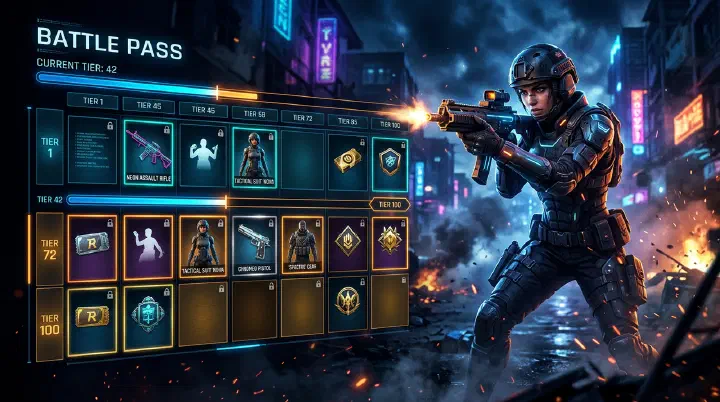
You log in after a two-week break. The lobby looks different. The battle pass screen has a new theme. Your rank badge, which you spent three weeks grinding to Platinum 2, now reads “Silver 3.” Your friend messages you: “Did you see the new battle pass skin? It’s at tier 45.” You check your Credits — you have 47. You check the event shop — the seasonal currency you had saved is gone. It expired. You check the season timer — 18 days left. You do the math and realize you can maybe hit tier 25 if you play every single night.
This is the RIVALS season cycle. It happens every 8 weeks, and it catches players who treat the game like a casual drop-in experience. Seasons are not just a cosmetic refresh. They reset your rank, clear your event currency, rotate the weapon meta, and introduce new reward tracks. If you do not understand the rhythm, you will lose progress, waste Robux, and miss rewards you could have earned.
This guide covers the full season system: how seasons work, what resets and what carries over, the battle pass economy, rank reset mechanics, seasonal events, the F2P vs premium decision, and the mistakes that cost players the most each season.
If you need the current season’s specific weapon changes and map rotations, pair this with the RIVALS Season 3 Weapons and Maps Guide. For the current battle pass tier list and reward breakdown, see the RIVALS Season 3 Battle Pass Guide.
How RIVALS Seasons Work
A RIVALS season is a fixed 8-week cycle. When one season ends, the next begins immediately — there is no off-season. Each season changes five things:
- Battle pass resets to a new free and premium track with 50 tiers.
- Ranked mode undergoes a soft reset, dropping your displayed rank by 1-2 divisions.
- Seasonal event introduces a new limited-time mode, event shop, and challenge chain.
- Weapon balance patch may adjust stats, recoil, or ability interactions.
- Seasonal cosmetics replace the previous season’s shop inventory and reward pool.
Some things carry over. Your weapon skins, charms, banners, titles, Credits, and account level persist across seasons. Your hidden MMR carries forward with compression. Your friends list, settings, and loadout presets stay intact. The things that reset are always tied to the season’s reward economy — progress toward rewards, not the rewards themselves.
| What Resets | What Carries Over |
|---|---|
| Battle pass tier progress | Owned cosmetics (skins, charms, banners, titles) |
| Displayed ranked badge | Hidden MMR (compressed) |
| Seasonal event currency | Credits (shop currency) |
| Seasonal challenge progress | Account level and XP |
| Event shop inventory | Friends list, settings, loadout presets |
The season boundary is the most important date in RIVALS. Note it. Write it down. Set a calendar reminder. Everything that expires — battle pass tiers, event currency, ranked progress — vanishes at that moment.
Battle Pass Economy: Free vs Premium
The battle pass is the centerpiece of every RIVALS season. It has two tracks:
Free Track
The free track gives 5 rewards spaced across 50 tiers. Each reward is a small Credit bundle — typically 25 Credits per reward, totaling 125 Credits per season. That is enough to buy one cheap cosmetic item from the shop, nothing more. The free track exists to give F2P players a taste of the reward loop, not to outfit a full loadout.
Premium Track (799 Robux)
The premium track adds 50 rewards across all 50 tiers. You get:
- 3 exclusive weapon skins (tiers 15, 30, 45), usually one Epic and two Legendary
- 2 exclusive weapon charms
- 1 exclusive ability VFX
- 1 exclusive kill banner
- 1 exclusive title (tier 50)
- 300 Credits returned across 3 tiers (5, 25, 40)
- XP boosts at certain tiers that accelerate the rest of the pass
The total value of premium rewards is roughly 2,500-3,000 Credits if purchased individually from the shop. Since the pass costs 799 Robux and returns 300 Credits, the effective cost is approximately 499 Robux for 2,500+ Credits worth of items. The math is good — but only if you reach the tiers.
The critical question is not “is the pass good value?” It is “will I reach tier 30+?” Everything below tier 30 is decent but not essential. The tier 30 weapon skin, tier 45 weapon skin, and tier 50 title are the anchor rewards. If you cannot reach tier 30, the premium pass is not worth buying.
Season-Exclusive Weapons and Cosmetics
Each season introduces exclusive weapons that are only available during that season’s window. These fall into three categories:
Battle Pass Weapon Skins
These are the tier 15, 30, and 45 skins on the premium track. They are the season’s signature cosmetics. The tier 45 skin is usually Legendary with a unique inspect animation. These skins occasionally return in vault events, but you should not count on it.
Seasonal Event Shop Rewards
The event shop carries weapon skins, charms, sprays, banners, and sometimes full character cosmetics. These are purchased with event currency earned from challenges. Event shop items are truly limited — once the shop closes, these items are gone until a possible vault return, which is rare and not guaranteed.
Ranked Season Rewards
At the end of each season, players receive ranked rewards based on their highest achieved rank. These are typically:
- A weapon charm for Bronze+
- A weapon skin for Gold+
- An animated weapon skin for Platinum+
- A title and exclusive cosmetic for Diamond+
Ranked rewards are never re-released. A Diamond season reward from Season 2 is permanently unavailable after the season ends. This makes ranked rewards the most exclusive seasonal items in the game.
Seasonal Rank Reset Mechanics
The rank reset is the most misunderstood part of the season system. Players see their rank drop and assume they lost progress. They did not. Here is what actually happens:
At the end of a season, your displayed rank drops by 1-2 divisions. A Diamond 2 player may reset to Platinum 1. A Gold 3 player may reset to Silver 1 or Silver 2. But your hidden MMR carries forward with compression — it moves slightly toward the median (approximately Gold 2) regardless of where you were. This prevents both extreme inflation and extreme deflation.
The first 5-10 matches of a new season function as soft placements. Your MMR confidence is lowered, so gains and losses are amplified. Win these matches and you climb back to your true rank quickly. Lose them and you will spend the first two weeks of the season recovering.
The Reset Exploit Nobody Talks About
Because MMR compresses toward the median, high-ranked players who play immediately at season start face a unique window: their MMR is artificially low relative to their skill, and their confidence is low, so wins produce massive ELO gains. A Diamond player who wins their first 5 placement matches can gain 30-40 ELO per win and rocket back to Diamond in a fraction of the normal time.
The counter-strategy for lower-ranked players is to wait. If you are Gold 3 and reset to Silver 1, the first 48 hours of a new season are filled with Diamond players climbing through your rank. Queuing immediately means facing players who are 2-3 divisions above your true skill level. Wait 2-3 days for the high-ranked players to climb out of your bracket, then queue. Your matches will be more balanced and your climb will be steadier.
Optimal Battle Pass Progression Strategy
Most players approach the battle pass wrong. They play normally, check their tier progress casually, and panic-grind in the final week. Here is the efficient approach:
Phase 1: Day 1-7 (Setup)
Do not buy the premium pass immediately. Play for the first week on the free track. Track your daily XP gain. If you are averaging 25,000+ XP per day, you can reach tier 50 in roughly 20 days — buy the pass. If you are averaging 10,000-15,000 XP per day, you can reach tier 30-35 — the pass is borderline. If you are below 10,000 XP per day, stay F2P.
During this phase, complete every daily challenge. They are the most XP-dense activity in the game. Three daily challenges at 1,500-3,000 XP each = 4,500-9,000 XP in 20-30 minutes of targeted play. Nothing else matches that efficiency.
Phase 2: Week 2-6 (Core Progression)
If you bought the pass, this is where you grind. Weekly challenges reset every Monday. Complete all three before the next reset. Stack weekly challenges with dailies — if a weekly asks for 50 eliminations and a daily asks for 10 headshots, use a precision weapon and progress both simultaneously.
Use your XP boosts strategically. If you unlock a 1-hour Double XP boost at tier 10, save it for a session where you can play for the full hour uninterrupted. Do not activate it for a 20-minute session. Stack boosts with Double XP weekends or event windows for 4x XP — these stacking windows are how hardcore players finish the pass in 7-10 days.
Phase 3: Week 7-8 (Cleanup)
By now you should know exactly which tier you will reach. If you are 5 tiers short of a reward you want, calculate whether daily challenges and remaining weeklies will close the gap. If not, either accept the shortfall or buy tier skips at 150 Robux per tier. Only buy tier skips in the final week, and only for a reward you genuinely want — never skip tiers early in the season.
Spend your event currency. The event shop closes at the season boundary. Refer to the reward priority framework in the RIVALS Limited-Time Events Guide for the tiered buying strategy.
Seasonal Events and Limited-Time Modes
Every season includes a themed event with a limited-time mode (LTM). These modes are the season’s identity — they are what makes a season feel different from the last one. Examples include Infection, Snowball Fight, Capture the Flag, and Beach Party.
The event mode is not always the best mode for completing challenges. An event mode that is fun but chaotic may be worse for win-based objectives than standard ranked play. A mode with long rounds and low kill counts may be worse for elimination-based challenges than TDM. Before you queue, check what the challenge actually requires and choose the mode that completes it fastest. The event playlist is for fun and flavor — it is not automatically the most efficient.
Event currency is the other major reward source during a season. It comes from daily challenges, weekly challenges, seasonal challenge chains, and match completion bonuses. The event shop has its own closing timer — sometimes it matches the season end, sometimes it closes a few days earlier. Check the timer. Missing the shop close by one day is a common and painful mistake.
For a full breakdown of event strategy, reward prioritization, and the decision framework for limited-time shops, see the RIVALS Limited-Time Events Guide.
F2P vs Premium Pass: The Decision Framework
The decision is simple on paper but hard in practice because players want the premium rewards and overestimate their playtime. Use this framework:
Buy the premium pass if:
- You play 4+ hours per week consistently
- You can complete daily challenges on at least 5 days per week
- You will still be playing RIVALS in 6 weeks
- The tier 30 and 45 skins are for weapons you actually use
Stay F2P if:
- You play less than 3 hours per week
- You skip days regularly and miss weekly challenges
- You are not sure if you will still be playing in a month
- The premium skins are for weapons you never equip
- 799 Robux is a meaningful amount of money for you
The hybrid approach: Play the first week on the free track. Track your XP. If your pace supports tier 30+, buy the pass in week 2. You lose nothing by waiting — the premium rewards are retroactive, meaning you unlock every premium tier you have already passed the moment you buy the pass. The only thing you miss is the XP boost from premium tiers, which is small enough that one week of waiting does not matter.
Common Mistakes Players Make Each Season
Mistake 1: Buying the Pass Before Checking Playtime
The premium pass is not a good deal if you never reach the rewards. Players buy it on day one because the trailer looked cool, play for two weeks, burn out, and reach tier 18. They paid 799 Robux for 125 Credits and a weapon charm. Wait one week. Check your actual playtime. Then decide.
Mistake 2: Queuing Ranked Immediately After a Season Reset
The first 48 hours of a new season are a blender. Diamond players are climbing through Platinum. Platinum players are in Gold. Everyone is in the wrong bracket. If you are Gold or below, queuing ranked on day one means facing players who are significantly better than you. Wait 2-3 days. The ladder will stabilize and your matches will be fair.
Mistake 3: Ignoring Event Currency Until the Last Week
Event currency is the most efficient reward source in the game. It comes from challenges you are already completing for battle pass XP. But players ignore the event shop until the final week, then discover they have 1,500 tokens and the skin they want costs 3,000. Check the event shop on day one. Mark your targets. Track your currency. Adjust your target if you are falling behind.
Mistake 4: Spending Credits on the Wrong Things
Credits carry over between seasons. That makes them valuable. Do not spend Credits on items that are available permanently — those will still be there next season. Spend Credits on seasonal items that are leaving the shop, or save them. A player who saves 500 Credits across two seasons can buy a premium shop skin without spending Robux.
Mistake 5: Not Using the XP Boost Window
XP boosts from codes, events, and premium pass tiers stack. A 2x event boost plus a 2x premium boost equals 4x XP. A 30-minute session during a 4x window is worth 2 hours of normal play. Track when Double XP events are active and plan your longer sessions around them. The XP boost is the single largest accelerator in the battle pass — ignoring it is leaving free tiers on the table.
Counter-Intuitive Truths About RIVALS Seasons
The Free Track Is Sometimes Better Than a Bad Premium Purchase
If you buy the pass and only reach tier 18, you paid 799 Robux for less value than a F2P player who reached tier 50 and collected 125 Credits. The F2P player spent nothing and got more usable rewards. A bad premium purchase is worse than a good F2P season. The premium pass is only good value if you reach the tiers.
Skipping a Season Can Improve Your Account
If you are burned out, skipping a season is not a loss — it is a reset. You come back fresh. Your MMR does not decay meaningfully. You missed some cosmetics, but cosmetics are infinite. The game will release more. The player who skips a season and returns motivated will climb higher and play better than the player who forces themselves through every battle pass.
The Best Season to Buy the Pass Is Not Always the Current One
If the current season’s weapon skins are for weapons you do not use, buying the pass is a worse value than waiting for a season where the tier 45 skin is for your main weapon. A legendary Deagle skin is wasted if you only play AR and Shotgun. The pass value is weapon-dependent. Evaluate the skins before you evaluate the price.
Waiting to Buy the Pass Costs You Nothing
The premium pass is retroactive. You can reach tier 30 on the free track, then buy the pass and instantly unlock every premium reward from tiers 1-30. The only thing you lose by waiting is the premium XP boost, which is minor. Waiting lets you confirm your playtime and commitment before spending Robux. There is no downside.
Event Modes Are Often the Worst Way to Complete Event Challenges
The event mode is designed for fun, not efficiency. If a challenge asks for 30 eliminations, a fast-paced TDM match may complete it in half the time of the event mode. If a challenge asks for wins, the event mode with random teams and gimmick mechanics may be the slowest path. Evaluate the challenge goal, then choose the mode. The event playlist is for the experience, not the grind.
FAQ
When does the RIVALS season end, and what happens to my rank?
RIVALS seasons typically run 8 weeks. Check the battle pass screen for the exact countdown timer. When the season ends, your displayed rank drops by 1-2 divisions in a soft reset. Your hidden MMR carries forward with compression toward the median. Unspent event currency expires. Battle pass progress resets to zero. Your owned cosmetics, Credits, account level, and settings all carry over.
Should I buy the premium battle pass or stay F2P in RIVALS?
Buy the premium pass if you play at least 4-5 hours per week and can reach tier 30+ before the season ends. If you play less than 3 hours per week, stay F2P. The most reliable method is to play the first week on the free track, track your daily XP, and buy the pass in week 2 if your pace supports tier 30+. The pass is retroactive, so waiting costs you nothing.
Do RIVALS season-exclusive weapons and cosmetics ever come back?
Some battle pass skins have returned in vault events or anniversary shops, but at higher Credit costs. Titles, kill banners, and ranked season rewards have historically stayed exclusive. Assume every season cosmetic is one-time only. If an item returns, treat it as a bonus, not an expectation.
How do I maximize value each season without spending extra Robux?
Start on day one. Complete daily challenges every session. Finish weekly challenges before reset. Use Double XP windows from codes and events. Spend event currency on one priority item first, not spread across cheap fillers. Save Credits for seasonal items that are about to leave the shop. If you are F2P, focus on the free battle pass track, seasonal event shop, and login bonuses — these three sources can earn 5-8 cosmetics per season without spending Robux.
What is the fastest way to level up the RIVALS battle pass?
Complete daily challenges first — they are the most XP-efficient activity. Then weekly challenges. Play objective modes (Domination, TDM) for higher XP per match. Use headshot kills for the +15 XP bonus. Save XP boosts for long sessions and stack them with Double XP events. If you buy the premium pass, purchase it early to access the premium XP boost tiers.
Related Guides
- RIVALS Season 3 Battle Pass Guide — current season’s tier list, reward breakdown, and specific XP values
- RIVALS Limited-Time Events Guide — event strategy, reward prioritization, and the tiered buying framework
- RIVALS Ranked ELO Climbing Guide — how the rank reset interacts with hidden MMR and climbing strategy
- RIVALS Codes and Rewards Guide — free XP boosts, Credits, and seasonal codes
- RIVALS Season 3 Weapons and Maps Guide — current weapon meta and map rotations for the season