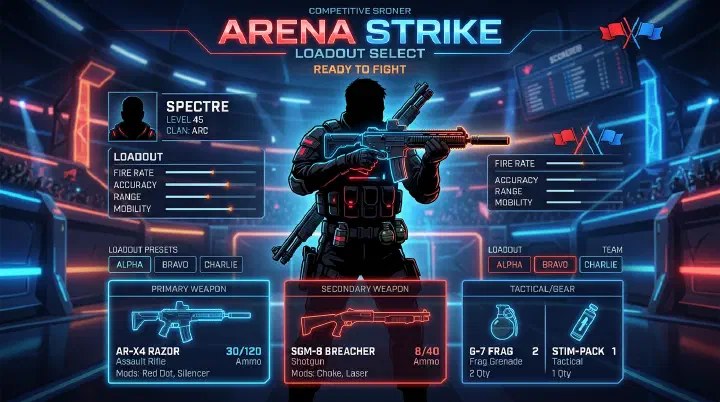
You’re down to 12 health. Two enemies are pushing from the left hallway, and you can hear footsteps behind you. Your primary is dry. Most players panic here — they try to reload and get torn apart. But you planned for this. You back into cover, whip out the shotgun you tucked into your secondary slot, and drop the first rusher with a single blast. The second hesitates. That’s all the time you need to swap back to your freshly reloaded AR and clean up. Three kills, one life, and the round flips because your loadout had synergy.
This guide is about that moment. Not just picking “good” weapons — picking weapons and utility that work together. A mismatched loadout fights against you. A synergized one turns impossible situations into clips worth saving.
What This Guide Covers
Building a loadout in Rivals isn’t about grabbing the highest-tier weapon in each slot and calling it a day. Your primary, secondary, and utility need to complement each other. We’ll break down:
- How primary and secondary weapons should cover each other’s weaknesses
- Utility choices that amplify your weapon picks rather than sitting unused
- Map-specific loadout adjustments that give you an edge before the first shot
- How your character ability should influence what you carry
- The three build philosophies — aggressive, defensive, and support — and why “hybrid” often fails
The Core Principle: Cover Your Gaps
Every weapon in Rivals has a range where it dominates and a range where it falls apart. Your loadout’s job is to make sure you’re never caught in a dead zone with no answer.
Think of it like a triangle:
- Long range: Snipers, marksman rifles, tap-fired ARs
- Mid range: Full-auto ARs, some SMGs
- Close range: Shotguns, most SMGs, melee
If your primary is an AR that shines at mid range, your secondary should handle either close or long. Running two mid-range weapons means you’ll lose every fight that happens in a tight corner or across an open field. I’ve seen players run AR + SMG and wonder why they keep dying to snipers on Rooftops. The answer is simple: their loadout had no answer for long sightlines.
Here are solid gap-covering combos that work:
- AR + Shotgun: The classic. Handles mid and close. Weak at long range, so play around cover and avoid open duels.
- Sniper + SMG: Covers long and close. Mid range is awkward — you’ll need to either back up or close the gap fast.
- Shotgun + Pistol/Marksman: Aggressive close-range play with a backup for those rare long shots.
- LMG + Shotgun: Hold angles with the LMG, then swap to shotgun when they push your position.
Map-Specific Loadouts: Don’t Fight the Terrain
Rivals has maps that play completely differently. Bringing the same loadout everywhere is like wearing snow boots to the beach. You’ll function, but you’re making life harder than it needs to be.
Close-Quarters Maps (Warehouses, Tight Corridors)
These maps are where shotguns and SMGs earn their keep. Long sightlines barely exist, so snipers become liability picks.
Recommended loadout:
- Primary: Shotgun or high-RPM SMG
- Secondary: Pistol or a compact SMG for quick swaps
- Utility: Movement ability or flash grenade
The goal here is speed. You want to be the one initiating fights at knifefight range. A shotgun primary with a fast-swap pistol secondary lets you chain kills without getting stuck in reload animations.
Open Maps (Rooftops, Long Lanes)
These maps punish close-range players who can’t close distance. If you’re running a shotgun here, you need a plan for every open stretch — usually a lot of flank routes and patience.
Recommended loadout:
- Primary: AR or sniper
- Secondary: SMG for when they push your position
- Utility: Smoke grenade or movement ability to cross open ground
On open maps, your secondary is your “oh no” button. It’s what you pull when someone rounds a corner while you’re holding a long angle with your sniper. An SMG secondary saves lives here.
Hybrid Maps (Mix of Open and Tight)
Most Rivals maps fall into this category. That’s why the AR + shotgun combo is so popular — it gives you an answer for both halves of the map.
Recommended loadout:
- Primary: Versatile AR
- Secondary: Shotgun or SMG
- Utility: Frag grenade or heal/regen ability
On hybrid maps, your utility becomes the tiebreaker. A well-placed grenade can turn a bad position into a free kill. A heal lets you trade aggressively and survive.
Ability-Weapon Pairings: Don’t Waste Your Passive
Your character ability isn’t separate from your loadout — it’s part of it. A movement ability paired with a sniper rifle is awkward. A damage boost paired with a shotgun is devastating.
Here are pairings that actually work:
- Speed/Movement abilities: Pair with close-range weapons. The whole point is closing gaps before they can react. Shotguns and SMGs love speed.
- Damage boost abilities: Pair with high-damage-per-shot weapons. A damage-boosted shotgun can one-shot at ranges it shouldn’t. A damage-boosted sniper body shot becomes a kill instead of a tag.
- Heal/Regen abilities: Pair with ARs or LMGs. These favor longer, drawn-out fights where you can peek, take damage, heal, and re-peek. Close-range weapons tend to end fights too fast for regen to matter.
- Vision/Information abilities: Pair with long-range weapons. Knowing where they are means nothing if you can’t act on that info from a distance.
The most common mistake I see is players picking their favorite ability and their favorite weapon independently. They end up with a speed boost and a sniper, or a heal and a shotgun. The abilities still work, but they’re fighting each other instead of stacking.
Build Philosophies: Pick One and Commit
There are three ways to approach loadout building in Rivals. Most players try to do all three at once and end up mediocre at everything.
Aggressive Builds
These loadouts are built for taking space and forcing fights. You’re not waiting for them to come to you — you’re going to them.
- Primary: Shotgun or high-RPM SMG
- Secondary: Pistol or another close-range option
- Utility: Flash, smoke for pushing, or movement ability
- Ability: Speed boost, damage boost, or anything that helps you win the first 2 seconds of a fight
Aggressive builds live and die by initiative. If you hesitate, you lose. The upside is you control the pace. The downside is one mistimed push ends your streak.
Defensive Builds
These loadouts punish aggression. You’re holding angles, watching flanks, and letting them walk into your crosshair.
- Primary: LMG or AR with large magazine
- Secondary: SMG or shotgun for when they collapse on your position
- Utility: Heal, shield, or area denial grenades
- Ability: Regen, shields, or anything that extends your lifespan in a fight
Defensive builds excel on objective modes and maps with strong hold points. The trap is playing too passively — if you never move, they’ll eventually pinch you from every angle.
Support Builds
These loadouts aren’t about your K/D. They’re about making your team win.
- Primary: Versatile AR (you need to handle whatever situation comes up)
- Secondary: Whatever covers your gaps
- Utility: Smokes for crossing, flashes for teammates, or heals
- Ability: Anything team-focused — revives, area buffs, information
Support builds are underrated in pub matches because the glory goes to the fragger. But a support player with good utility timing wins more games than a selfish player with 30 kills and zero objective time.
Failure Analysis: Why Your Loadout Is Costing You Games
I’ve watched hundreds of Rivals matches, and the same loadout mistakes show up again and again. Here are the ones that actively lose rounds.
The “Meta Slave” Loadout
You watched a YouTube video, copied the exact loadout, and now you’re running it on every map against every team. The problem is that meta loadouts are built for a specific situation — usually coordinated team play on a specific map. In a random pub match on a close-quarters map, that sniper + pistol combo gets you killed in hallways before you can scope in.
Why it fails: You’re letting someone else make decisions without context. No loadout is optimal for every situation.
The Overlap Disaster
AR primary. SMG secondary. Both want to fight at the same ranges. When your AR runs dry in a mid-range duel, your SMG doesn’t solve the problem — it’s just a worse version of the same tool. You had no answer for the shotgun rusher who closed the gap, and no answer for the sniper holding the long lane.
Why it fails: Redundancy feels safe, but it leaves real gaps uncovered. A loadout with overlap is a loadout with blind spots.
The Utility Afterthought
You spent ten minutes theorycrafting your primary and secondary, then grabbed “whatever” for utility. Now you’re in a 1v2 with no way to even the odds. No smoke to cross open ground. No flash to push a corner. No heal to survive a trade.
Why it fails: Utility wins fights that weapons can’t. A perfectly timed flash beats a perfectly aimed shot, because the flash makes the shot impossible.
The “I Can Do Everything” Hybrid
AR for mid. Shotgun for close. Sniper for long. Heal ability. Smoke utility. On paper, you’re ready for anything. In practice, you have no strengths. Your shotgun isn’t specialized enough to beat a real close-range build. Your AR loses to dedicated mid-range players. Your sniper shots don’t hit because you haven’t practiced with it.
Why it fails: Hybrids spread themselves thin. In a game where TTK is fast, being “okay” at everything means losing to players who are great at one thing.
Decision Framework: How to Actually Choose
When you’re staring at the loadout screen before a match, run through these questions in order:
- What map are you playing? Close, open, or hybrid? Eliminate weapons that don’t fit the terrain.
- What mode are you playing? TDM rewards aggression. Objective modes reward whatever your team needs — sometimes that’s frags, sometimes it’s utility.
- What’s your team missing? Three snipers already? Be the close-range player. No support? Consider utility that helps the team.
- What’s your personal strength? If you can’t hit sniper shots, don’t run a sniper. A “worse” weapon you can use well beats a “better” weapon you miss with.
- Does your ability match your weapons? Run the pairing check. Speed + close range. Damage + high burst. Heal + sustained fights.
- Do your primary and secondary cover different ranges? If they overlap, swap one out.
This takes 10 seconds once you’ve done it a few times. It saves you from loading into a match already at a disadvantage.
Counter-Intuitive Tips: The Stuff That Seems Wrong
Here are a few loadout decisions that get you flamed in lobby chat but actually work.
Skip the meta AR for a “worse” one that fits your playstyle. The top-tier AR might have better stats on paper, but if its recoil pattern doesn’t match how you pull down, you’ll miss more shots. A lower-tier AR you can laser with is objectively better for you. Stats are averages. Your accuracy is personal.
Run double close-range on an open map. Sounds insane, right? But if your whole team is sniping and losing every close fight, swapping to shotgun + SMG and forcing entry through flank routes can break the enemy’s setup. Sometimes the counter-play is to refuse their game entirely.
Sometimes skip the heal utility for another frag grenade. Heals feel safe. They forgive mistakes. But if you’re playing aggressive and your life expectancy per push is 8 seconds anyway, that heal never gets value. Two frag grenades, used well, get more kills than a heal that sits off cooldown.
Your secondary matters more than your primary in clutch situations. You’ll reload your primary mid-fight more often than you think. A secondary you’re comfortable with — even if it’s “low tier” — saves rounds. I’ve won more 1v2s with a basic pistol I practiced with than with a “better” secondary I never touched in the range.
FAQ
What is the best all-around loadout in Rivals?
There is no single best loadout — it depends on the map and your playstyle. However, an AR primary + shotgun secondary + movement utility is the most versatile starting point for most players.
Should I use the same loadout for every map?
No. Close-quarters maps favor shotguns and SMGs, while open maps reward AR and sniper loadouts. Adapt your loadout per map for best results.
How important is utility vs weapons in a loadout?
Utility is often more important than your secondary weapon. A well-timed grenade or movement ability wins fights that raw aim cannot. Don’t neglect your utility slot.
Related Guides
- Rivals Weapon Tier List: Every Gun Ranked for Competitive Play
- 1v1 Duel Strategies: How to Win Every Duel in Rivals
- Movement Mastery: Advanced Techniques for Rivals
- Maps and Strategies: Complete Guide to Every Rivals Map
The difference between a good player and a great one in Rivals isn’t always aim. Sometimes it’s the loadout they built before the match even started. Build with intention, cover your gaps, and make sure every slot in your loadout earns its place.