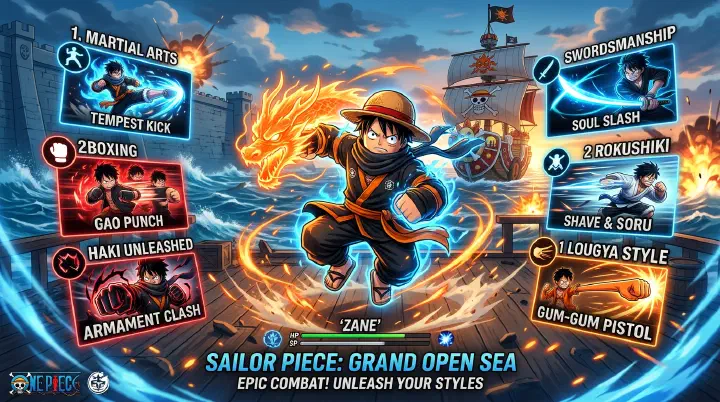
You are grinding the Bandit Boss for the fifth time, your health bar flickering red, when it happens again. A player wearing a basic Marine uniform — no fancy fruit aura, no glowing weapon — walks up, hits three buttons, and deletes the boss in eight seconds. You check their level. Lower than yours. You check their inventory. No legendary fruit. What they have is a fighting style you passed over at level 30 because it “looked basic.” That is the moment most Sailor Piece players realize the truth: fighting styles are not cosmetic sidegrades. They are the hidden backbone of every top-tier build.
What Players Get Wrong About Fighting Styles
The biggest trap in Sailor Piece is treating fighting styles like temporary placeholders until you find a good devil fruit. Veterans know this is backwards. A maxed-out fighting style often out-damages mid-tier fruits, costs zero stamina to maintain, and works in every zone — including the ones that drain or disable fruit abilities.
Here is what goes wrong:
- Spreading mastery too thin. Players unlock three styles by level 400 but none past 200 mastery. This means you miss the final moves — usually the burst attacks and combo extenders that define a style’s identity.
- Ignoring stat scaling. Some styles scale off Strength, others off Fighting Style Mastery, and a few hybridize with Defense. Dumping everything into fruit stats while your melee stat sits at base level cripples your damage.
- Picking for looks, not kit synergy. A style with flashy animations but no gap-closer is painful in PvP. A style with slow windups is frustrating in PvE. You need to match the kit to the content you actually play.
- Neglecting water combat. Sea Beast hunting, underwater caves, and certain PvP zones punish fruit users. A strong fighting style becomes your only damage source in those moments.
Every Fighting Style Ranked and How to Unlock It
Sailor Piece features a roster of fighting styles spread across starter towns, hidden islands, and late-game trainers. Below is the full breakdown of each style, where to find it, and what it brings to your build.
S-Tier: The Styles That Define the Meta
Dark Leg
- Unlock: Purchase from the trainer in Baratie after reaching level 150 and defeating the Head Chef.
- Strengths: Insane aerial mobility, multi-hit combo strings, high burst on the final kick.
- Upgrade path: Mastery 1 → 150 → 300 → 500. Each breakpoint adds a new aerial variant or combo extender. At 500, the Diablé Jambe finisher procs burn damage over time.
- Best for: PvP dueling, aerial boss fights, and players who like aggressive, in-your-face pressure.
Fishman Karate
- Unlock: Train with the Fishman NPC in the underwater grotto near Shark Park after level 200.
- Strengths: Massive AoE water bursts, bonus damage in rain or near water, strong crowd control.
- Upgrade path: Mastery 1 → 150 → 300 → 500. Unlock the Water Prison hold at 300 and the Ocean Current ultimate at 500.
- Best for: Farming grouped mobs, Sea Beast raids, and builds that spend time near coastlines.
A-Tier: Strong, Flexible, and Easy to Build Around
Electro
- Unlock: Dropped by the Thunder God boss in the Sky Islands or purchased from the Mink trainer after level 250.
- Strengths: Fast attacks, stun procs, excellent combo filler. The lightning effects can mask your animation startup.
- Upgrade path: Mastery 1 → 150 → 300. No 500-tier move, but the 300 unlock (Thunder Claw) is a solid gap-closer.
- Best for: Hybrid builds that mix melee and fruit abilities. The stun frames buy time for cooldown resets.
Rokushiki / Six Powers
- Unlock: Marine Fortress trainer after completing the CP9 questline at level 300.
- Strengths: Soru gives unmatched mobility, Tekkai provides a defensive option, and Rankyaku offers ranged pressure.
- Upgrade path: Mastery 1 → 150 → 300 → 450. You unlock individual techniques rather than linear upgrades, making it customizable.
- Best for: PvP outplay artists and players who want a toolkit rather than a raw damage rotation.
B-Tier: Niche but Powerful in the Right Hands
Black Leg (Base)
- Unlock: Starter trainer in the First Town, available from level 1.
- Strengths: Free, fast to level, and teaches you the core melee mechanics of the game.
- Upgrade path: Mastery 1 → 100 → 200. Caps out early, so treat it as a stepping stone to Dark Leg.
- Best for: New players learning animation canceling and combo timing.
1 Sword Style
- Unlock: Sword trainer in the Starter Town or the dojo on Swordsman Island at level 100.
- Strengths: Clean hitboxes, good range, and a parry option at higher mastery.
- Upgrade path: Mastery 1 → 150 → 300. The 300 unlock (36 Pound Phoenix) is a strong mid-range projectile.
- Best for: Players who want a melee-ranged hybrid without committing to a full fruit build.
2 Sword Style
- Unlock: Same trainer as 1 Sword Style, but requires 200 mastery in 1SS first.
- Strengths: Higher DPS, dual-hit combos, and a spinning guard-break at 300 mastery.
- Upgrade path: Mastery 1 → 150 → 300. The style rewards aggression but drains stamina fast.
- Best for: Burst-focused players who can manage stamina economy.
Dragon Claw
- Unlock: Rare drop from the Revolutionary Army boss or bought from the hidden trainer after clearing the Revolutionary Base at level 350.
- Strengths: Armor-breaking heavy attacks, dragon-scale defense buff at 300 mastery.
- Upgrade path: Mastery 1 → 200 → 400. Slower than other styles but hits like a truck.
- Best for: Tanky frontline builds that trade speed for raw damage.
C-Tier: Situational or Early-Game Only
Combat (Basic Fists)
- Unlock: Default from character creation.
- Strengths: Zero barrier to entry. Teaches you movement and dodge timing.
- Upgrade path: None. Replace this as soon as you reach the first town.
- Best for: The first 30 minutes of gameplay.
Finger Sukuna (Speculative / Event)
- Unlock: Limited event drop or raid reward. Availability varies by update.
- Strengths: Extremely high single-target damage, cursed energy mechanics.
- Upgrade path: Event-dependent. Usually caps at 300 mastery.
- Best for: Collectors and players who want a flashy, rare kit.
Combat Mechanics: How Fighting Styles Actually Work
Understanding the underlying systems makes the difference between mashing buttons and executing true combos.
Mastery scaling: Every fighting style has a hidden damage curve tied to your Fighting Style stat and the style’s mastery level. The curve is not linear. Levels 1-100 feel slow. Levels 200-300 feel like a massive power spike. Levels 400-500 turn basic attacks into deletion tools. This is why spreading points across multiple styles early on feels terrible — you never hit the breakpoints where the math shifts.
Animation canceling: Most styles allow you to cancel the recovery frames of a move by dashing, jumping, or swapping to a fruit ability. Learning the exact frame window for your main style is the single biggest DPS increase available. Practice on the training dummies in the lobby until the cancel feels automatic.
Hitstun and combo limits: Sailor Piece uses a diminishing returns system on hitstun. After a certain number of hits in a combo, the enemy gains temporary super armor and can escape. High-tier styles have tools to reset or bypass this limit — usually through grabs, stuns, or knockdowns. Know your style’s combo limit and design your rotation around it.
Stamina and blocking: Blocking reduces damage but drains stamina. Some styles (like Rokushiki) have stamina-positive defensive options. Others (like 2 Sword Style) are stamina-negative and require you to play around your opponent’s block. If you find yourself out of stamina constantly, either raise your Defense stat or switch to a lighter style.
Water zones and fruit disable: In any submerged or rain-soaked zone, Logia intangibility and many fruit active abilities stop working. Your fighting style does not. This makes melee investment mandatory for Sea Beast hunting and certain raid encounters.
Devil Fruit Pairings: What Works With What
The strongest builds in Sailor Piece combine a fighting style with a devil fruit that covers its weaknesses. Here are the proven pairings:
- Dark Leg + Flame or Magma Fruit: Dark Leg gives you the aerial mobility to land Flame’s ground-pound meteors and Magma’s AoE eruptions. The burn from both sources stacks, creating oppressive damage over time.
- Fishman Karate + Ice or Water Fruit: This is the aquatic terror build. You become unstoppable in water zones, and the freeze from Ice sets up your Water Prison perfectly.
- Electro + Rumble or Light Fruit: Both fruits are fast and hit-and-run. Electro’s stun locks the target long enough for your fruit’s high-damage windup to land. Light Fruit’s laser beams + Electro claw is a classic burst combo.
- Rokushiki + Dark or String Fruit: Soru gives you the positioning to land Dark’s black hole and String’s puppet control. Tekkai lets you survive the counterattack if you miss.
- Dragon Claw + Buddha or Diamond Fruit: Pure tank build. Buddha gives you the size and range to land Dragon Claw’s slow heavies, while Diamond provides the defense to trade hits without dying.
- 1 Sword Style + Quake Fruit: Quake’s stagger frames set up clean sword combos. The ranged projectile from 36 Pound Phoenix punishes opponents who try to heal or run.
The general rule: if your fruit is slow, pair it with a fast fighting style. If your fruit is fragile, pair it with a defensive style. If your fruit lacks mobility, pair it with Dark Leg or Rokushiki.
Building an Effective Melee Combat Strategy
Here is a step-by-step framework for constructing a melee build that works in both PvE and PvP.
Step 1: Commit to one style until 300 mastery. Do not swap because a new trainer looks cool. Get the core kit first.
Step 2: Match your stat spread to your style. Dark Leg and Electro want high Fighting Style and moderate Strength. Dragon Claw wants max Strength. Rokushiki wants a split between Fighting Style and Defense because you need stamina to Soru and Tekkai repeatedly.
Step 3: Learn one true combo. A true combo is a string that the opponent cannot escape from if the first hit lands. For Dark Leg, it is typically aerial light attacks into the Diablé finisher. For Fishman Karate, it is Water Prison into the ground slam. Practice until you can execute it without thinking.
Step 4: Add a defensive option. Every build needs an escape. That might be Soru, a dash-cancel, or a block-string into a pushback move. If your combo fails, you need a plan B.
Step 5: Test in PvP before claiming mastery. PvE bosses have predictable patterns. Real players do not. Take your build to the arena and see if your combo actually lands on a moving, blocking, dodging target. If it does not, adjust your opener or switch to a style with better neutral-game tools.
The Counter-Intuitive Truth: Sometimes You Should Not Use a Fighting Style
Here is the advice that sounds wrong but is absolutely correct: if you are a high-level Logia user with maxed fruit mastery and a strong ranged kit, sometimes unequipping your fighting style gives you better results.
Why? Because fighting styles lock you into melee range, and some fruits want to stay at maximum distance. A Flame or Light user who spends all their time in melee is wasting the safety advantage their fruit provides. In those cases, your fighting style should be a backup tool — equipped, but not the star of the show.
The best players in Sailor Piece are not the ones who max everything. They are the ones who know when to switch. Against Sea Beasts, they are melee gods. Against a Buddha fruit user in PvP, they are kite-and-poke artists. Your fighting style is a tool, not a religion. Learn it, master it, and then have the discipline to put it away when the situation demands something else.
Related Guides
- Sailor Piece Beginner Guide
- Sailor Piece Boss Strategies Guide
- Sailor Piece Bounty & Honor PvP Guide
- Sailor Piece Codes and Rewards Guide
- Sailor Piece Crew & Ship Guide
- Sailor Piece Devil Fruits Guide
- Sailor Piece Devil Fruits Tier List
- Sailor Piece Haki and Combat Guide
- Sailor Piece Haki Training Guide
- Sailor Piece Island Boss Farming Guide
- Sailor Piece Islands Progression Guide
- Sailor Piece Leveling & XP Guide
- Sailor Piece PvP Battle Guide
- Sailor Piece Quick Ship Upgrade
- Sailor Piece Race Awakening V2 Guide
- Sailor Piece Races & Hybrid Builds Guide
- Sailor Piece Sea Beasts & Boss Hunting Guide
- Sailor Piece Ship Progression Guide
- Sailor Piece Ships & Navigation Guide
- Sailor Piece Trading and Economy Guide