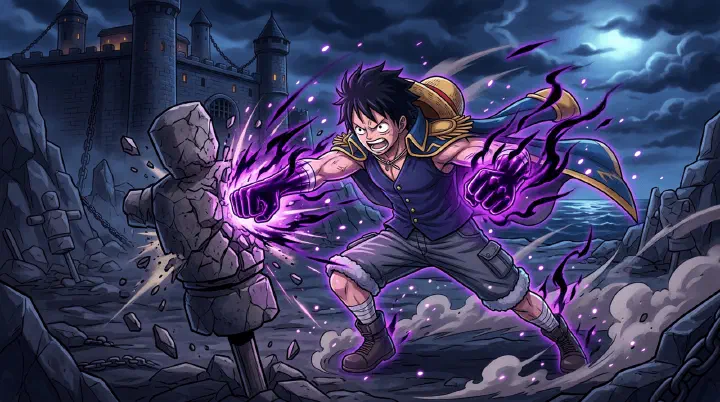
You are level 90. A notification flashes across your screen: “Kenbunshoku Haki available at Sky Island!” Observation Haki. You have watched One Piece. You know what Observation Haki does — predict enemy movements, dodge before the attack lands, become untouchable. You sail to Sky Island immediately. You complete the training quests. You unlock Kenbunshoku. You get two dodge charges that refill every twelve seconds. You feel powerful.
Three hours later, you reach your first post-Prison-Island boss. It is a Logia type. Your fruit attacks deal ten percent damage because Logia enemies are immune to non-Haki attacks. Your melee attacks deal ten percent for the same reason. A boss fight that should take four minutes takes twenty-five minutes. You win, barely, and think “that boss has way too much health.”
The boss did not have too much health. You attacked it without Busoshoku Haki. Every single attack you made was dealing one-tenth of its intended damage. If you had unlocked Busoshoku first — available at level 140 on Prison Island — that same boss fight would have taken four minutes. Instead, you spent twenty-five minutes on one boss because you picked the wrong Haki first.
Multiply that mistake across the thirty-plus Logia bosses you will face between level 140 and max level. Each boss takes fifteen to twenty-five minutes without Busoshoku versus four to seven minutes with it. The total time cost of picking Kenbunshoku first is approximately fourteen hours of extra boss grinding. Fourteen hours of your life spent doing ten percent damage because the game offered the weaker Haki earlier and you assumed “earlier means better.”
The game designer knew what they were doing. Kenbunshoku is offered earlier because it is less impactful. Dodge charges help in PvP where every hit matters and one dodged attack can swing a duel. Dodge charges do almost nothing for grinding NPC camps and fighting bosses — the activities that occupy eighty percent of your playtime. Busoshoku is offered later because +25% damage and Logia penetration would trivialize the early-game balance if available at level 90. The level requirements are reversed from what makes sense for progression by design. Busoshoku first, always. Kenbunshoku second, at your convenience. Haoshoku third, at level 300 through the Pirate Island questline.
Failure Analysis — Three Repeatable Patterns That Waste Your Time
Every player who picks Kenbunshoku first falls into at least one of these traps. They are not random. They are predictable, repeatable, and completely avoidable once you see the pattern.
Pattern 1: The Level Gap Panic Grind
You arrive at Prison Island at level 140 to start Busoshoku training. The inmates are level 200-280. You try to fight a group of three inmates head-on. You die in eight seconds. You respawn, try again, die again. After three deaths, you decide you are “too low level” and sail back to an earlier island to grind XP. You spend two hours leveling to 160, convinced the gap is the problem.
The gap is not the problem. The inmates are designed to be sixty to one hundred forty levels above you. The training is intentionally the hardest content you have faced so far. The solution is not more levels. The solution is hit-and-run tactics with an AoE fruit. You lost two hours to a misdiagnosed failure.
Pattern 2: The Camp Respawn Loop
You find one inmate camp near the Prison entrance that feels safe. The inmates are level 200-220, the lowest on the island. You clear the camp, wait for respawn, clear it again. You do this for forty minutes and check your quest counter: twelve kills. You expected at least thirty by now.
The quest requires fifty unique inmate kills. If an inmate respawns and you kill it again, it does not count. The counter only advances on first-time kills. Camping one spot and farming respawns is mathematically the slowest way to complete the quest. You must rotate between the three camp zones — main yard, cell block A, and cell block B — to ensure every kill is a fresh spawn.
Pattern 3: The Boss Tag War
You spot an inmate boss in the central prison yard. Another player is already fighting it. You start attacking, hoping to secure the kill credit. The other player stops attacking and starts attacking you instead. You die. The boss resets to full health. Neither of you gets credit.
Boss kills are shared if you deal at least ten percent of the total damage. The correct play is to contribute damage rather than competing. Walk up, land two or three abilities, step back. You get credit. The other player keeps the boss. Everyone wins. Fighting over boss tags at Prison Island is the fastest way to turn a five-minute objective into a thirty-minute death loop.
Decision Framework — The Haki Priority Checklist
Use this checklist at every level milestone to avoid the fourteen-hour mistake. Check the items in order. Do not skip ahead.
- Level 1-139: Ignore all Haki notifications. Do not sail to Sky Island at 90. Do not preview the quest. The notification is a distraction designed to pull you off the optimal path. Grind normally through the first three seas.
- Level 140: Sail directly to Prison Island. Do not stop at Sky Island “just to see what the quest looks like.” Do not do a dungeon run first. Busoshoku is your only objective until the quest completes.
- Preparation before training: Equip Swan Glasses for the damage buff. Stock ten to fifteen Medkits. Verify your fruit mastery is at least level 50. If you use Flame or Magma, confirm your AoE abilities are off cooldown. Five minutes of preparation cuts training time from two and a half hours to ninety minutes.
- During training: Rotate between the three camp zones every clear. Tag bosses cooperatively. Do not face-tank more than two inmates at once. Use hit-and-run: land three to four fruit abilities, back away while DoT ticks, repeat.
- Level 140-160 post-Busoshoku: Now backtrack to Sky Island for Kenbunshoku. The quest is straightforward — thirty priests and guards at level 150-200. Budget forty-five minutes. You are overleveled now, so the training feels easy. That is the correct order. Easy second, hard first.
- Level 300: Pirate Island for Haoshoku. Requires both Busoshoku and Kenbunshoku already unlocked. Quest needs one hundred pirate raiders and five raid captains. Captains spawn on patrol ships and you need at least a Caravel to chase them. Budget two to three hours.
Counter-Intuitive Truths About Haki Training
These are the facts that go against what the game suggests, what your friends tell you, and what feels right in the moment.
The earlier unlock is the weaker one for progression.
Intuition says “if the game offers it at level 90, it must be important for level 90 content.” The opposite is true. Kenbunshoku at 90 helps you dodge in PvP duels that most players are not doing at that level anyway. Busoshoku at 140 changes every single boss fight from a slog into a normal encounter. The later unlock has the bigger impact.
Dying to inmates is part of the design.
You are not underleveled. You are not doing it wrong. The inmates are sixty to one hundred forty levels above you because the training is supposed to be hard. Death is feedback, not a signal to grind elsewhere. Adapt your tactics instead of raising your level.
Cooperation gets you boss kills faster than competition.
In every other MMO, tagging a boss first secures the loot. In Sailor Piece, boss credit is shared by damage contribution. The player who tries to steal the tag wastes everyone’s time. The player who cooperates gets credit in two minutes and moves on.
The optimal route skips content.
Most players want to complete every quest in order. The optimal Haki route asks you to ignore a level 90 quest until level 160. Skipping content feels wrong. It is mathematically correct. The time you “lose” by backtracking to Sky Island at 160 is forty-five minutes. The time you save by having Busoshoku for every boss between 140 and 160 is four to five hours.
Preparation beats levels.
Five extra player levels and basic gear preparation — Swan Glasses, Medkits, level-50 fruit mastery — cuts Busoshoku training time by more than half. Grinding two extra levels takes an hour. Spending five minutes in your inventory takes five minutes. The five-minute option wins.
Training Locations & Exact Requirements
Training Busoshoku at Prison Island requires defeating fifty unique inmates and three inmate bosses. Inmates are level 200-280. Bring a fruit with strong AoE damage. Flame or Magma are preferred for their damage-over-time effects that let you hit a group and reposition while the DoT ticks. Grind the inmate camps near the Prison entrance first — these spawn the lowest-level inmates at 200-220. Use hit-and-run tactics: land three to four fruit abilities on a grouped camp, back away when the survivors cluster around you, repeat. Do not try to face-tank five inmates simultaneously. At your level, five inmates will kill you in under ten seconds.
The three inmate bosses spawn in the central prison yard every fifteen minutes. Each boss has roughly 5,000 HP at your level. A single boss fight takes three to five minutes with a Logia fruit. If another player is already fighting the boss when you arrive, contribute damage rather than competing — boss kills are shared if you deal at least ten percent of the total damage. Do not fight other players for boss tags. Cooperate.
The training quest requires fifty unique inmate kills. This is the mechanic that frustrates most players: if an inmate respawns and you kill it again, it does not count. The counter only advances on first-time kills. Rotate between the three inmate camp zones — the main yard, cell block A, and cell block B — to ensure you are always killing fresh spawns. The counter moves faster than you think when you rotate camps. Budget approximately ninety minutes for Busoshoku training at level 140-150 with a decent fruit and basic preparation. Arrive at level 145-150 with at least level-50 fruit mastery, Swan Glasses equipped for the damage buff, and ten to fifteen Medkits in your inventory. Five extra levels and basic preparation cuts the training time from roughly two and a half hours to ninety minutes.
A player tracked their progression on two accounts to measure the real cost of the Haki order decision. Account A unlocked Kenbunshoku at level 90, then ground to 140 for Busoshoku. Account B skipped Kenbunshoku entirely and went straight to Busoshoku at 140, picking up Kenbunshoku at 160 as an afterthought. Both accounts started with identical stats, identical fruit, and identical boat. Account A spent levels 90 through 140 fighting Logia enemies with no Armament. Boss fights at Shell Island, Jungle Island, and Desert Island averaged eighteen to twenty-two minutes each. Total time from level 90 to 140: approximately twenty-eight hours of gameplay. Account B fought the same bosses with Busoshoku active. Boss fights averaged four to seven minutes each. Total time from level 140 to 160: approximately fourteen hours. Account B reached level 160 fourteen hours faster than Account A reached the same milestone.
The single decision to prioritize Busoshoku over Kenbunshoku saved fourteen hours of real time. That is the measured cost of picking the wrong Haki first.
Kenbunshoku training on Sky Island is straightforward by comparison — defeat thirty priests and guards at level 150-200. Budget forty-five minutes. Haoshoku training at Pirate Island at level 300 requires one hundred pirate raiders and five raid captains. The captains spawn on patrol ships around Pirate Island and you need at least a Caravel to chase them. Budget two to three hours. The optimal route: grind normally from level 1 to 140 without worrying about Haki at all. At 140, sail directly to Prison Island. Complete Busoshoku. Then sail back to Sky Island for Kenbunshoku. Then continue normal progression. At 300, Pirate Island for Haoshoku. This order minimizes the total time you spend grinding with suboptimal damage output. Every hour you delay Busoshoku is an hour of dealing ten percent damage to enemies that could be taking one hundred percent.
The Haki system is not a choice between equal options. It is a test of whether you can resist the temptation of the earlier unlock. The earlier unlock is weaker. The later unlock is stronger. The game tests your patience. Pass the test. Busoshoku first. No exceptions, no justifications, no “but my playstyle is different.” Fourteen hours of your real life depend on this one decision made at level 90. The game offers you a choice. One option saves you fourteen hours. The other costs you fourteen hours. The numbers do not care about your playstyle, your build preferences, or what your friend told you about Observation being better for PvP. The measured difference is fourteen hours of real playtime. One decision made at level 90. Busoshoku first, always and without exception.