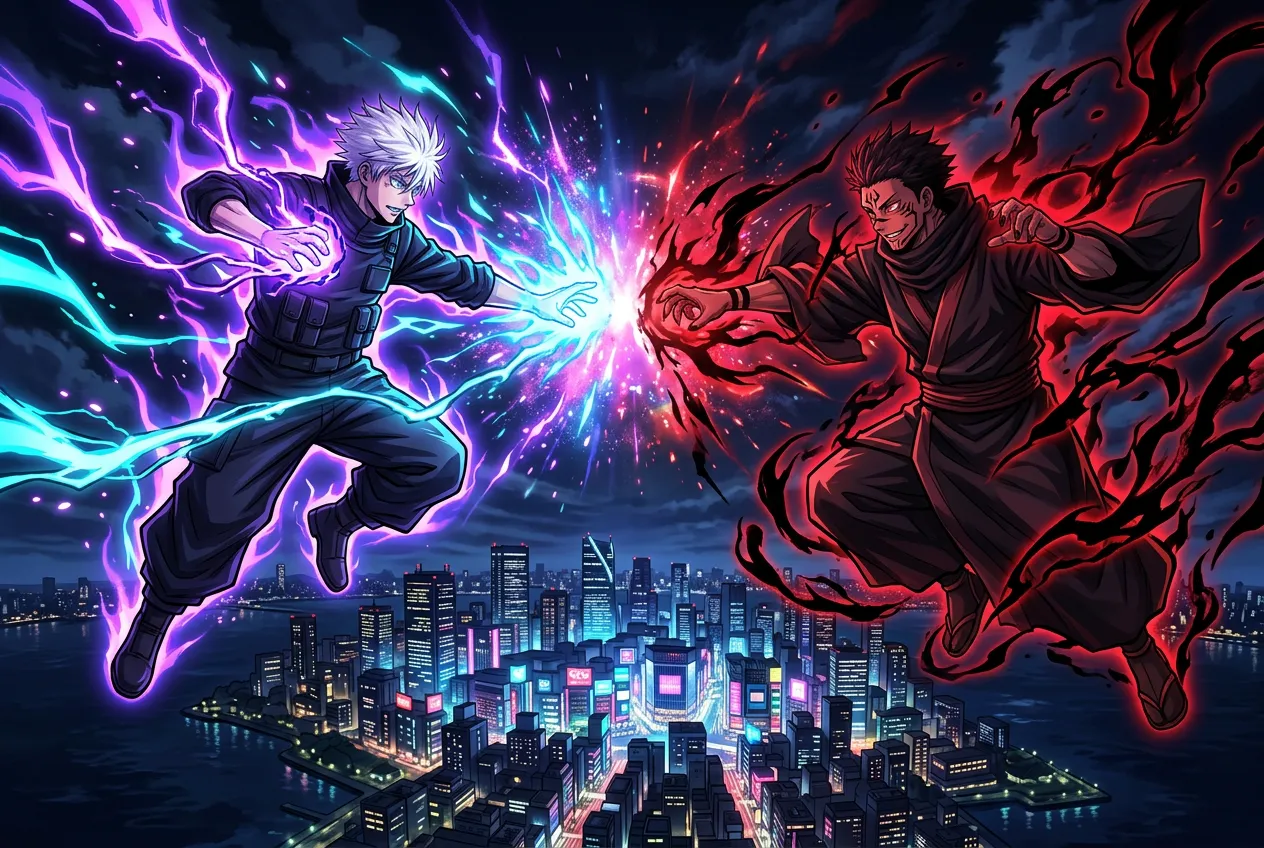
You log into Sailor Piece after the Update 3 patch finishes. The sky over the main archipelago looks wrong. Near the northeast horizon, there’s a streak of purple-black sky that doesn’t match any weather effect you’ve seen before. You sail toward it. The closer you get, the more the screen distorts — like heat haze, but darker. This is the Cursed Energy barrier. You pass through it. Shinjuku Island loads in.
That’s the JJK Expansion entrance. No menu prompt. No quest marker that holds your hand. You find it by looking at the sky and sailing toward the thing that doesn’t belong. It’s the most atmospheric piece of world design Sailor Piece has done, and it sets the tone for everything that follows.
This guide covers what Update 3 actually adds, how to navigate Shinjuku Island’s scalable bosses, which of the two new specs you should invest in, and why the Ascend System matters more than either of them.
What the JJK Expansion Actually Adds
Update 3 is not a reskin. It introduces five things that change how you approach endgame in Sailor Piece:
Shinjuku Island. A new endgame zone gated behind a Cursed Energy barrier northeast of the main archipelago. It hosts bosses with scalable difficulty — you pick the tier before each fight, and the rewards scale with the risk.
Two new fighting styles (specs). “Strongest Of Today” draws from Gojo’s kit — space manipulation, technique negation, domain expansion. “Strongest In History” draws from Sukuna’s kit — slashing attacks, high-output burst damage, multi-target cleave. Both are acquired through JJK-specific quests on Shinjuku Island, not through the standard Fighting Styles menu.
The Ascend System. A permanent progression layer that sits on top of your level. Each Ascend tier costs JJK-specific materials (earned from Shinjuku bosses and quests) and grants incremental, permanent stat increases — damage, durability, and Cursed Energy efficiency. Think of it as a secondary leveling track that doesn’t reset.
Aura Crates. New loot boxes that drop from Shinjuku bosses and Cursed Energy events. They contain Ascend materials, spec upgrade items, and cosmetic auras that visibly change your character’s Cursed Energy color. The drop pool is shared — opening a crate for cosmetics means you’re not getting progression mats from it.
Level cap increase. The maximum level has been raised. Community reports point to a new cap around 2,550 or slightly higher. You’ll want to be at or near the previous cap before attempting Shinjuku’s baseline difficulty.
If you’ve been following the Hellsing Update, you’ll notice the JJK Expansion follows a similar structure — new island, new combat spec, new progression mechanic — but the execution is different. Hellsing gave you Crimson Island and Blood-Blood Fruit. JJK gives you Shinjuku and a stat system that benefits every build you own, not just the new specs.
Shinjuku Island: The Scalable Endgame
You arrive at Shinjuku’s docks. The island layout is compact — urban rubble, collapsed high-rises, a central plaza that serves as the boss arena. NPCs with JJK-themed dialogue are scattered around, most of them handing out daily quests that reward Ascend materials.
The Scalable Difficulty System
The standout feature on Shinjuku is how bosses work. Before each fight, you speak to an NPC who lets you pick a difficulty tier:
- Tier 1 (Cursed Womb). Baseline. You can clear this at the old level cap with a decent spec. Rewards are minimal but consistent — one or two Ascend mats per clear.
- Tier 2 (Semi-Grade 1). Noticeable step up. Bosses gain an extra phase and their attack patterns speed up. You’ll want a maxed-out fighting style and at least basic Haki. Rewards improve significantly.
- Tier 3 (Special Grade). This is where Shinjuku gets serious. Bosses have domain-like area effects, damage thresholds that punish low DPS, and mechanics that one-shot you if you’re standing in the wrong place. Rewards include rare Ascend materials and Aura Crates.
Here’s the thing about scalable difficulty that isn’t obvious at first: the jump from Tier 2 to Tier 3 is much larger than from Tier 1 to Tier 2. Community reports suggest Tier 3 bosses have roughly triple the effective HP of Tier 2 — not because their health bar triples, but because they gain damage reduction mechanics and healing phases that extend the fight. If you’re barely clearing Tier 2, you are not ready for Tier 3. You’ll burn through your consumables in phase one and wipe when the domain effect comes out.
Shinjuku Boss Rotation
Shinjuku has a rotating boss schedule. The exact rotation order is not yet fully documented, but the community has confirmed at least three JJK-themed bosses:
- A cursed-spirit boss that uses terrain denial — pools of cursed energy on the ground that deal damage over time. Stay mobile. Ground-based fighting styles struggle here.
- A sorcerer-type boss that parries frontal attacks. You need to hit it from behind or during its post-combo recovery window. Observation Haki helps a lot for timing.
- A domain-casting boss that traps you in an enclosed arena. You can’t leave until one of you dies. Bring healing items.
The rotation means you can’t farm the same boss indefinitely. You adapt to what’s available, or you wait. This is a deliberate design choice — it pushes you to diversify your approach rather than finding one optimal strategy and repeating it.
Common Shinjuku Mistakes
Mistake 1: Overestimating your Tier readiness. Players walk into Tier 3 because they cleared Tier 2 comfortably, not realizing the difficulty curve isn’t linear. You need roughly double the effective DPS to clear Tier 3 compared to Tier 2. If the Tier 2 fight took you four minutes, Tier 3 will likely take seven or eight — and you have to survive that entire duration.
Recovery: drop back to Tier 2 and farm Ascend tiers first. Two Ascend tiers can make the Tier 2-to-Tier 3 gap manageable.
Mistake 2: Ignoring the Cursed Energy barrier visual cue. New players sail straight past Shinjuku because they don’t recognize the distorted sky. There is no UI marker. Look northeast for the purple-black haze. If you hit the world border, you’ve gone too far.
Mistake 3: Burning Aura Crates immediately. Crates drop infrequently, especially at Tier 1. Opening them as soon as you get one gets you cosmetics you might not want and progression mats you won’t fully benefit from yet. Save crates until you’ve chosen your spec and know which upgrade path you’re committing to. More on this in the Aura Crates section below.
Strongest Of Today vs Strongest In History: Which Spec Wins?
This is the decision everyone asks about. Both specs are acquired through quest chains on Shinjuku Island — you talk to the JJK NPCs near the central plaza and complete their tasks. The quest chains are mutually exclusive at first: you pick one spec to unlock, and the other requires a separate material grind to unlock afterward.
Here’s how they differ in practice.
Strongest Of Today (Gojo-Inspired)
This spec leans into area control and damage mitigation. Its identity revolves around technique negation — reducing incoming damage, canceling certain boss mechanics, and creating safe zones on the battlefield.
The core gameplay loop: you activate your technique field, enemies inside it deal reduced damage to you, and your counterattacks gain a damage bonus. When you fill your Cursed Energy gauge, you can deploy a domain expansion that paralyzes everything in a large radius for several seconds — free damage window for you and your crew.
Where it shines:
- Solo boss fights. The damage reduction lets you survive longer without healing items.
- Endgame PvE content where survival is the bottleneck, not DPS.
- Content where bosses have one-shot mechanics that need to be negated.
Where it struggles:
- Group PvP. The technique field is stationary — enemies just walk out of it.
- Mob farming. Strongest Of Today kills one target at a time. Farming large groups is slow.
Strongest In History (Sukuna-Inspired)
This spec is about raw, multi-target damage output. Its identity is slashing attacks that cleave multiple enemies, high burst damage, and an ultimate that covers a wide area.
The gameplay loop: you build Cursed Energy through basic attacks, spend it on slashing combos that hit everything in front of you, and at full gauge you deploy a massive AoE that hits everything on screen. The damage numbers are big. The clear speed for mob-heavy content is unmatched.
Where it shines:
- Mob farming and grinding. You clear groups faster than any other spec in the game.
- Group PvP and Bounty hunting. Multi-target cleave punishes clustered enemies.
- Content where DPS is the primary check — you kill things before they can threaten you.
Where it struggles:
- Solo boss fights against targets with high HP and no adds. The AoE advantage is wasted.
- Surviving extended fights. No built-in damage reduction means you rely entirely on dodging and healing items.
Decision Framework: Which One Do You Pick?
Ask yourself these three questions, in order:
- Do you mostly play solo or with a crew? Solo players benefit more from Today’s survivability. Crew players benefit more from History’s AoE damage in group content.
- What’s your bottleneck right now? If you’re dying before bosses die, pick Today. If bosses take too long and you run out of time or patience, pick History.
- What does your existing spec collection look like? If you already have a high-damage fighting style from the Fighting Styles system like Crimson Art, History overlaps with it in role. Today fills a different niche — the tanky counter-attacker — that the current spec roster doesn’t cover well.
| Factor | Strongest Of Today | Strongest In History |
|---|---|---|
| Playstyle | Tank / counter-attacker | Burst damage / AoE cleave |
| Best for | Solo bossing, survival content | Mob farming, group PvP |
| Survivability | High (technique negation) | Low (dodge-dependent) |
| Clear speed (mobs) | Slow | Fastest in game |
| Boss kill speed | Moderate, but consistent | High burst, falls off in long fights |
| Skill ceiling | Medium — timing-based | High — positioning and resource management |
If you’re still undecided: pick Strongest Of Today. It’s the safer choice for progression content. You can unlock History later with the secondary quest chain, and the Ascend System benefits both specs equally — so you’re not losing long-term progress by starting with the wrong one.
Counterintuitive advice: don’t pick a spec based on which anime character you like more. The specs are balanced differently than the source material. Strongest In History (Sukuna) looks like the obvious “strongest” pick by name, but in actual gameplay, Strongest Of Today (Gojo) has a higher solo success rate across Shinjuku’s Tier 3 bosses. The name is flavor. The kit is what matters.
The Ascend System: The Real Long-Term Power
There’s a joke going around the Sailor Piece community: “The JJK Expansion added two specs and everyone’s arguing about which one is broken, but the real meta change is the button in the corner of the UI nobody clicked yet.”
That button is the Ascend System.
What Ascend Actually Does
Ascend is a permanent stat track. It doesn’t reset. It doesn’t decay. Each Ascend tier costs a combination of Cursed Energy fragments (from Shinjuku bosses), Ascend Essence (from Shinjuku daily quests), and a rare drop called a Cursed Core (Tier 3 Shinjuku bosses only, low drop rate).
Each tier gives you:
- A small but permanent increase to all damage output (reports suggest roughly 3-5% per tier, though exact numbers aren’t confirmed)
- Damage reduction against Cursed Energy attacks from Shinjuku enemies
- Improved Cursed Energy regeneration rate, which translates directly to more frequent domain/special ability usage
The stat gains are incremental. One Ascend tier won’t feel transformative. But three Ascend tiers compound into a noticeable power gap between you and someone at the same level who hasn’t touched the system.
Ascend Resource Priority
You have limited playtime. Here’s how to spend it:
- Daily Shinjuku quests first. They’re the most consistent source of Ascend Essence and take 10-15 minutes. Do them every day you play.
- Tier 2 boss farming for Cursed Energy fragments. Tier 2 is the sweet spot for efficiency — faster clears than Tier 3, better drops than Tier 1. You get roughly two to three fragments per clear.
- Tier 3 bosses only when you’re fishing for Cursed Cores. Cores are the Ascend bottleneck. They only drop at Tier 3, and the drop rate isn’t generous. Don’t farm Tier 3 for fragments — it’s inefficient. Go in for Cores, leave when you’ve got one.
- Aura Crates last. Crates can drop Cursed Cores, but the chance is low and the crate itself could have been Ascend Essence instead (crates and essence share the same drop table slot on some bosses). Prioritize direct material drops over crate gambling.
The Ascend Snowball Effect
Here’s the counterintuitive part of the JJK Expansion that matters most:
Ascend benefits every spec you own, not just the new ones. Your old fighting style, your devil fruit build — they all get the damage boost and durability increase. The Ascend System effectively buffs your entire account. If you’ve invested heavily in a non-JJK build (Crimson Art from Hellsing, a rare devil fruit, a maxed-out weapon spec), Ascend makes that investment even stronger instead of invalidating it.
This is the opposite of how most Roblox updates work. Usually, the new thing makes the old thing obsolete. With Ascend, the old thing gets better. The players who will dominate PvP a month from now aren’t the ones who rushed to unlock Strongest In History on day one — they’re the ones who farmed Ascend tiers while everyone else was arguing about specs.
Practical example: a player with Ascend tier 3 and a maxed Fighting Style from before the update will outperform a player with Ascend tier 0 and Strongest In History in most solo content. The spec is a tool. Ascend is the stat stick that makes every tool hit harder.
Aura Crates: When to Open and When to Hold
Aura Crates drop from Shinjuku bosses and the periodic Cursed Energy events that spawn across the island. They contain:
- Cosmetic auras (change your Cursed Energy visual)
- Ascend materials (including Cursed Cores at a low rate)
- Spec upgrade items (used to enhance your JJK spec abilities)
- A small chance at unique titles
The crate is a gamble. When you open it, you get one item from the pool. You can’t pick.
The Case for Saving Crates
Early after the update, the community was opening crates immediately. That was a mistake. Here’s why you should hold:
- You don’t know which spec you’re committing to yet. Spec upgrade items are spec-specific. If you pull a Strongest In History upgrade but end up maining Strongest Of Today, that item is wasted until you unlock the second spec — which takes a second material grind.
- Cosmetic auras are the most common pull. If you open a crate day one, you’re most likely getting a purple glow around your character and zero progression value. The aura looks cool. It doesn’t help you clear Tier 3.
- Cursed Core drop rate from crates appears better at higher Ascend tiers. Community reports suggest — though this isn’t confirmed — that your Ascend tier affects crate loot quality. If true, opening crates at Ascend 0 is leaving value on the table.
Open crates after you’ve:
- Chosen and unlocked your main JJK spec
- Reached at least Ascend tier 1
- Have a clear upgrade path in mind
If you really want the cosmetic aura, open one. Then save the rest.
Post-Update Leveling: What Changed
The level cap increase means you have levels to grind again. Here’s how the landscape shifted:
Shinjuku Island mobs give competitive XP. The cursed-spirit enemies roaming Shinjuku’s streets drop XP comparable to the previous best farming spots, plus they have a chance to drop Cursed Energy fragments. If you’re grinding levels post-update, doing it on Shinjuku gives you Ascend progress at the same time — two birds, one stone.
The old XP meta still works. If you had a preferred grinding route from before the update (check the Leveling & XP guide for routes), it’s still viable. The JJK Expansion didn’t nerf existing XP sources. You have options.
Ascend doesn’t give XP. Ascend tiers increase your stats but not your level. You progress both tracks in parallel — levels unlock content (like Shinjuku Tier 2 at higher levels), and Ascend makes you stronger within that content. Don’t neglect one for the other.
Island progression check. If you haven’t completed the core island chain yet, Shinjuku is going to be inaccessible. The Islands progression guide covers the full path. You need to be at endgame before the JJK content opens up — there’s no shortcut for new players.
The Bigger Picture: What the JJK Expansion Means for Your Account
Update 3 didn’t add a single piece of content you finish and move on from. It added systems. The Ascend track is permanent. The scalable bosses are repeatable. The new specs give you build options you didn’t have before. This is an expansion designed to keep you playing over weeks and months, not hours.
The players who get the most out of it won’t be the ones who speedrun the quest chains and move on. They’ll be the ones who:
- Hit their Shinjuku dailies consistently
- Farm Tier 2 efficiently instead of banging their heads against Tier 3 undergeared
- Ascend before chasing cosmetics
- Pick a spec that complements what they already have, not what looks coolest
The JJK flavor is fun. The Cursed Energy visuals are some of the best work the Sailor Piece team has done. But the lasting value is in the systems underneath the theme — and those systems reward patience, not hype.
FAQ
How do I unlock Shinjuku Island in the JJK Expansion?
Reach the new level cap (community reports suggest 2,550+), then sail northeast from the main archipelago until you see a purple-black distortion in the sky. That’s the Cursed Energy barrier. Sail through it to reach Shinjuku. If the island doesn’t load, check that you’ve completed the introductory JJK questline — look for a new NPC near the Marine HQ docks with dialogue about “strange energy readings.”
Strongest Of Today vs Strongest In History — which spec should I pick?
Strongest Of Today (Gojo-inspired) is the better solo choice — damage reduction, technique negation, and a stun domain that creates free damage windows. Strongest In History (Sukuna-inspired) is the better group choice — multi-target cleave, high burst damage, and the fastest mob-clearing speed in the game. If you mostly play alone, Today. If you run with a crew or live in PvP, History. Both specs benefit equally from the Ascend System, so you can unlock the second one later without losing progress.
What does the Ascend System actually do, and is it worth grinding?
Ascend is a permanent stat track that exists alongside your level. Each tier gives incremental boosts to damage, damage reduction against Cursed Energy, and Cursed Energy regeneration. The gains are small individually but compound — three Ascend tiers create a visible power gap. Most importantly, Ascend buffs every spec and build you own, not just JJK content. Prioritize Ascend over Aura Crates and over rushing both new specs. It’s the single highest-value grind in the JJK Expansion.
Related Guides
- Sailor Piece Fighting Styles & Combat Guide — All fighting styles compared, including how the new JJK specs fit into the roster
- Sailor Piece Hellsing Update Guide — The previous major update: Crimson Island, Blood-Blood Fruit, and Crimson Art
- Sailor Piece Islands Progression Guide — Full island unlock order and level requirements through endgame
- Sailor Piece Leveling & XP Guide — Optimal grinding routes and XP strategies post-level-cap increase