You installed SNIPE three months ago. You’ve put in 180 hours. Your flick shots are clean, your sensitivity is dialed in, and you can name every map. You’re also hardstuck Gold 2. Meanwhile, the player who started two weeks after you just hit Platinum. They’re not more talented. They didn’t buy a better mouse. They simply practiced things in an order that made sense — and you didn’t, because no one told you what that order was.
The SNIPE community is full of advice. “Just aim better.” “Learn Silent Peek.” “Wall run more.” None of it is wrong, but all of it is contextless. A Silver player grinding Silent Peek is like a guitarist learning sweep arpeggios before they can strum a chord. The technique is real. The timing is just catastrophically wrong. And the result is a player who can occasionally pull off something flashy in a private server, then dies in ranked because they never learned when to stop moving or how to track an enemy’s ability cooldown.
This roadmap isn’t a list of tips. It’s a sequence. Each stage builds on the last. Skip a step and you’ll look good in Deathmatch and lose in ranked. Follow it and you’ll climb with fewer hours than players who’ve been stuck for seasons.
Why Most Players Plateau (And Never Realize It)
Before the roadmap, you need to understand why most players never climb past their current rank. It isn’t lack of talent. It’s misallocated practice time.
The Aim Trainer Trap. New players see “aim is everything” in comment sections and spend 40% of their playtime in aim trainers or Deathmatch. Aim matters in SNIPE, but it has severe diminishing returns. A player with average aim and perfect positioning beats a player with great aim and bad positioning nine times out of ten. Once you can hit a strafing target consistently, more aim training barely moves the needle.
Learning Techniques Out of Order. YouTube montages make Silent Peek look like the skill that separates good players from great ones. It is — but only after you have automatic crosshair placement, consistent b-hopping, and the discipline to reposition after every shot. A Silver player who learns Silent Peek first develops bad habits: they rush the timing, expose themselves, and blame the technique instead of their foundation.
Tilt Queuing and No Review. The average hardstuck player queues ranked, loses three in a row, and keeps going. They never review a death. They never ask “what actually killed me?” They just assume their aim was off and queue again. After 200 hours of this, they’re exactly where they started — but now they’re angry about it.
The SNIPE Ranked Roadmap: Stage by Stage
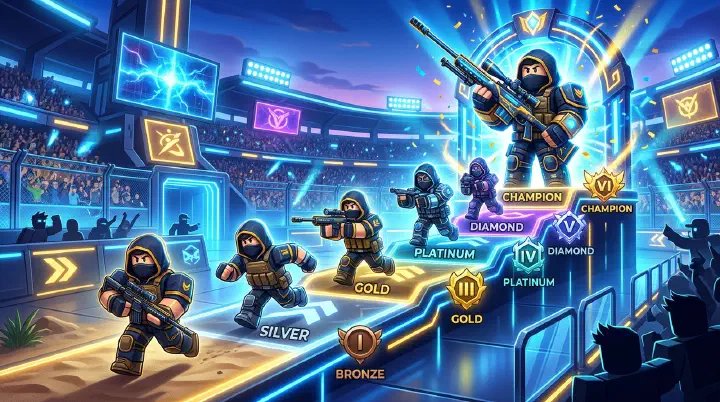
This roadmap covers six stages, from absolute beginner to competitive ranked (Diamond+). Each stage has a specific skill milestone, a daily practice routine, a recommended loadout, and the exact habit that breaks you into the next rank.
Stage 1: Bronze → Silver (0-10 Hours)
Skill Milestone: You can hit stationary and slow-moving targets while strafing, and you never stand still in a gunfight.
Most Bronze players treat SNIPE like a point-and-click adventure. They stop moving to shoot. They look at the ground. They reload in the open after every kill. Silver players don’t have better reflexes — they just don’t make these unforced errors.
What to Practice:
- Crosshair placement: Keep it at head height at all times. Pre-aim corners before you peek them.
- Strafing: Shoot between direction changes, never while stationary.
- Map awareness: Learn the names of all seven maps and know where the power positions are.
Daily Routine (30 minutes):
- 10 minutes: Private server, strafe in a circle while shooting wall markers. Don’t stop moving.
- 15 minutes: Casual matches. Focus only on crosshair height and strafing. Ignore your score.
- 5 minutes: Walk each map in a private server. Memorize where the high ground is.
Loadout: Heavy Sniper + Deagle + Grapple Hook. This setup is forgiving and teaches you to hold angles and escape bad fights.
The Breakthrough Habit: After every death, ask one question: “Was I standing still?” If the answer is yes, that’s why you died. Fix that before worrying about anything else.
Stage 2: Silver → Gold (10-40 Hours)
Skill Milestone: You can wall run and b-hop consistently, and you reposition after every kill.
Silver is the movement checkpoint. Players here have basic aim but still ADS in the open, don’t use cover between shots, and hold the same angle for 30 seconds. Gold players move constantly and never let the enemy know where they’ll peek from next.
What to Practice:
- Wall run chains: Approach a wall at a 20-30° angle, jump + strafe into it, and maintain the run.
- B-hop momentum: Chain 3+ crouch-jumps without losing speed.
- Post-kill rotation: After every elimination, move to a new position before engaging again.
Daily Routine (45 minutes):
- 15 minutes: Empty map, wall run + b-hop chains only. No shooting.
- 15 minutes: Kill Race lobbies. Apply movement under pressure. Track whether you’re repositioning after kills.
- 15 minutes: Ranked. Play for placement, not kills. Surviving to top 5 is more important than your K/D.
Loadout: Semi-Auto Sniper + Tactical SMG + Wall Run or Grapple Hook. Start learning map-dependent ability choice.
The Breakthrough Habit: Set a timer for 15 seconds after every kill. If you’re still in the same spot when it goes off, you’re doing it wrong. Repositioning is more important than the kill itself.
Stage 3: Gold → Platinum (40-80 Hours)
Skill Milestone: You can Dash Cancel at 70%+ consistency and start attempting Silent Peek in live matches.
Gold is the most populated rank for a reason: it’s where good aim hits a wall made of technique and decision-making. Gold players know the basics but can’t execute advanced tech under pressure. They also die to the same positioning mistakes repeatedly.
What to Practice:
- Dash Cancel: Dash → scope mid-dash → fire → unscope before landing. Drill until it’s automatic.
- Silent Peek: Scope the instant before strafing out, fire within 1-2 frames of clearing cover, strafe back.
- Cooldown tracking: Mentally note when enemies use Dash or Grapple Hook. Punish them during the downtime.
Daily Routine (60 minutes):
- 15 minutes: Private server, Dash Cancel drills against a wall. Add strafe direction changes.
- 15 minutes: 1v1 duels against Platinum players. Focus on one technique per session. Lose the duel but land the tech.
- 15 minutes: Ranked. Pre-aim common angles. Stop repeeking the same corner.
- 15 minutes: Review one death. Was it mechanical or decision-based? Log it.
Loadout: Semi-Auto Sniper + Deagle + Wall Run. Gold lobbies start punishing predictable Grapple Hook arcs.
The Breakthrough Habit: Before every peek, ask: “Did I already peek this angle?” If yes, rotate to a different one. The second peek is the one that kills you.
Stage 4: Platinum → Diamond (80-120 Hours)
Skill Milestone: Silent Peek is 80%+ consistent, and you predict enemy positions before you see them.
Platinum players have the mechanics. What separates them from Diamond is game sense — the ability to know where enemies are based on audio, kill feed, and spawn logic. Platinum players also choke in endgames because they choose the flashy play over the smart one.
What to Practice:
- Silent Peek consistency: Frame-perfect timing under pressure. If you can’t do it in ranked, you don’t know it yet.
- Predictive positioning: Use audio cues and kill feed to pre-aim where enemies will be, not where they are.
- Endgame discipline: In the final 5, take the guaranteed placement over the risky kill.
Daily Routine (75 minutes):
- 15 minutes: Silent Peek reps with a partner. Add pressure by having them shoot back.
- 20 minutes: Ranked. Record the session.
- 20 minutes: Review your recording. Categorize every death as mechanical or decision. Decision errors should approach zero.
- 20 minutes: 1v1 duels or Kill Race. Apply predictive pre-aims.
Loadout: Comfort pick between Semi-Auto and Heavy Sniper + Deagle + Wall Run. Diamond lobbies demand consistency over experimentation.
The Breakthrough Habit: Before every engagement, predict where the enemy is and what ability they have available. If your prediction is wrong, figure out why. This is how game sense becomes automatic.
Stage 5: Diamond → Champion/Nemesis (120+ Hours)
Skill Milestone: You adapt your playstyle mid-match based on the specific players in your lobby.
At this level, everyone has perfect mechanics. The differentiator is adaptation. Champion players notice when an opponent always peeks left, always uses Grapple Hook aggressively, or always rotates the same route. They exploit these patterns before the opponent realizes they have them.
What to Practice:
- Lobby analysis: In the first two rounds, identify each opponent’s playstyle and adapt.
- Spawn manipulation: Control which areas of the map are “safe” to influence where enemies spawn.
- Mental endurance: Maintain focus across 10+ round matches without autopiloting.
Daily Routine (90+ minutes):
- 20 minutes: Warm-up with targeted drills based on your previous session’s weaknesses.
- 40 minutes: Ranked. Play one rank at a time. No autopilot.
- 30 minutes: Review one full match. Note opponent patterns and your adaptation (or lack thereof).
Loadout: Fully adaptive. Swap based on lobby composition and map. Two primary weapons and three abilities should be comfortable.
The One-Hour Dilemma: DM or Ranked?
You have exactly 60 minutes to play. You want to improve. Do you grind Deathmatch for aim, or queue ranked for real experience?
The answer depends on what you did yesterday. If you played ranked and lost three in a row, your game sense isn’t the problem — your mechanics are probably degraded by tilt. Do 15 minutes of focused DM practicing one technique, then queue ranked for the remaining 45. If you haven’t played in two days, skip DM entirely. Your aim won’t decay in 48 hours, but your decision-making will. Queue ranked immediately and warm up in the first two rounds.
If you’re on a win streak, never interrupt it to DM. Momentum is a real factor in ranked performance. If you’re on a loss streak, stop queuing ranked after the second loss. Use the remaining time for DM or review a previous match.
The wrong choice is always “I’ll do a little of both.” Splitting your focus means you get half the value of either option. Pick one, commit to it, and have a specific goal before you load in.
Counter-Intuitive Truths That Break Rank Plateaus
These five ideas go against what most SNIPE guides teach. That’s exactly why they work.
Aim training stops working after Silver. Once you can consistently hit a strafing target, spending more time in aim trainers is a poor return on investment. The players stuck in Gold with 100+ hours of aim training are proof. Your bottleneck is positioning, ability timing, or decision-making — none of which are fixed by clicking heads on a static target.
Dying with full ability cooldown means you played too safe. New players save their Grapple Hook or Wall Run for “the perfect moment” that never comes. Abilities are for creating opportunities, not reacting to emergencies. If you finish a match with unused abilities, you left kills on the table. Use them aggressively, fail, and learn the limit. Safe players don’t climb.
The best practice isn’t ranked — it’s 1v1 duels where you only use your worst technique. Most players practice what they’re already good at because it feels good. The player who only Dash Cancels in DM gets great at Dash Cancel — but if their Silent Peek is what’s actually losing them duels, they’re wasting time. Force yourself to use your weakest technique in 1v1s. You’ll lose. You’ll be frustrated. You’ll also fix the actual problem.
Sometimes you should stop moving. Every guide tells you to never stand still. But at long range against a skilled player, your rhythmic strafe becomes predictable. They’ll track it. The counter-play? Stop. Crouch. Take the shot. Their muscle memory is tuned to motion, not stillness. They’ll overswing. You’ll land the hit. Then you move. Advanced play isn’t always about doing more — it’s about knowing when to do nothing.
Watching your own deaths is more valuable than watching pro gameplay. Pro players have different reaction times, different hardware, and different lobby compositions. Your own death replay shows exactly what went wrong in your specific rank, with your specific habits. One 10-minute review of your own gameplay teaches you more than an hour of Twitch streams.
Related Guides
- SNIPE Beginner Guide — Controls, Game Modes & First Win
- SNIPE Advanced Techniques & Ranked Guide
- SNIPE Ranked Climbing Guide — RP System & Tier Strategy
- SNIPE Movement Mechanics — Wall Run, B-Hop & Momentum
- SNIPE Beginner Mistakes — 10 Errors That Get You Killed
- SNIPE Positioning & Angles — Win Every Duel
- SNIPE Settings & FPS Optimization