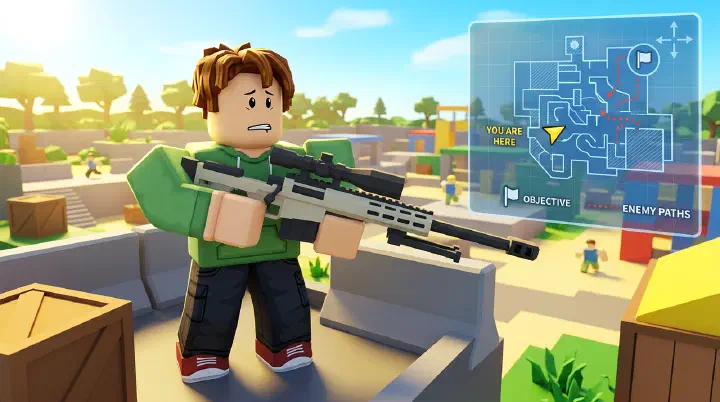
Scene Opening: Your First 30 Seconds in Snipe
The match loads. You’re on Rooftops — a sprawling vertical maze of scaffolding, crane platforms, and sky-bridge sightlines. Your finger hovers over W. You sprint forward because that’s what you do in every other shooter. A lens flare catches your eye from somewhere above. You stop moving to look up, scope in, and scan the rooftops.
Nothing. You lower your scope.
Gray screen. Killcam.
An enemy on the crane platform you just looked at — except he was already scoped and aimed at your position. He saw your scope glint from 50 studs away, held his breath, and waited for you to scope out. Your moment of immobility lasted maybe half a second. That’s all he needed. You never fired a shot.
You respawn. Now you’re frustrated. You sprint faster, harder, toward the enemy spawn zone. You slide around a corner and there he is — point blank. You try to scope, but the zoom is too close, the barrel clips through his chest, and he knifes you twice before your scope finishes its animation. Dead again. 0-6. Match time: 47 seconds.
This is the authentic Snipe first-match experience. It feels unfair because it is unfair — not because the game is broken, but because you’re playing against people who understand systems that the tutorial never explains. The gap between “installed the game” and “won a gunfight” is wider than in any other Roblox FPS. Here is the bridge across that gap.
Failure Analysis: Why You Lost Those First Fights
Every death in that opening scene traces back to one of four root causes. Here is exactly what went wrong and why.
Root Cause 1: You Sprint Into Unknown Space
Sprinting is the #1 killer of new Snipe players. The sprint-to-fire delay is 300ms — three tenths of a second where you cannot shoot. That doesn’t sound like much, but in a game where TTK is one frame, 300ms is an eternity. Every time you sprint around a corner, you’re betting that no enemy is there. In Rooftops, with twelve sightlines per square meter, that bet loses 80% of the time.
The fix: Walk. Walk everywhere until you know exactly where enemies are. Walking has zero sprint-to-fire delay. A walking player who rounds a corner and sees an enemy can scope and fire before the sprinter has even finished their sprint animation. You will win every encounter against a sprinting opponent simply by walking.
Root Cause 2: You Hard-Scope and Hold Angles
Hard-scoping (keeping your scope zoomed for more than 2-3 seconds) is a death sentence for three reasons:
- Scope glint. The instant you scope in, a visible lens flare appears to every enemy in your sightline. They see you before you see them.
- Movement penalty. While scoped, you move 40% slower. You’re a slow, glowing target.
- Target ability. Enemy players using Target can see you through walls. A hard-scoper is the easiest Target ping in the game — you’re sitting still, scoped, completely predictable.
The fix: Scope only when you’re about to shoot. Unscope immediately after firing. If you’re scoped for more than 2 seconds without firing, you’ve already lost the advantage. Scope behind cover, peek, fire, unscope, reposition. That rhythm — scope-peek-fire-unscope-move — is the fundamental cadence of Snipe.
Root Cause 3: You Scope at Close Range
The sniper scope has a fixed 4× zoom. At close range (under 15 studs), that zoom makes tracking a moving target nearly impossible. The barrel also has a minimum range — if an enemy is standing on your character model, your shot may not register because the scope perspective puts your crosshair behind them.
The fix: At close range, don’t scope. Hipfire has extreme spread, so your better option is the knife. Two knife swings kill at any range. If an enemy closes distance, swap to knife and strafe while swinging. The knife swing has a wider hitbox than the sniper bullet and doesn’t require precision. Close-range deaths are the most frustrating for beginners because they feel unavoidable — but the knife is your solution.
Root Cause 4: You Fight the Same Angle After Dying
After you die to a specific position, your instinct is to return to that exact spot and try again. This is called a revenge peek, and it’s the most predictable behavior in Snipe. The enemy who killed you knows you’ll come back because 90% of players do. They’re already scoped on your spawn route.
The fix: After dying, take a completely different path. If you died trying to push the crane on Rooftops, go to the underpass instead. If you died holding mid-lane on Bridge, flank through the outer corridor. The enemy cannot kill you from an angle they’re not watching. Break the pattern.
The First-Match Decision Framework
Your first five matches should follow a simple three-phase framework. Do not skip phases. Do not rush to phase 3. Each phase builds the muscle memory for the next.
Phase 1: The Ghost Protocol (Matches 1-3)
Goal: Stay alive for 60+ seconds per match. Zero kills is acceptable.
Loadout:
- Weapon: Heavy Sniper (default)
- Ability: Dash
- Strategy: Find one piece of cover near the center of the map. Peek left for one second. Peek right for one second. Do not fire. Do not scope for more than one second. If someone shoots at you, Dash away and find new cover.
Success metric: If you survive 60 seconds, you win. The enemy who killed you at 61 seconds didn’t beat you — they got lucky with map RNG. You executed the protocol correctly.
Why this works: You’re building the foundational skill of Snipe: map awareness through survival. Every second you’re alive is a second your brain is mapping enemy positions, spawn routes, and sightlines. Players who die in 15 seconds never learn the map.
Phase 2: The First Contact (Matches 4-7)
Goal: Land at least 3 shots per match. Kills don’t matter.
Loadout: Same as Phase 1.
Strategy: Pick a single sightline on Bridge. Stand behind cover. Scope. Wait for an enemy to cross your sightline. Track them with your scope for half a second. Fire. Miss. Unscope. Reposition. Repeat.
Success metric: You fired 10+ times per match. You landed 3+ hits. You do not have a positive K/D. You do not care.
Why this works: You’re learning the rifle’s timing — the 1.2-second bolt cycle, the scope-in animation, the quickscope window. These timings cannot be learned from reading. They must be felt. Three landed shots in a match means you’re tracking targets correctly.
Phase 3: The First Kill (Matches 8-15)
Goal: Secure your first elimination.
Loadout: Heavy Sniper, Dash ability. Map: Bridge only.
Strategy: Find an enemy who is standing still. Stationary targets are common in low-skill lobbies — players who hard-scope, players checking their phone, players who don’t know you’re watching. Wait for the moment they stop moving. Scope, breathe, fire. If you miss, reposition. Do not chase the kill.
Success metric: You get your first elimination. You celebrate. You immediately die to their teammate who heard the shot and now knows your position. You do not care — you got one.
Why this works: The first kill breaks the psychological barrier. After that, every kill feels achievable. Your brain now knows that elimination is possible, which reduces panic in future engagements.
5 Counter-Intuitive Truths That Will Change Your First 10 Matches
1. Don’t Aim Down Sights in Your First Few Matches
This sounds like terrible advice. It’s a sniper game — you should aim. But here’s the problem: a scoped new player is a dead new player. The scope glint gives away your position. The movement penalty makes you an easy target. The zoom disorients you at close range.
Instead: Play hipfire-only for your first two matches. Keep your crosshair at head height. Track enemies with your crosshair but don’t scope. This forces you to learn enemy movement patterns, spawn locations, and map geometry — all without the crutch of the scope. After two matches, add scoping back in. You’ll be shocked at how much better your positioning is.
2. The Best Ability for Beginners Is the One That Runs Away
The tier lists say Thunder Dash is S-tier. Target is S-tier. Forcefield is A-tier. All are wrong for a new player.
A beginner with Thunder Dashes into a group of enemies and dies. A beginner with Target pings enemies but doesn’t know how to act on the intel and dies. A beginner with Forcefield deploys it backward, or too late, or in the open, and dies.
The best ability for a complete beginner is Dash. It’s the lowest cooldown (12 seconds). It’s the simplest input. It does one thing — moves you 15 studs in the direction you’re looking — and it does it instantly. You use it only to escape. Escape is the most important skill you don’t have yet. Learn to escape first. Learn to fight second.
3. You Should Lose Your First 15 Matches on Purpose
Losing to win sounds like a participation trophy mentality. It’s not. It’s deliberate practice through failure.
In your first 15 matches, your sole objective is to maximize the number of engagements you survive, not the number of kills you get. Every engagement you survive is a data point. You learned:
- Which direction the enemy came from
- Which ability they used
- Which corner they were holding
- How they reacted when you peeked
A player who goes 2-20 in their first 10 matches has learned more than a smurf who goes 20-2 on a fresh account. The smurf already knows the game. You don’t. Embrace the losses as learning.
The concrete rule: In your first 15 matches, your goal is not to win. Your goal is to die in a different place each time. If you die in the same spot twice, you wasted a death.
4. The Rifle Is Not Your Primary Weapon — The Map Is
New players treat the sniper rifle as their primary tool. The map is a backdrop. This is inverted.
In Snipe, the map is your weapon. The rifle is the tool you use to capitalize on the advantage the map gives you.
- A corner is cover that lets you peek safely.
- A rooftop is a sightline that forces enemies to look up.
- A corridor is a funnel that limits enemy approach vectors.
- A shadowed alcove is concealment that hides your scope glint.
- A wall-running surface is a mobility route that breaks the enemy’s crosshair placement.
If you walk into a match thinking “where do I aim,” you’ll lose. If you walk into a match thinking “which piece of cover gives me an advantage,” you’re already ahead of 80% of players in your lobby.
The drill: Before your first match of the day, spend 2 minutes in a private server on Bridge. Walk to every piece of cover. Stand behind it. Peek each side. Notice which angles each cover spot protects and which it exposes. Do this every day for a week. You will know Bridge better than Platinum players.
5. The Only Thing That Matters in Your First 50 Matches Is Crosshair Placement
Aim trainers. Reaction time drills. Flick practice. None of these matter for a beginner. One thing determines whether you win fights in Snipe: where your crosshair is before you see the enemy.
If your crosshair is at floor level when an enemy rounds a corner, you need to:
- Realize there’s an enemy (100ms)
- Flick upward to head height (200ms)
- Adjust left or right (100ms)
- Fire (50ms)
Total: 450ms. The enemy who has their crosshair at head height needs only to fire. Total: 50ms. You die before your brain processes the threat.
The fix: Every time you move, imagine a laser beam extending from your crosshair at head height. If that laser would hit a wall, the floor, or the sky — your crosshair is wrong. Correct it. Do this 500 times in your first few matches and it becomes automatic. Crosshair placement is the single biggest difference between a Bronze 1 player and a Gold 3 player.
Frequently Asked Questions
Will I ever get matched against people who are also new?
Snipe’s matchmaking prioritizes connection speed over skill rating, especially in casual modes. In your first 10-15 matches, you will face players of all ranks, including Diamonds and Platinums who are warming up or grinding free lobbies. This is normal and expected. The game does not have a dedicated “new player pool” or bot matches.
What sensitivity should I use on my first day?
Start at default sensitivity. Play 5 matches. If you’re consistently over-flicking (crosshair passes the target), lower it by 10%. If you’re under-flicking (crosshair stops short), raise it by 10%. Repeat until your crosshair lands on target without conscious correction. The vast majority of Snipe players on PC fall between 800-1600 DPI with in-game sensitivity between 15-25. On controller, start with default and only adjust if movement feels sluggish or twitchy.
Should I watch replays of my deaths?
Yes, absolutely. Snipe doesn’t have a built-in replay system, but you can record gameplay with OBS or Xbox Game Bar. Watch your deaths at 0.5x speed. For each death, ask: “Where was my crosshair before the fight started?” If it wasn’t at head height, that’s the problem. “Was I moving?” If you were stationary, that’s the problem. “Did I scope too early?” If you saw the scope glint before you saw the enemy, that’s the problem. Most deaths in the first 20 matches trace to one of these three causes.
Why do I keep getting knifed?
Knife deaths happen because you’re too close to the enemy and you try to scope. At close range, the knife kills in two swings (0.6 seconds per swing). The sniper rifle takes 1.2 seconds to cycle between shots. If you miss your first shot at close range, you’re dead before you can fire again. The fix: when an enemy closes within 10 studs, immediately swap to knife. Don’t try to quickscope. Don’t try to run. Knife. You’ll win close-range duels through swing speed alone, even if your aim is poor.
Can I change my loadout during a match?
No. Your weapon, ability, and knife are locked for the entire match. You select them from the loadout screen before queueing. This means your pre-match decisions matter — if you pick Thunder Dash for a Rooftops match and then realize you’d rather have Target, you’re stuck with Thunder Dash for the full match. Take 30 seconds before each queue to confirm your loadout matches the map you want to play.
Which map should a brand new player absolutely avoid?
Avoid Rooftops and Warehouse for your first 10 matches. Rooftops has 3+ vertical levels, multiple grapple-only access points, and sightlines from every direction — you’ll die before you understand the layout. Warehouse is pure close-quarters chaos with no sightlines longer than 15 studs, making the sniper rifle nearly useless. Play Bridge exclusively for your first 10 matches. It’s a single lane with clear cover positions and obvious sightlines. You always know where enemies are coming from.
How do I deal with scope glint giving away my position?
Scope glint is visible the instant you scope in, regardless of where you’re standing. The only way to avoid it is to control when you scope. Never scope before you’re ready to shoot. The sequence is: behind cover → scope in → peek out → fire → unscope → move. If you scope before you peek, the enemy sees the glint before they see your body. If you scope after you peek, they see only your body. The second scenario is better because they have to react to you appearing, not pre-aim the glint.
Your First-Match Checklist
Before you queue your first match, run through this checklist:
- Map: Bridge (select from map vote — do NOT queue random)
- Ability: Dash (escape-focused, not aggression)
- Weapon: Heavy Sniper (default is fine)
- Audio: Headphones on, in-game music off, footsteps audible
- Sensitivity: Default (adjust after 5 matches)
- Crosshair: At head height before every corner
- Movement: Walking, not sprinting
- Scoping: Behind cover only, never in the open
- Goal: Survive 60 seconds, not get kills
- After death: Take a different route back to the action
One match at a time. The first kill will come. When it does, it’s because you survived long enough to earn it.
Related Guides: