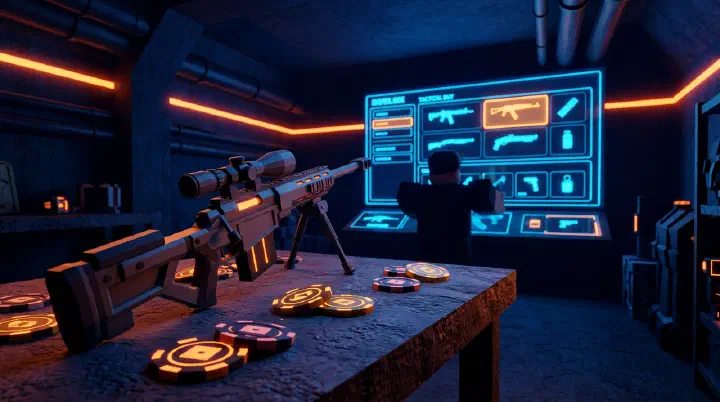
It is Round 3. You are 0–2 down. The scoreboard glares at you in red. You open the buy menu, hover over the bolt-action sniper rifle, and see 2,900 credits. Your heart pounds. One shot changes everything, you think. You click buy. The rifle lands in your hands, but you skip armor to afford it. You peek mid. You miss. The enemy AR player sprays you down in half a second. You are dead. You are broke.
Now look at the scoreboard again. Your teammates all bought pistols and saved. The enemy team is stacked with full rifles, armor, and smokes. Round 4 rolls in and your team has 1,200 credits each. The enemy has 4,500. You get steamrolled. Round 5? Same story. By Round 6 the score is 0–5 and someone on your team rage-quits.
Here is the truth nobody wants to hear: you did not lose that match because your aim was off. You lost it inside the buy menu. You mistook desperation for aggression. You traded the next three rounds for one hopeful peek. That is what bad economy does. It creates a debt that compounds faster than any interest rate. In Snipe, credits are not just currency. They are time machines. Save now, dominate later. Spend now, suffer later.
This guide teaches you how to manage your credits round by round, when to buy versus save versus force-buy, how weapon tiers fit into your budget, and how to keep your entire team on the same economic page.
Why Bad Economy Loses More Games Than Bad Aim
Bad aim loses duels. Bad economy loses rounds before they start. A player with cracked aim but zero credits is just a talented target. Here are the five economic mistakes that silently murder win rates in Snipe.
Force-buying when you should save. This is the number one killer. After losing the pistol round and the follow-up, your team has maybe 2,500 credits each. You force-buy a mid-tier rifle and light armor. The enemy full-buys with rifles, heavy armor, and utility. You die. Now you are broke for two more rounds. One bad buy spirals into three lost rounds.
Buying alone when your team is eco-ing. Economy is a team sport. If four players save and one buys, that one player is an island. The enemy will trade them out, then collapse on the rest of your team with superior gear. You spent 3,000 credits to get one kill and lose the round anyway.
Not tracking enemy economy. If the enemy team just won two rounds, they are rich. If they just lost two, they are fragile. You should peek aggressively against a broke enemy who cannot afford utility, and play safe against a rich enemy with full nades. Ignoring their bank means you play the same way every round, and that is exactly how you get punished.
Wasting credits on unused utility. Smokes and flashes are powerful, but only if you use them. Too many players buy two smokes, throw one poorly, die with the second in their pocket, and then complain they are broke. If you do not have a plan for the utility, do not buy it.
Upgrading weapons instead of securing armor. A shiny new rifle with no armor is a gift to the enemy. Armor absorbs damage, reduces flinch, and keeps you alive long enough to trade kills. Always buy armor before you upgrade your weapon. No exceptions.
Round-by-Round Economy Flow
Snipe matches follow a predictable credit rhythm. Learn the beat and you will never be caught off guard.
Round 1: The Pistol Round. Everyone starts with base credits. Buy light armor and one piece of utility. Do not buy a primary weapon. Pistols are lethal at close range, and the extra credits you save here decide whether you can buy on Round 2 or Round 3. The goal is not to out-gun the enemy. It is to survive, get one or two kills, and set up a healthy bank.
Round 2: The Crossroads. If you won Round 1, you have roughly 3,000–3,500 credits. Buy a sub-rifle or an entry-level rifle, heavy armor, and one utility item. Do not buy the most expensive rifle on the board. You need to leave yourself a buffer. If you lose Round 2 after a full luxury buy, you are broke for Round 3.
If you lost Round 1, you have around 2,000 credits. This is the hardest decision in the game. The correct answer 90 percent of the time is to save. Buy nothing except maybe light armor. Stack your credits so that Round 3 becomes a full-buy round for your entire team. The temptation to force-buy here is enormous. Resist it.
Round 3 and Beyond: The Decision Tree. After Round 2, your buys should follow this logic. First, check your team credits. If four or more players have 3,500+, call a full buy. If two or three have 3,500+ but the rest are broke, call a half-buy. If only one player is rich, that player should save with the team.
Next, check enemy economy. If the enemy just lost and is likely saving, push aggressively with cheap gear. They cannot trade effectively. If the enemy is on a win streak and fully stacked, play for picks and trades. Do not try to out-spend them. Play for information and survive.
Finally, check the score. If you are ahead, play conservative and preserve your bank. If you are behind, you can afford one aggressive force-buy per half, but only if the entire team commits. A solo force-buy is just throwing credits away.
Weapon Economy Tiers
Not every weapon fits every budget. Think of your loadout as a puzzle where the pieces must add up to your available credits minus armor and utility.
Pistol Tier (0–1,000 credits). Your starting sidearm and light armor. Used in pistol rounds and pure eco rounds. Do not underestimate this tier. A clean headshot with a pistol earns you a free rifle from the ground.
Sub-Rifle Tier (1,000–2,500 credits). Budget rifles and SMG-style weapons. These are your half-buy workhorses. They are accurate enough at mid-range and cheap enough that losing one does not break your economy. Buy these when your team is on the edge between saving and full-buying.
Rifle Tier (2,500–4,000 credits). The standard full-buy weapon. Reliable damage, decent range, and manageable recoil. This is where most rounds are won or lost. If your team calls a full buy, this is your default choice.
Sniper Tier (4,000+ credits). High-risk, high-reward. Only purchase when you have heavy armor, at least one utility item, and a comfortable bank above 5,000 credits. A sniper without backup gear is a lottery ticket, not a strategy.
Luxury Tier (5,000+ credits). Premium rifles and heavy snipers. These are situational. Buy them only when you are personally on a hot streak, your team is ahead, and you have already secured armor and utility. A luxury weapon does not make you invincible. It makes you a target.
Team Economy Coordination
Solo queue economy is painful, but it is not hopeless. Here is how to herd cats in the buy menu.
Call your buy plan immediately when the round ends. Use the quick-chat or type “save” or “buy” in team chat. If you are the highest credit player, take the lead. If nobody speaks, match the majority. Three saves means you save. Three buys means you buy.
Never buy above the team line. If everyone is on pistols and you buy a rifle, you become the enemy’s only target. They will trade you instantly, pick up your weapon, and now the enemy has a free rifle while your team has nothing.
Drop weapons for teammates when you can afford it. If you are sitting on 6,000 credits and your top fragger is broke, buy them a rifle. A good player with a rifle is worth more than a mediocre player with a sniper. This is especially true in the final rounds of a half, where one extra rifle can swing the entire match.
Track your teammates’ habits. If one player forces every single round, stop trying to match them. Play around their predictability. Let them entry, let them die, and pick up their gun if they drop it. It is cynical, but it is better than joining them in bankruptcy.
Counter-Intuitive Economy Truths
Some of the best economic decisions in Snipe look stupid on the surface. Here are three that will save your rank.
Sometimes you should throw a round on purpose. If your team is split between broke and rich, and the enemy is fully stacked, a coordinated save round is better than a chaotic half-buy. Everyone buys nothing. You hide, you delay, you bleed the clock, and you accept the round loss. Why? Because next round your entire team full-buys together, while the enemy who just won is now on a mixed buy. You traded one round for a 60 percent chance to win the next. That is good math.
The best save round is a half-buy. Wait, did I not just say save completely? Yes, but context matters. A true save round is for when your team is shattered. A half-buy is for when you have 2,500 credits and the enemy is probably saving too. In that window, a cheap rifle and light armor gives you a fighting chance against an enemy who is also on weak gear. It is not a save. It is an ambush.
Keeping a pistol is sometimes better than upgrading. If your team is on an eco round and you already have a pistol with ammo, do not buy a sub-rifle. Save the extra 1,500 credits. Your goal on an eco is not to win the round. It is to get one kill, steal a rifle, and bank the credits you did not spend. A sub-rifle eco is just a slower way to go broke.
The Mental Game of Economy
Economy management is not just math. It is discipline. The best Snipe players feel the same emotional pull to force-buy that you do. The difference is they ignore it. They treat credits like a resource to be invested, not a score to be spent.
Before every buy, ask yourself three questions. Can I afford to full-buy again next round if we lose this one? Is my team buying with me? Does the enemy have the gear to punish my purchase? If the answer to any of those is no, your finger should not be on the buy button.
The scoreboard does not care about how shiny your weapon is. It cares about rounds won. And rounds are won by teams who show up with full kits, not by heroes who showed up with a sniper rifle and a dream.