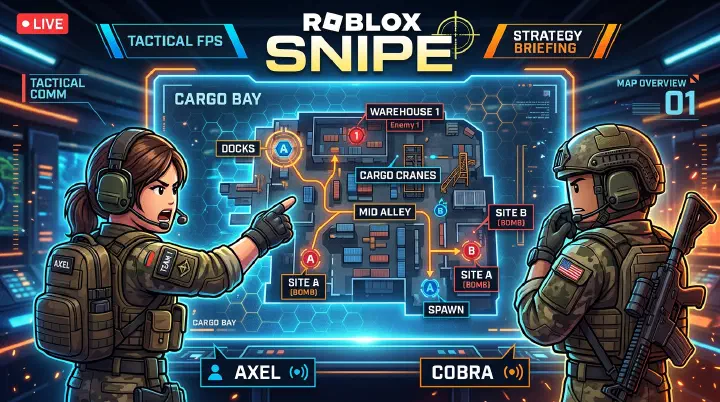
You’re holding A site on Cargo. Scope glint flickers from the central tower. You spot two enemies pushing through the container gap — one has a sniper, the other’s carrying a knife and moving fast.
You panic-mic: “Uh, guys, there’s people over here by the boxes, wait no, one guy has a knife, I think they’re pushing — aw man, behind the big thing —”
Your teammate on B site rotates toward A. He doesn’t know where “the big thing” is. He peeks the wrong container gap and eats a headshot from the tower sniper you never mentioned. The knifer rounds the corner and melees you while you’re still describing geometry.
The enemy team? They said “Two A, crane and gap. Pushing.” Three words. One kill. Zero confusion.
Your squad had better aim that round. You had worse words. Words lost the round.
Why Teams Fail at Communication
Most Snipe players treat voice chat like a livestream commentary. They’re narrating their own experience instead of broadcasting actionable intel. That’s the whole problem.
Vague callouts are the biggest killer. “Over there,” “by me,” “the thing,” “behind you” — these phrases assume your teammates share your camera angle. They don’t. Your “behind you” could mean the doorway to your left, the rooftop above, or the spawn tunnel three seconds away. Every ambiguous call forces a teammate to guess. In ranked, guessing gets you killed.
Then there’s the no-standard-names issue. One player calls it “crane.” Another calls it “hook.” A third calls it “that tall thing.” When the callout changes every round, your brain spends half a second translating instead of reacting. Half a second is the difference between a pre-aim and a death cam.
Too much talking fills the channel with noise. If someone’s constantly describing their own firefight — “he’s jumping, okay I missed, now he’s sliding, oh no he’s behind the —” — nobody else can make short, critical calls. Voice chat has a bandwidth limit. It’s not about politeness. It’s about signal-to-noise ratio. When the channel is full of commentary, emergency calls don’t get through.
Wrong info priority is the silent round-ender. Players lead with enemy health (“he’s so weak!”) or their own action (“I’m rotating”) instead of enemy position. Your team doesn’t need to know you’re rotating. They need to know where the threat is. Health callouts matter, but only after everyone knows where to shoot.
The teams that win aren’t the teams with the most talkative players. They’re the teams with the most compressed information. Same data, fewer syllables, zero ambiguity.
The Callout System — Standardized Map Language
Every competitive map in Snipe has natural landmarks. The problem is everyone makes up their own names. Standardization fixes that. Here are the agreed-upon callouts for the current competitive map pool.
Use these names in every match. Don’t improvise. If your duo partner says “crane,” you both know exactly where that is. Consistency beats creativity in comms.
Cargo
| Callout | Location |
|---|---|
| Tower | Central elevated platform |
| A Gap | Container alley on A-site side |
| B Gap | Container alley on B-site side |
| Water | Shallow edge zone, silent footsteps |
| Crane | East-side hook structure |
| Warehouse | Spawn-adjacent covered building |
| Walkway | West elevated passage |
Refinery
| Callout | Location |
|---|---|
| Catwalk | Mid overhead passage |
| Forklift | B-side ground vehicle |
| Boiler | East corner room |
| Silo | Tall cylindrical structure, north end |
| Service | Ground-level maintenance door |
| Pipes | Overhead pipe cluster near spawn |
Docks
| Callout | Location |
|---|---|
| High A | Top container stack, A-site |
| Low B | Ground containers, B-alley |
| Crane | Map-center loading crane |
| Office | Second-floor room, south end |
| Pier | Water-adjacent walkway |
| Stacks | Triple container cluster, mid |
Outpost
| Callout | Location |
|---|---|
| Bunker | Central reinforced building |
| Ridge | North elevated rock line |
| Tower | Radio structure, east |
| Gate | Main southern entrance |
| Tents | West-side soft cover cluster |
| Rocks | Southeast boulder formation |
Old Town
| Callout | Location |
|---|---|
| Bell | Tower structure, map center |
| Café | Balcony building, A-side |
| Church | Large interior, B-side |
| Alley | Narrow mid passage |
| Market | Open courtyard, southwest |
| Roofs | Connective rooftop network |
Subway
| Callout | Location |
|---|---|
| Platform | Main track-level walkway |
| Tracks | Ground level between rails |
| Maintenance | Lower hatch access |
| Tunnel | North spawn corridor |
| Station | Central enclosed room |
| Rafters | Overhead beam structures |
Six maps. Every major zone labeled. Print this, memorize it, or keep it on a second monitor. When your team uses the same words, your reaction time drops by half a second because you’re not translating. You’re just acting.
What to Say, When to Say It
Not all information is equal. In a clutch, you have maybe two seconds to speak before the fight resolves. If you say the wrong thing first, your teammate gets bad data at the worst possible moment.
Here’s the priority system. Memorize it. Use it every single call.
Priority 1: Enemy Position
Where are they? How many? Which direction are they moving?
Examples:
- “Two A gap, pushing site.”
- “One crane, scoped.”
- “Three mid, rotating B.”
This is always first. Everything else is secondary. If you only have time for three words, make them location words.
Priority 2: Enemy Health / Weapon
Only after position is established. Health callouts help your team decide whether to push or hold. Weapon callouts tell them what range to expect.
Examples:
- “Tower, one shot.”
- “B gap, knifer, full HP.”
- “Two A, both damaged.”
Never lead with health. “He’s one shot” without a location means your teammate has to ask “where?” — and now you’ve burned two callouts for one piece of intel.
Priority 3: Your Action
What you’re doing matters, but only after the team knows the threat.
Examples:
- “I’m holding A.”
- “Rotating to B now.”
- “Pushing with you.”
This prevents double-commits and coverage gaps. But if you say “I’m rotating” while an enemy is walking into site uncontested, you’ve wasted critical seconds.
Priority 4: Teammate Instruction
Direct commands to a specific player. Use sparingly.
Examples:
- “Dave, watch your left.”
- “Hold B, I’m flanking.”
- “Don’t peek, he’s scoped.”
These are high-risk. If you’re wrong, you’ve given a bad order. Only issue instructions when you’re certain of the situation and the player needs a specific adjustment.
Follow the order. Position first. Health second. Your action third. Instructions last. Every time.
The Ping System — Your Silent Partner
Snipe’s ping system is better than most Roblox FPS games, and most players barely use it. That’s free information you’re leaving on the table.
The basic ping marks a location. Use it when you don’t have time to talk, when you’re dead and spectating, or when the position is too complex to describe quickly. “Pinged A gap” is faster and clearer than “he’s in the space between the two containers on the left side of A.”
But the ping system has layers most players ignore.
Danger pings — the red warning marker — should be used for enemy positions you can’t currently see but know exist. “Danger on crane” tells your team an enemy was there recently and might still be. It’s a prediction tool, not just a spotted tool.
Movement pings — the go-here marker — are for coordinating rotates. If you’re holding A alone and need help, ping B site and say “Rotate.” Your teammate sees the visual cue plus hears the audio. Double signal, zero confusion.
Enemy pings while dead are your most powerful comms tool. Most players go silent when they die. Wrong. Your death cam shows exactly where your killer is. Ping it. Instantly. Your team now has live intel on an enemy position the killer thinks is hidden. That one ping wins more rounds than you’d believe.
Here’s the rule: if you’re dead, you’re not done talking. You’re now an intel drone. Spectate, ping, call rotations. Your mic doesn’t turn off because your character hit the floor.
The Counter-Intuitive Truth: Talk Less, Win More
Every guide tells you communication is key. They’re right. But they skip the part where too much communication is just as bad as none.
The best callout is sometimes silence.
If you’re in a 1v1 clutch and your teammate starts narrating their own screen — “okay he’s probably A, or maybe B, I don’t know, be careful” — you’ve just lost audio cues. You can’t hear footsteps. You can’t hear scope-ins. You can’t hear the subtle metal clang of someone dropping from a container. Their voice fills the space where game audio should live.
In clutches, the channel belongs to the player alive. Everyone else stays quiet unless they have definite intel. “He’s A site, I saw him” is allowed. “You got this” is not. Encouragement is nice. It’s also noise.
Talking less also preserves mental bandwidth. When you’re constantly calling, you’re not listening. You’re not processing audio cues. You’re performing instead of playing. The best IGLs in Snipe aren’t the loudest. They’re the most sparse. They say three words that matter instead of thirty that don’t.
Another counter-intuitive point: don’t repeat yourself. If you said “Two A gap” and nobody responded, they heard you. Repeating “Two A gap, guys, two A gap, hello?” just trains your team to tune you out. Make the call once. Trust your teammates to process it. If they didn’t hear it, that’s on them. Your job is clear transmission, not repetition.
The final truth: sometimes the best comm is a ping and a breath. Mark the spot. Let your teammate focus. Let the game audio speak. You’ll be shocked how many clutch rounds turn on a footstep you only heard because nobody was talking over it.
Common Comms Mistakes (Quick Hits)
- Calling while scoped. Your voice chat key is next to your movement keys. Hitting push-to-talk while scoped makes you strafe unpredictably or unscope. Bind push-to-talk to a mouse button or a key your left hand never touches mid-fight.
- Talking over entry fraggers. The person pushing first needs to hear audio cues. If you’re the second man in, you call. If you’re first, you listen.
- Backseat gaming in spectate. “If I were you I’d peek left” helps nobody. The player alive has different info than your death cam. Give facts, not strategy.
- Emotional calls. “That’s so stupid” or “how did he see me” wastes seconds and tilts the team. Stay mechanical. Facts only.
- Calling after the round ends. Post-round analysis belongs in the pre-round buy phase, not while the next round is loading. Focus forward.
Each of these costs you one round per match. Fix all five and your win rate climbs a full division without your aim improving at all.
Putting It Together
Good communication isn’t a personality trait. It’s a system. You use the same callout names every time. You follow the priority order every time. You ping when talking is too slow. You shut up when the clutch player needs audio.
The next time you’re on Cargo and you see two enemies pushing A gap, here’s the call:
“Two A gap. Pushing site.”
Six words. Position. Count. Action. Your team knows where to look, how many to expect, and that they’re moving. No “over there.” No “by the thing.” No “uhhh.”
If you get traded, you ping the tower sniper who got you. Your teammate hears “Two A gap” and sees the tower ping. He pre-aims the gap, checks the tower, and wins a 1v2 because his information was clean.
That’s the game within the game. Aim gets you the duel. Comms gets you the advantage before the duel starts. And in Snipe, the player with the advantage wins almost every time.
Standardize your language. Compress your calls. Trust the silence. Your teammates won’t thank you — they’ll just win more. That’s the only metric that matters.
Related Guides: