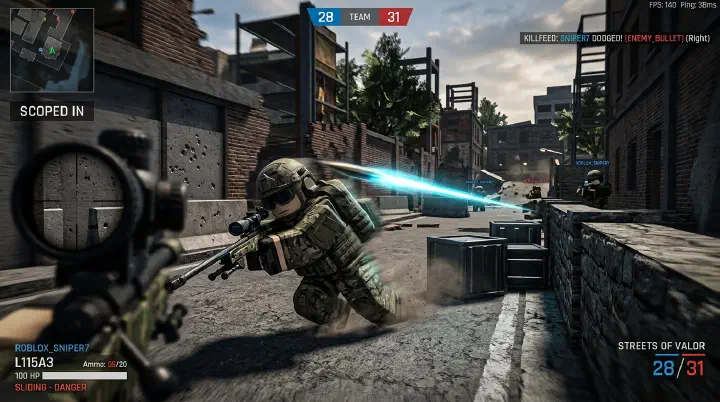
You’re holding mid lane on Bridge. Crosshair glued to the catwalk opening. You’ve got the Heavy Sniper. You’ve landed three headshots this match. You’re feeling it.
A pixel shifts in your peripheral vision. You scope in. The lens flare from an enemy scope flashes across your screen. Then gray. Killcam.
He wasn’t holding the angle. He was already in motion. He jump-peeked the corner, saw your stationary silhouette centered in his crosshair, and pulled the trigger while you were still bringing your scope up. Total time you were visible to him: zero milliseconds. Total time he was visible to you: about two frames. You never had a chance because you weren’t moving — and he was.
This is Snipe. Movement determines who shoots first. Not aim. Not reaction time. Movement.
Why Standing Still Is Losing You Fights
Let’s break down the exact timeline of what happened on Bridge, frame by frame.
You’re stationary behind cover. You hear a footstep. Here’s your sequence:
- Scope-in animation: 300ms
- Target acquisition (your brain recognizes the shape): 150-200ms
- Reaction + trigger pull: 150ms
- Total time to first accurate shot: 600-650ms
Now the enemy’s sequence, jump-peeking the same corner:
- Airborne exposure to sightline: 50ms
- Pre-aimed crosshair placement (he already knew the angle): 0ms
- Trigger pull: 50ms
- Total time to first shot: 100ms
He fired five to six times before your scope even finished opening. If his crosshair was at head height — and for a Diamond player, it always is — you’re dead before your finger touches the trigger. This isn’t a skill gap. It’s a mechanics gap. You’re playing a different game than he is.
The numbers get worse if you’re crouched or scoped before he peeks. A stationary scoped player has zero momentum. The jump-peeker has the initiative, the angle surprise, and the pre-fire advantage. Three advantages. You have a sniper rifle and a death screen.
The 3-Movement-Type Framework
Diamond+ players in Snipe don’t randomly mash movement keys. They run a decision framework with three distinct movement types, each with a specific trigger condition. Learn the trigger, pick the movement, win the duel.
Slide-Canceling
What it is: Slide out of cover, cancel the slide animation early with a jump or scope input, fire during the cancel window, and either re-enter cover or commit to the fight.
When to use it: The enemy knows you’re behind this specific piece of cover. They’re holding the angle. You need to challenge without being predictable.
Why it works: Slide-cancels break the standard peek rhythm. A standard strafe peek is predictable — left, right, left, shoot. A slide-cancel changes your hitbox height, your speed, and your exit timing. The enemy expecting a shoulder peek at 0.8 seconds gets a sliding target at 0.4 seconds.
Input sequence:
- Hold sprint toward the corner
- Tap crouch to initiate slide roughly one body-width from the edge
- Scope in or jump during the first half of the slide
- Fire the instant your crosshair clears the wall
- Either jump back to cover or strafe perpendicular to the sightline
Practice drill: Load into a private server on Bridge. Stand behind the mid-lane pillar. Slide-cancel left, then right, alternating directions. Don’t fire — just watch your camera movement. The goal is to clear the corner with your crosshair already at head height. Do this for five minutes before you add the shot.
Jump-Peeking
What it is: Jump around a corner while scoped or hip-firing, take the shot at the apex of the jump, and land behind cover or keep moving.
When to use it: You suspect an enemy is holding an angle but you don’t have exact information. You need visual confirmation and a shot opportunity in the same motion.
Why it works: Jump-peeks exploit the way hitboxes lag behind movement in Snipe’s netcode. At the jump apex, your head hitbox is slightly behind your camera. The enemy holding the angle sees your feet first, then your body, then your head — but by the time their brain processes the head location, you’ve already fired and dropped back.
Input sequence:
- Approach the corner at a 45° angle while scoped
- Jump roughly one step before the corner
- Release movement keys at apex for a brief moment of stability
- Fire
- Hold the opposite strafe key to land back behind cover
The risk: If the enemy isn’t there, you’re exposed in mid-air with no cover. Don’t jump-peek the same angle twice. The second jump-peek is the easiest kill in the game.
Off-Angle Repositioning
What it is: After taking a shot — hit or miss — you completely abandon your current position and relocate to an angle the enemy cannot predict.
When to use it: You fired and missed. You fired and hit but didn’t kill. You took any shot from a known position. If the enemy saw you, or heard you, or you killed their teammate from that spot, the spot is dead.
Why it works: Most Snipe players, even in Platinum, re-peek the same angle. They want the validation of the headshot from the spot that worked. So the enemy pre-fires the same corner, pre-aims the same lane, and kills them. Off-angle repositioning turns every duel into a new fight where you have the information advantage.
Examples by map:
- Bridge: Fired from catwalk? Drop to underpass and hold the ladder exit. They’ll peek catwalk again. You won’t be there.
- Warehouse: Shot from behind the red crate? Wall-run across the shelving units to the opposite corner. The enemy pushing your old position presents their back to you.
- Rooftops: Scoped from the crane? Grapple to the lower rooftop and hold the crane ladder. Revenge peeks are the most predictable movement in ranked.
For a full breakdown of power positions on every map, read the Snipe Map Mastery Guide.
When to Use What: The Decision Tree
You don’t need to memorize every situation. You need one question: Did the enemy see me last?
- No — and I know where he is: Slide-cancel. Challenge the angle with an unpredictable entry.
- No — and I don’t know where he is: Jump-peek. Get information and a shot in one motion.
- Yes — he saw me, heard me, or I killed his teammate from this spot: Off-angle reposition. Never re-peek.
There’s a fourth scenario: multiple enemies. If you’re outnumbered, off-angle reposition is the only correct answer. Slide-canceling into a 1v2 gets you traded. Jump-peeking into a 1v2 gets you focused. Reposition, separate the fight into two 1v1s, and pick them off one at a time.
The Counter-Intuitive Habit Diamond Players Hide
Every guide tells you to move fast. Peek fast. Slide fast. Be unpredictable. Here’s what the guides don’t tell you: Diamond+ players intentionally slow-peek when they know the enemy is low on health.
Here’s why. A player below 30 HP, after taking a body shot, enters survival mode. They pre-fire the aggressive peek. They expect the slide-cancel. They dump their remaining ammo into the corner at the exact timing a fast peek would arrive. If you walk-peek instead — no slide, no jump, just a slow strafe around the corner — their pre-fire whiffs. You hear the empty clicks. You line up the headshot on a reloading, panicking target.
This only works when you have exact information. You need to know the enemy is low. You need to know they’re the type to pre-fire. And you need the discipline to override your muscle memory that screams “go fast.” But when it works, it looks like you read their mind. You didn’t. You read their health bar and their panic.
Input Timing: The Milliseconds That Matter
Snipe’s engine rewards specific input windows. Miss the window and you’re either stuck in animation or spraying inaccurately.
- Slide-cancel window: You have roughly 120ms after slide initiation to cancel with a jump or scope. Cancel too late and you finish the full slide — predictable and slow.
- Jump-peek stability frame: At the apex of your jump, there’s a 40-60ms window where your movement penalty resets. Fire in this window. Fire too early or too late and your shot goes wide.
- Landing momentum: You retain slide momentum for 200ms after landing. Jump immediately after landing to chain into a bunny hop. Wait longer than 200ms and you reset to sprint speed.
If your FPS is below 60, these windows feel inconsistent. The game renders fewer frames, so the cancel inputs drop. Before you drill movement mechanics, fix your frame rate. The Snipe Settings & FPS Optimization Guide has the exact config Diamond players use to maintain 144+ FPS on mid-range hardware.
Map-Specific Movement Routes
Movement without map knowledge is just random jumping. Here are three routes that win fights.
Bridge — Underpass to Catwalk Chain After firing from catwalk, drop into underpass. Slide-cancel out of the tunnel exit. If the enemy peeked catwalk, they’re now exposed to your underpass angle with no cover between you. This route takes 4 seconds if you chain the slide-cancel into a wall-run up the ladder.
Warehouse — The Floor Is Lava Route Warehouse is close-quarters chaos. The players who survive are the ones who never touch the floor. From the spawn side crates, jump to the shelving unit, wall-run across the back wall, drop to the middle crate stack, and slide off toward the enemy spawn. You cross the entire map without taking a predictable path. SMG users holding the floor lanes never look up.
Rooftops — Zipline Cancel to Crane Grapple to the zipline. Mid-ride, cancel with a jump and immediately wall-run up the crane support. Players watching the zipline expect you to ride it to the end. You’re on the crane before they adjust their crosshair. This pairs perfectly with the Heavy Sniper’s long sightlines.
Movement routes change based on your loadout. If you’re running an SMG, you want tight corner routes. If you’re sniping, you want elevated repositioning paths. The Snipe Weapons Tier List breaks down which weapons reward aggressive movement and which punish it.
The 10-Minute Daily Practice
Movement is muscle memory. You can’t think through a slide-cancel in a ranked match — it has to be automatic. Here’s the daily routine:
- Minutes 0-3: Private server, Bridge, mid-lane pillar. Alternate slide-cancel left and right. No firing. Focus on crosshair placement at head height.
- Minutes 3-6: Same pillar. Add the shot. Slide-cancel, fire at the wall, check bullet placement. Adjust sensitivity if you’re consistently off.
- Minutes 6-8: Jump-peek the catwalk corner. Scope in before the jump, fire at apex, land back in cover. Repeat ten times.
- Minutes 8-10: Off-angle drill. Fire one shot from a position, then move to a completely different angle within 5 seconds. Practice the “spot is dead” instinct.
Do this before your first ranked match. It sounds boring. So does stretching before a run. And just like stretching, it prevents injury — except the injury is losing 25 RP because your slide-cancel failed in a 1v1.
From Gold to Diamond: Movement Is the Filter
Gold players in Snipe have decent aim. They can land headshots in casual. They can’t climb because they take every fight from the same angle, standing still, expecting aim to carry them.
Diamond players don’t necessarily have better aim. They have better positioning, better timing, and better movement discipline. They know that a shot taken while moving beats a perfect shot never taken because the shooter died during scope-in.
If you’re hardstuck Gold, stop tweaking your sensitivity. Stop blaming hit registration. Start moving. The Snipe Ranked Climbing Guide breaks down the exact RP thresholds and mental checkpoints for each tier, but the mechanical gate between Gold and Diamond is this: can you take a shot while your hitbox is changing? If yes, you climb. If no, you don’t.
New to Snipe? Start with the Snipe Beginner Guide to learn the basics before you drill advanced movement. And if you want the frame-perfect tech that sits on top of these fundamentals — animation cancels, wall-run chains, and silent peeks — the Snipe Advanced Techniques Guide has the exact input sequences.
FAQ
How long does it take to learn slide-canceling? About three hours of focused practice for the basic input. Two weeks of ranked matches before it becomes automatic under pressure. The jump-cancel window is forgiving enough that you’ll hit it 80% of the time within a day. The hard part is adding the shot without hesitating.
Should I always move while shooting? Almost always. Snipe’s movement penalty while scoped is lighter than most Roblox FPS games. A slow strafe while scoped barely affects accuracy, but it makes you dramatically harder to hit. The only time to stand still is the slow-peek against a low-health pre-firer — and even then, you’re moving, just slowly.
What’s the best map to practice movement on? Bridge for slide-cancels and jump-peeks — the sightlines are clean and the cover is obvious. Warehouse for off-angle repositioning — the verticality forces you to think in three dimensions. Avoid Rooftops until you’ve mastered the basics; the elevation changes add complexity that distracts from the core inputs.
Does controller movement differ from keyboard? Controller players can slide-cancel and jump-peek identically, but off-angle repositioning is harder because turning speed is limited by stick range. Controller players should prioritize slide-cancels and lean harder on map-specific routes that don’t require rapid 180° adjustments.