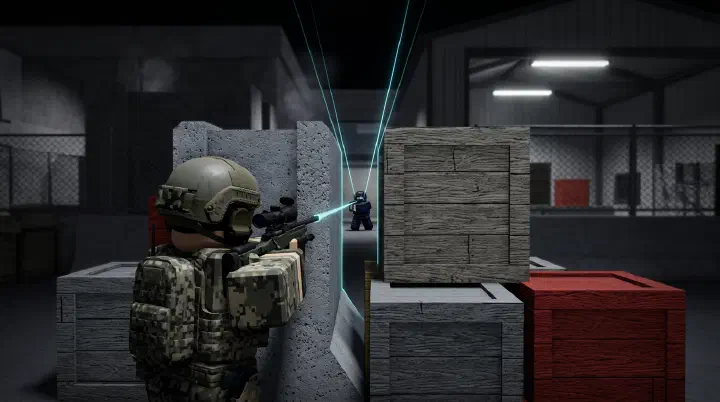
You climbed the catwalk on Refinery. The spot every YouTuber calls “S-tier.” You’re prone, scoped on mid, breathing controlled. The enemy peeks the doorway you’ve been watching for fifteen seconds.
You die.
Kill cam loads. The shot didn’t come from the doorway. It came from a stack of crates 40 studs to your left — a position you’d swear had no line of sight to where you were lying. The killer is crouched behind a forklift, and there’s a gap between the forklift’s tire and the crate behind it. Maybe two pixels wide on your screen. He saw your scope glint. You never saw him.
That’s not bad luck. That’s the entire game you’re not playing yet.
Why “Power Positions” Are Death Traps
The catwalk on Refinery isn’t a power position. It’s a landmark. Every player above Gold has died there, killed there, and pre-aimed it from spawn. The moment you climb it, six enemies already know where your head will appear.
Same story for every “best spot” on every map:
- Bunker rooftop (Outpost): Pre-aimed by anyone holding the ridge.
- Container stack (Docks): Three off-angles see your back the second you scope.
- Bell tower (Old Town): A literal funnel — one grenade and you’re done.
- Crane operator booth (Refinery): Glass walls, every angle exposed.
The mistake isn’t picking a strong sightline. The mistake is picking a predictable one. In Snipe, predictability is the only thing that gets you killed at range. If your enemy knows where to look before you fire, your scope-in animation is a death sentence.
Read that again. Your scope-in animation — the half-second your character locks into ADS — is when good players kill you. Not when you fire. Not when you peek. When you commit.
So the question isn’t “where’s the best sightline?” It’s “where can I shoot from that nobody is pre-aiming?”
If you’re still gunfighting from the textbook spots, the Snipe ranked climbing guide won’t help you past Platinum. Positioning is the wall.
The Off-Angle Framework
An off-angle is any position that:
- Sees a common sightline,
- From a spot the enemy doesn’t naturally check first,
- With cover you can break engagement to in under one second.
Three rules. All three matter. Miss any and you’re not holding an off-angle — you’re holding a worse version of the obvious spot.
Let’s break each one down.
Rule 1: See the common sightline
Off-angle doesn’t mean “weird random corner.” It means you’re watching the same lane the enemy expects to fight on — just from a different vector. If your off-angle stares at a wall while the action happens elsewhere, you’re not flanking. You’re hiding.
Example: On Docks, mid players expect duels through the central container alley. The “power position” is the high container at A-side. The off-angle is the gap between two low containers on B-side that sightlines the alley at a 30-degree skew. Same fight. Different vector.
Rule 2: Unnatural check order
When players push a bombsite or sweep a room, they have a default scan pattern. Eyes go to the obvious threats first — doorways, windows, high ground. Off-angles exploit the gap before the second sweep.
You want positions that fail the “scope-up scan.” When an enemy ADSes, their cone of vision is narrow. If you’re 20+ degrees off their expected scan path, you get the first shot. Free.
Rule 3: One-second disengage
Holding an off-angle means committing to a shot. Miss, get spotted, get traded — that’s the off-angle tax. You need a cover-break inside one second or you die.
This is why crouch-strafing off a head-glitch beats prone every time at mid-range. Prone is high damage uptime, but the disengage is 2-3 seconds of getting back up. By then you’re dead.
Head-Glitch Positioning — The Mechanical Edge
A head-glitch is a position where your character model is mostly hidden behind geometry, but your weapon’s barrel and a sliver of your head clear the cover. Your scope sees over. Their bullets hit the railing.
Snipe’s hitboxes favor head-glitches harder than most Roblox FPS games. The model’s neck-to-head transition is narrow, and clipping through low cover only exposes about 12 pixels of headshot zone at 100 studs.
The catch: most “obvious” head-glitches are pre-aimed. Same problem as power positions. You need the awkward head-glitch.
Spots to look for:
- Sandbags at half-character height with a small dip in the middle — crouch in the dip, only your scope shows.
- Stair railings at the top of staircases. Most players check the stair entrance, not the top railing.
- Window sills you can crouch behind rather than stand in the window. Standing in a window is suicide. Crouching shows only the top of your head over the sill.
- Sloped terrain edges — natural head-glitches that don’t look like positions because they’re not “structures.”
The best head-glitches on every map are unlabeled. They look like terrain. That’s why they work. The map mastery guide covers the geometry — this is what to do with it.
Map-by-Map: Power Position vs Off-Angle
Here’s the swap-out for each major map. Stop playing the left column. Start playing the right.
| Map | Textbook Spot (Avoid) | Off-Angle Replacement |
|---|---|---|
| Refinery | Catwalk over mid | Forklift gap, B-side service door |
| Docks | High container A | Low container gap, B-alley skew |
| Outpost | Bunker rooftop | Slope dip behind the radio tower |
| Old Town | Bell tower window | Café balcony rail, half-crouch |
| Subway | Platform end | Maintenance hatch at track level |
| Quarry | Crane platform | Rock outcrop south of the pit |
Six maps, six swaps. Each off-angle sees the same fight the textbook spot does, from a vector enemies don’t pre-aim.
Sightline Denial — The Other Half
Holding off-angles is offense. The defensive half is sightline denial: actively breaking enemy sightlines so they can’t hold off-angles on you.
Three techniques:
- Smoke discipline: Don’t smoke the obvious lane. Smoke the off-angles that look into the obvious lane. You’re not blocking the fight — you’re blocking the spectator.
- Crouch-walking through transitions: Standing transitions get clipped by head-glitch holders. Crouch through danger zones even if it feels slow. You’d rather be slow than dead.
- Pre-firing scope glints: If you suspect an off-angle, don’t peek to confirm. Pre-fire one round at the suspected spot. Scope glints reveal positions. If you see one flicker, you’ve found him.
This ties into movement mechanics — slide-cancels and crouch-strafes are how you break sightlines, not just how you dodge.
The Counter-Intuitive Rule: High Ground Loses
Every shooter ever made tells you high ground is king. In Snipe, high ground is a tell.
When you climb anywhere — catwalk, rooftop, crane — you broadcast your position via the climb animation. Skilled players watch climb hotspots from off-angles and pre-aim the silhouette at apex.
The counter-intuitive truth: mid-height off-angles beat high ground positions in 1v1s above Gold rank.
Why? Two reasons.
First, gravity and bullet drop. Snipe has subtle drop at 150+ studs. From high ground shooting down, drop adds to your aim error. From mid-height shooting horizontally, drop is predictable.
Second, escape options. High ground has one exit: the way you climbed. Mid-height positions usually have lateral escape routes. When the trade goes bad — and it will, sometimes — lateral escape saves your KD.
This doesn’t mean never take high ground. It means high ground is a commit, not a default. Take it when you’ve cleared the off-angles that look into it. Not before.
Pre-Aiming and the Anti-Pre-Aim Mindset
Half of Snipe gunfights are decided before either player sees the other. The winner pre-aimed the right spot. The loser didn’t.
Pre-aiming is good. The problem is what you pre-aim. Most players pre-aim the textbook spots — because that’s where they’d go. So everyone pre-aims everyone, and the first to peek dies.
Anti-pre-aim positioning means:
- Approach the fight from angles you wouldn’t pre-aim if you were the enemy.
- Hold positions that aren’t on the pre-aim shortlist.
- When you do peek a pre-aimed angle, do it with movement (slide, crouch-strafe) so the pre-aim shot misses your head.
This is the same logic advanced techniques covers for jiggle-peeking — small movements break pre-aimed crosshair placement at range.
Common Positioning Mistakes (Quick Hits)
- Sitting still after a kill. Your muzzle flash gave you up. Reposition every kill, no exceptions.
- Holding the same angle twice in a round. Once they know where you are, you’re a target. Rotate.
- Scope-in before the fight. Scoped move speed is half of hipfire. Walk to your position hipfire. Scope only when you’ve committed.
- Ignoring audio cues. Footstep direction tells you which off-angle the enemy is rotating to. Listen before you peek.
- Hugging cover too tight. Stand a half-step back from cover. Tight-hugging exposes your shoulder to wide off-angles.
Each of these costs you 1-2 fights a match. Fix all five and your survival rate jumps a full tier.
The Mental Loop
Good positioning isn’t a checklist. It’s a loop you run every 5-10 seconds:
- Where am I being seen from right now?
- Where would I shoot myself from if I were the enemy?
- What’s my disengage if this position breaks?
- When was the last time I rotated?
If you can’t answer all four in under two seconds, you’re not positioning. You’re sitting. Sitting players die.
The best Snipe players don’t have better aim than you. They have a better question loop. They’re constantly re-evaluating their position relative to where the fight is, where enemies have been seen, and where the next push will come from. The aim comes after.
Putting It Together
Stop climbing the catwalks. Stop sitting in the bell tower. Stop treating Snipe like a sniper-camping game.
Treat it like a chess match where every piece is a sightline, every off-angle is a knight fork, and every pre-aim is a trade your enemy is hoping you’ll make.
Run the loop. Hold awkward angles. Disengage in one second. Pre-aim the off-angles, not the doorways. Crouch-walk transitions. Pre-fire suspected scope glints.
Do this for ten matches. Your KD won’t double. Your deaths will halve. Same thing on the leaderboard, but it feels different — you’ll stop dying to ghosts you never saw, and you’ll start being the ghost.
If you’re still picking up the basics — recoil patterns, weapon selection, the rank structure — read the beginner guide and weapons tier list first. Positioning sits on top of fundamentals. It doesn’t replace them.
But once your aim is okay and you’re stuck in Gold or Platinum, this is the wall. Off-angles, head-glitches, sightline denial, anti-pre-aim. The wall comes down when you stop playing the spots everyone plays.
The catwalk is a death trap. The forklift gap is a kingdom.
Go take it.