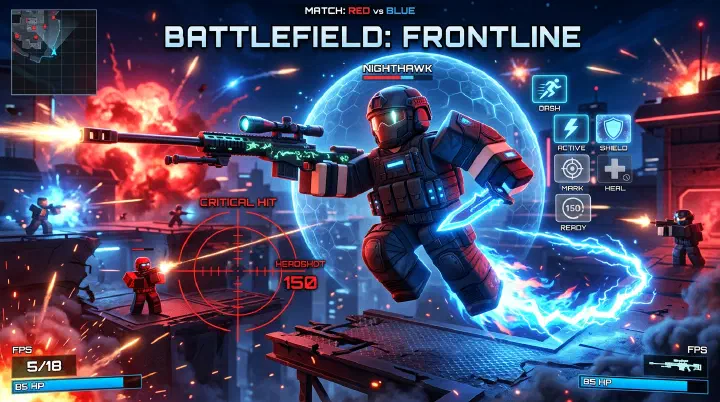
You’re three rounds into a Team Deathmatch on Warehouse. The score is tight. You pop Thunder Dash, charge through the central corridor, and spot an enemy crouched behind the forklift. Perfect. You dash right at them, stun trail blazing, and — you pull out your sniper rifle.
You try to scope. The crosshair swims. You’re practically standing on their toes. They don’t even scope back. Two knife swings later, you’re dead. The kill feed shows you got zero damage. You had every advantage: surprise, ability uptime, momentum. And you threw it all away because you brought a sniper rifle to a knife fight.
That death isn’t bad aim. It isn’t lag. It’s a loadout misunderstanding. You picked an ability designed for close-range aggression, then defaulted to your primary weapon in a range where your primary weapon is the worst option in the game. SNIPE only gives you one rifle, one knife, and one ability. But the difference between a cohesive loadout and a mismatched one is the difference between a 5-kill streak and a feed.
This guide is about building that cohesion — understanding not just which ability is strong, but which weapon that ability wants you to use, and how to build a playstyle where every piece works together.
What Players Get Wrong About Weapon & Ability Combos
Most players treat their ability like a bonus button. They pick Thunder Dash because it looks cool, then play the exact same way they’d play with Target. They pick Forcefield because they’re “defensive,” then never learn the knife combos that make Forcefield lethal. Here’s where it falls apart.
Using abilities without switching weapons. Every ability in SNIPE shifts your optimal engagement range. Thunder Dash and Dash push you into knife territory. Target and Super Jump keep you at rifle range. Forcefield creates a no-man’s land where rifle duels happen on your terms. Players who use Thunder Dash to close distance, then try to quickscope from 8 studs away, are fighting their own loadout. Your ability told you to get close. Your weapon choice needs to listen.
Building around one weapon instead of both. The sniper rifle is your default. It’s iconic. It’s satisfying. But treating the knife as a panic button instead of a core part of your kit means you’re only playing with half a loadout. Every ability has a knife application and a rifle application. Ignoring either one is like playing with one hand behind your back.
Chasing synergy that doesn’t match their hands. Target plus long-range rifle play is objectively strong. But if your natural instinct is to push, flank, and hunt, Target will feel like a crutch you forget to use. You’ll pop it, see enemies through walls, and then push anyway because sitting still bores you. The “best” combo on paper is worthless if it fights your instincts. A B-tier ability that matches your playstyle beats an S-tier ability you misuse.
Forgetting that abilities have cooldowns. Your ability is up for maybe 5 seconds out of every 20-30. The other 25 seconds, you’re just a player with a rifle and a knife. If your entire game plan requires your ability to be active, you’re helpless for 80% of the match. Cohesive loadouts work even when the ability is on cooldown.
The Weapon & Ability Matrix: What Each Combo Wants From You
SNIPE’s loadout system is simple on the surface. One rifle. One knife. One ability. But the interplay between those three elements creates distinct playstyles that can dominate or crumble depending on how well you understand the assignment.
Thunder Dash — The Aggressor’s Contract
Thunder Dash is the most misunderstood ability in SNIPE because it promises aggression but punishes the wrong kind. Players see “dash forward and stun” and think it means “charge in and shoot.” It doesn’t. It means “charge in and knife.”
- Rifle application: Extremely limited. The only time you should scope after a Thunder Dash is if the enemy is outside knife range but still inside the stun trail. That window is narrow — roughly 10-15 studs. Beyond that, you should have used a different ability.
- Knife application: This is why you picked Thunder Dash. Dash past or through the enemy, stun them, then knife → knife. Two swings. Any body part. Dead before the stun wears off. The dash-knife combo is the single highest close-range DPS sequence in the game.
- Playstyle requirement: You must be comfortable leading with your knife. If your instinct after every dash is to scope, sell Thunder Dash and buy Target instead. You’re wasting the stun.
- Best on: Tight maps with corridors and blind corners (Warehouse, Construction). Maps where enemies can’t retreat from the stun trail.
- Cooldown play: Without Thunder Dash, you’re a standard rifle player. Play conservative, hold angles, and wait for the cooldown. Do not pretend you’re still an aggressor while it’s down.
Target — The Information Playmaker
Target reveals every enemy through walls for 2 seconds. On paper, it’s a defensive intel tool. In practice, it’s the strongest aggressive ability in the game — if you know how to use the information.
- Rifle application: Pop Target, identify the nearest enemy, pre-scope their angle, then peek and fire. The key is pre-scoping. Don’t peek, then scope, then shoot. That’s 0.6 seconds. A good player can react in 0.3. Scope behind cover, peek already scoped, fire the instant your crosshair clears the wall. Target makes this possible because you know exactly where to pre-aim.
- Knife application: Target is actually a knife enabler for flankers. Pop it, see that the enemy team is facing the other direction, then rotate behind them and knife. Most players think Target is for shooters. Smart players think Target is for route planning.
- Playstyle requirement: You need patience. The worst Target users pop it and immediately peek the closest enemy. Better players wait 1-2 seconds — many enemies reposition when they suspect they’ve been revealed, and you catch them mid-rotation with no cover.
- Best on: Large maps with multiple angles (Cargo, Bridge). Any map where “not knowing where enemies are” is the main reason you die.
- Cooldown play: Without Target, rely on audio and spawn knowledge. You should still have a general idea of enemy positions based on kill feed and team movements. Target confirms what you should already suspect.
Forcefield — The Duelist’s Shield
Forcefield deploys a 5-second barrier that blocks all incoming fire. Players think it’s purely defensive. They’re half right — but they miss the offensive applications entirely.
- Rifle application: The classic use. Deploy Forcefield before peeking a known sniper lane. You get one free shot without risk. If you miss, retreat and wait for the next cooldown. This turns 50/50 duels into 90/10 duels in your favor. The enemy has to hit a difficult shot; you get to take a free one.
- Knife application: Forcefield is actually a knife trap. Place it at a 45-degree angle to a corner. The enemy sees the Forcefield and pre-aims the obvious peek side. You peek from the opposite side — they’re looking at the shield, not at you — and knife them before they rotate their crosshair. Or: deploy Forcefield in a corridor, push through it with your knife out, and force the enemy to either retreat or engage in a knife fight on your terms.
- Playstyle requirement: You need to think in angles, not just health bars. Forcefield is about geometry — creating safe sightlines and unexpected peek points. If you deploy it reactively while already taking fire, you’ve already lost most of its value.
- Best on: Maps with long sightlines and defined chokepoints. 1v1 Duel mode, where one free peek wins the round.
- Cooldown play: Without Forcefield, you’re vulnerable in rifle duels. Play around cover more aggressively, use Silent Peek techniques, and avoid straight-up trades.
Dash — The Versatility Engine
Dash is the “I don’t know what to pick” ability. That’s not an insult — it’s genuinely the safest choice because it enables both rifle and knife play without locking you into either.
- Rifle application: Dash Cancel. Scope mid-dash, fire at the peak of momentum, land behind new cover. The enemy sees you for less than 0.5 seconds. Dash also crosses sniper lanes safely — dash → slide stacks momentum and carries you across open ground faster than any other movement sequence.
- Knife application: Dash into close range, knife, dash out. The short 12-second cooldown means you can use this multiple times per life. Against players who panic-scope at knife range, a dash-in-knife-dash-out pattern is nearly impossible to counter without Thunder Dash of your own.
- Playstyle requirement: You need to be adaptable. Dash doesn’t give you a free win like Thunder Dash’s stun or Target’s wall-hack. It gives you options. If you commit to one playstyle and never deviate, you’re not using Dash correctly.
- Best on: Every map, every mode. Dash has no bad matchups — but it also has no dominant ones.
- Cooldown play: With a 12-second cooldown, Dash is rarely “down” for long. But during those brief windows, play slightly more conservative. Don’t take the risky cross without it.
Super Jump — The Vertical Gambler
Super Jump launches you vertically ~40 studs. It’s the riskiest ability in the game because you’re exposed mid-air with a predictable arc. But in the right hands, it creates angles that break every rule of ground-level play.
- Rifle application: Super Jump at the edge of a rooftop, scope on the way up, fire at the apex, land back on the roof. The brief aerial angle catches enemies who only check head-height and ground-level sightlines. At the apex, you’re nearly stationary for 0.2 seconds — that’s your shot window.
- Knife application: Minimal. Super Jumping into knife range is suicide — you’re a slow-moving target with no way to cancel the animation. The only exception is landing on an unsuspecting enemy from above, which is more luck than strategy.
- Playstyle requirement: You need strong tracking aim and exact timing. Miss the apex shot, and you’re landing in a bad position with your ability on cooldown. This ability is for players who can hit difficult shots consistently — not for players who are still learning rifle fundamentals.
- Best on: Maps with vertical geometry and rooftop sightlines (Rooftops, containers on Cargo).
- Cooldown play: Without Super Jump, you’re stuck on the ground. Play standard rifle angles and don’t try to recreate the aerial peek with wall runs — it’s not the same.
Platform & Speed — The Traps
Platform spawns a moving platform. Speed gives a 30% movement boost. Both abilities sound useful. Both are outclassed by everything above.
- Platform: You’re a slow-moving target on a predictable path. Every ability above has a direct counter-play application. Platform has none. Skip it for serious play.
- Speed: Everything Speed does, Dash does better. The 30% boost doesn’t change your hitbox or make you harder to track. It just makes you run slightly faster in a straight line. Against hitscan sniper rifles, that’s barely relevant.
The Decision Framework: Picking Your Combo
Don’t copy a YouTuber’s loadout. Answer these three questions honestly.
Question 1: When an enemy appears 10 studs away, what’s your first instinct?
- Scope and shoot → You want Target or Forcefield.
- Pull my knife → You want Thunder Dash.
- Dash sideways and reassess → You want Dash.
Question 2: Why do I die most often?
- “I never see them coming” → Target. Information fixes ambushes.
- “I lose rifle duels even when I shoot first” → Forcefield. One free peek changes everything.
- “I get pushed and can’t escape” → Dash. Mobility is survival.
- “I want to push but they always shoot me first” → Thunder Dash. The stun trail is your entry ticket.
Question 3: What’s my weakest weapon?
- “My knife aim is inconsistent” → Avoid Thunder Dash. You need guaranteed knife execution.
- “My rifle aim is shaky under pressure” → Avoid Super Jump. You need to hit the apex shot.
- “I don’t know when to switch weapons” → Start with Dash. It forgives indecision.
The honest answers matter more than the “best” ability. A player with great knife mechanics and terrible patience will climb higher with Thunder Dash than Target, even if Target is technically S-tier.
Counter-Intuitive Insight: Target Is a Knife Ability
Every guide lists Target as a rifle tool. Wall-hack intel, pre-scope angles, free headshots. That’s true. But it’s also the most powerful knife ability in the game — if you play it that way.
Here’s the play: Pop Target. See that three enemies are looking down mid lane. See that one enemy is isolated on the flank, facing away from you. Instead of peeking mid for the easy shot, rotate to the flank. The isolated enemy has no idea you’re coming. You close the distance while they’re holding an angle in the wrong direction. Two knife swings. Free elimination. The rest of the team doesn’t even know you’re there until the kill feed updates.
Target doesn’t just tell you where enemies are. It tells you where enemies aren’t looking. That information is more valuable for knife flankers than for rifle duelists. A rifle duel still requires you to hit the shot. A knife flank from behind is guaranteed damage.
The best Target players in SNIPE aren’t the ones with the highest accuracy. They’re the ones with the highest flank success rate. They use Target to find the lonely player, the distracted player, the player who thinks they’re safe. Then they make them pay.
If you’ve been playing Target as a “scope and shoot” ability, try this for one match. Pop it, find the isolated enemy, and go knife them. You’ll win fights you have no business winning — not because your aim improved, but because your decision-making did.
Building a Cohesive Playstyle: The Three Archetypes
Most players drift between styles mid-match. They play aggressive with Thunder Dash, then suddenly try to hold angles like they have Forcefield. Cohesion means committing to an identity and letting every decision flow from it.
The Entry Fragger (Thunder Dash + Knife Primary) Your job is to create chaos. Pop Thunder Dash at the start of a round, stun the first enemy you see, and knife them before their team reacts. You die a lot. That’s fine. Your K/D matters less than your opening pick rate. If you’re consistently getting the first kill in a round, you’re doing your job. Between cooldowns, play support — spot enemies, call positions, don’t take risky rifle duels where you’ll just feed.
The Intel Sniper (Target + Rifle Primary) Your job is to never take a fair fight. Pop Target every 20 seconds, identify the weakest enemy position, and delete them before they can react. You should have the highest accuracy in the lobby because you only take shots you know will land. Between cooldowns, play defensively. Let enemies come to you. Your rifle is strong enough to win defensive duels; don’t throw that away by pushing aggressively without intel.
The Duelist (Forcefield + Balanced) Your job is to win 1v1s. Deploy Forcefield before every peek, take the free shot, and retreat. You’re the player who holds the bomb site alone, who wins the clutch, who never dies to trades because you never expose yourself without protection. Between cooldowns, use cover aggressively and rely on Silent Peek techniques. Your strength is consistency — you should have the lowest death count in the lobby.
Pick one. Play it for ten matches. Don’t switch because you had one bad round. Cohesion comes from repetition, not variety.
Related Guides
- SNIPE Beginner Guide: Controls, Movement & Getting Started
- SNIPE Weapons & Abilities Guide: Best Loadouts & Combos
- SNIPE Weapons Tier List: Best Guns for Ranked
- SNIPE Advanced Techniques & Ranked Guide
- SNIPE Movement Mechanics Guide: B-Hop, Wall Run & Momentum
- SNIPE Positioning & Angles Guide: Win Every Duel
- SNIPE Maps & Strategies Guide: Positioning & Advanced Tactics
- SNIPE Ranked Climbing Guide: RP System & Tier Strategy
- SNIPE Solo vs Squad Guide: Team Play & Communication
- SNIPE Game Modes Guide: Every Match Type & Win Conditions
- SNIPE Settings & FPS Optimization Guide
- SNIPE Beginner Mistakes Guide: 10 Errors That Get You Killed
- SNIPE Codes & Rewards Guide
- SNIPE Events & Seasonal Guide
- SNIPE Map Mastery Guide
- SNIPE Map Callouts & Communication Guide