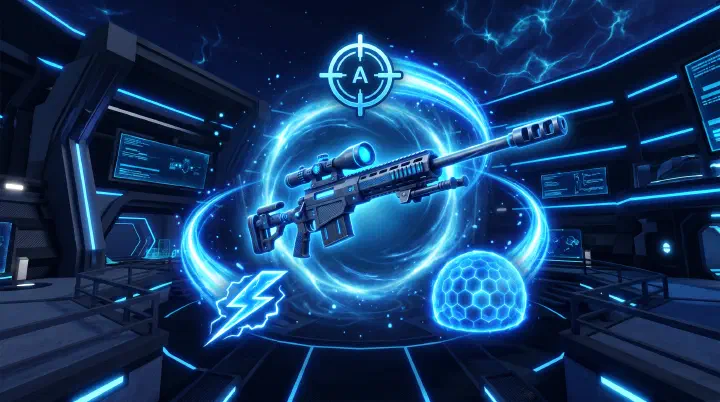
You’re scoped in on a Cargo lane. Crosshair on the corner. You’ve been holding this angle for 12 seconds. Then — crack. You’re dead. Killcam shows the guy knew exactly where you were because he popped Target, saw your silhouette, and pre-fired the angle before you even registered his scope glint.
That’s the moment most players realize: in SNIPE, knowing your weapon is table stakes. The real game is how your weapon, your ability, and your movement all talk to each other.
SNIPE’s loadout system is intentionally minimal: one sniper rifle, one knife, and one ability. But within those constraints, the interplay between your weapon handling, ability choice, and movement creates distinct playstyles that hard-counter specific opponents. This guide breaks down every weapon stat, every ability’s tactical value, and the combinations that actually win matches — not just the ones that look good on paper.
The Sniper Rifle: What You’re Actually Holding
Every player uses the same sniper rifle. No variants, no attachments, no skins that affect performance. SNIPE’s skill expression comes from how you use it, not what you use.
Here’s what the rifle gives you:
- Damage: 100 to the body, 200 to the head. One-shot kill anywhere on the body. This is the defining mechanic of SNIPE — every engagement is potentially lethal in one frame.
- Fire rate: Roughly 1.2 seconds between shots due to the bolt-action cycle. You’re effectively a single-shot weapon in any duel. Miss, and you have a 1.2-second window where you’re helpless.
- Scope zoom: Fixed 4x magnification. No toggle, no variable zoom. You learn to work with this one magnification or you die.
- Bullet type: Hitscan. No travel time, no bullet drop. Where your crosshair is when you click is where the bullet lands. This is why quickscoping works — there’s no projectile to account for.
- Hipfire spread: Extreme. You’ll hit maybe one in five shots beyond 5 studs. If you’re not scoped, you’re gambling.
- Reload: 2.5 seconds for a 5-round magazine. Manage your reloads between engagements — getting caught mid-reload is a death sentence.
- Movement penalty: 40% slower while scoped. This is the game telling you: don’t hard-scope. Reposition, scope, shoot, unscope, move.
Internalize these numbers. The 1.2-second bolt cycle and the 40% movement penalty are the two stats that dictate every decision you make in a gunfight.
Scoping Mechanics
Scoping in SNIPE is binary — you’re either fully scoped (accurate) or you’re not. There’s no “partial scope” accuracy ramp. This has three massive implications:
- Quickscoping works reliably. Scope in, fire the instant the scope overlay appears, and the shot is fully accurate. No RNG. No bloom. Just timing.
- Hard-scoping is a death trap. Every second you stay scoped, you’re immobile and visible. Opponents using Target can see your stationary silhouette through walls. You’re basically a free kill waiting to happen.
- Scope flicking is the meta. Scope in slightly to one side of where you expect the enemy, then flick onto them and fire. This minimizes the window where they can react to your scope glint.
Scope Glint: The Silent Killer
Your scope produces a visible glint to enemies within your field of view. This is the #1 thing that gets new players killed, and it’s the #1 thing intermediate players exploit:
- Glint appears the instant you scope in. Not after a delay. Instantly.
- It’s visible even through partial cover. If any part of your scope has line-of-sight to an enemy, they see the glint.
- Smart players scope in behind cover, then strafe out. By the time the glint is visible, the shot is already being fired.
- If you see a glint, you have roughly 0.5 seconds before the shot arrives. React accordingly.
The Combat Knife: Not Just a Backup
The knife is more than a last resort. Master it and you’ll win close-quarter encounters against players who panic-scope — which is most of them.
- Damage: 50 per swing
- Swings to kill: 2 (any body part — headshots don’t matter with the knife)
- Attack speed: 0.6 seconds between swings, so a full kill takes about 1.2 seconds
- Range: Roughly 5 studs. You need to be close.
- Movement bonus: 15% faster than holding the rifle. This alone makes knife-out movement a viable rotation tool.
Knife Techniques That Actually Win Fights
The Dash-Knife Combo: Thunder Dash through an enemy (stunning them), immediately knife twice. The stun prevents them from scoping or running, and two quick knife swings finish them before the stun wears off. This is the most reliable close-range kill in the game.
Knife While Wall Running: You can swing your knife while wall running. If an enemy is positioned near a wall you’re running on, a quick knife swipe as you pass can catch them off guard. Most players don’t track vertical + horizontal movement simultaneously.
The Reload Cancel: If you fire, miss, and the enemy pushes you during your bolt cycle, swap to knife. One knife hit + bolt cycle finish + quickscope is faster than waiting for two full bolt cycles. It’s a tight window, but it’s the difference between dying during the bolt animation and winning the fight.
All 7 Abilities: Detailed Breakdown
S-Tier
Target
- Cooldown: 20 seconds
- Effect: All enemies within a large radius are highlighted through walls for 2 seconds.
- Best on: Large maps with many angles (Cargo), Free-for-All mode.
- Counters: Forcefield — the shield blocks scoped shots even when you’re revealed.
- Advanced use: Pop Target, identify the nearest enemy, then don’t immediately peek them. Wait 1 second. Many players panic and reposition when they suspect they’ve been revealed, and you catch them mid-rotation — when they’re moving, not aiming.
Thunder Dash
- Cooldown: 25 seconds
- Effect: Dash forward roughly 30 studs, leaving a stunning trail that lasts 2 seconds.
- Best on: Tight maps with corridors, Team Deathmatch — chain stuns on grouped enemies.
- Counters: Dash (can dodge the trail), Forcefield (blocks stun if timed right).
- Advanced use: Dash not directly at the enemy, but slightly to their side. The stun trail cuts off their retreat path. Then quickscope them while they’re stunned and can’t move.
A-Tier
Forcefield
- Cooldown: 30 seconds
- Effect: Deploy a 5-second protective barrier in front of you. Blocks all incoming fire.
- Best on: 1v1 Duels, maps with long sightlines.
- Counters: Thunder Dash (dash through the forcefield and knife), flanking.
- Advanced use: Don’t deploy it reactively when you’re already being shot at. Deploy it before peeking a known sniper lane. It gives you one free peek without risk — and in SNIPE, one free peek is often one free kill.
Dash
- Cooldown: 12 seconds
- Effect: Quick dash roughly 15 studs in your look direction. No stun trail.
- Best on: Any map, any mode. It’s the most versatile movement ability in the game.
- Counters: Target — they can see where you dashed to.
- Advanced use: Combine with slide for extended distance. Dash then immediate slide — the momentum stacks, carrying you about 25 studs total. Great for crossing sniper lanes safely.
B-Tier
Super Jump
- Cooldown: 18 seconds
- Effect: Launch vertically roughly 40 studs into the air.
- Best on: Maps with vertical geometry, rooftops, containers.
- Counters: Any scoped player with decent tracking aim — you’re exposed mid-air.
- Advanced use: Super Jump at the edge of a rooftop, scope on the way up, fire at the apex, and land back on the roof. The brief aerial angle catches enemies who are only checking ground-level sightlines.
C-Tier
Platform
- Cooldown: 22 seconds
- Effect: Spawn a floating platform that moves slowly in the direction you’re facing.
- Note: Platform is fun but impractical. You’re a slow-moving, exposed target. Use it for clip-worthy trickshots, not for serious matches.
D-Tier
Speed
- Cooldown: 15 seconds
- Effect: 30% movement speed boost for 3 seconds.
- Note: Everything Speed does, Dash does better. The movement boost is negligible compared to the instant reposition of Dash. Skip this ability entirely — there’s no situation where it’s the optimal choice.
Failure Analysis: The 3 Ways Players Get Killed by Their Own Loadout
Failure #1: The Hard-Scope Trap
What happens: You scope in on a lane, hold the angle, and wait. 8 seconds pass. 10 seconds. You’re 40% slower, stationary, and your scope glint is visible to anyone who peeks. An enemy with Target spots you, pre-aims the corner, and one-taps you before you even see them.
Why it happens: New players assume sniping means holding angles. In most FPS games, that’s true. But SNIPE punishes static play because the combination of hitscan rifles, scope glint, and wall-hack abilities means a stationary target is a dead target.
The fix: Scope in behind cover, strafe out, fire, unscope, move. The entire sequence should take under 2 seconds. If you haven’t fired within 3 seconds of scoping, you’re doing it wrong. Unscope and reposition.
Failure #2: The Panic Swap
What happens: You fire, miss, and the enemy starts pushing you. You panic and swap to your knife — but you’re still 15 studs away. The enemy calmly scopes in and shoots you while you’re running at them with a knife out. You die looking foolish.
Why it happens: Players hear “knife is strong” and overcommit to it. The knife is a 5-stud weapon. If the enemy isn’t within that range, your rifle — even with a 1.2-second bolt cycle — is still the better option. You can quickscope faster than you can close 10 studs of distance.
The fix: Only swap to knife when the enemy is within 5 studs, or when you’ve Thunder Dashed through them and they’re stunned. In every other situation, stay on your rifle and either quickscope or reposition.
Failure #3: The Ability Waste
What happens: You pop Target, see two enemies, and immediately peek the angle. You die. Or you Thunder Dash directly at a scoped enemy, they sidestep the trail, and you land in front of them with your ability on cooldown. You die.
Why it happens: Abilities are treated as “press to win” buttons rather than tools that require setup. Target reveals enemies — it doesn’t make you invincible while peeking. Thunder Dash closes distance — it doesn’t guarantee the enemy will be stunned.
The fix: Target is for information, not for immediate engages. Use it to plan your rotation, then peek from an unexpected angle 2 seconds later. Thunder Dash is for cutting off escape routes, not for charging directly at scoped enemies. Dash to where they’re going, not where they are.
Decision Framework: Which Ability When?
Here’s how to think about ability selection, in order of priority:
What’s the map? Large and open (Cargo, Rooftops) → Target or Forcefield. Tight corridors (Warehouse, Tunnel) → Thunder Dash or Dash.
What’s the mode? Team Deathmatch → Thunder Dash for chaining multi-kills. Free-for-All → Target for tracking multiple threats. 1v1 Duels → Forcefield wins peek battles.
What’s your personal weakness? Bad at tracking enemies? Pick Target — it does the tracking for you. Bad at winning 1v1s? Pick Forcefield — it gives you a free first shot. Bad at movement? Pick Dash — it’s the simplest reposition tool.
What’s the enemy team running? If you see 3+ Thunder Dashes, switch to Forcefield to block their entries. If you see 3+ Targets, switch to Dash so you’re never where they last saw you.
Still don’t know? Pick Dash. It’s never the worst choice. 12-second cooldown, pure mobility, no fancy conditions. You can’t go wrong with “move faster.”
Best Loadout Combinations
The Aggressor
- Ability: Thunder Dash
- Playstyle: Push, stun, eliminate, repeat. You’re the entry fragger.
- Knife usage: High — dash-stun into double knife is your primary close-range combo.
- Best maps: Tight maps with corridors and corners.
- Weakness: Forcefield users who can block your dash entry. Against them, dash to the side, not through.
The Phantom
- Ability: Target
- Playstyle: Information warfare. Always know where enemies are, pre-aim every peek.
- Knife usage: Low — you should rarely be close enough to need it.
- Best maps: Large maps with many angles (Cargo).
- Weakness: Thunder Dash users who close distance before your Target cooldown refreshes. Keep a mental timer — if Target is on cooldown, play passive.
The Survivor
- Ability: Forcefield
- Playstyle: Defensive sniper. Hold angles, win peek battles, never die.
- Knife usage: Medium — for when enemies push through your forcefield.
- Best maps: Maps with long sightlines, 1v1 Duels.
- Weakness: Flanking. Forcefield only protects one direction. Check your sides every 5 seconds.
The Ghost
- Ability: Dash
- Playstyle: Never stop moving. Constant reposition, impossible to track.
- Knife usage: Medium — dash into close range, knife, dash out.
- Best maps: Any map. It’s the most versatile playstyle.
- Weakness: Target users who track your dash destination. After dashing, change direction immediately.
Counter-Intuitive Truths About SNIPE’s Loadout System
1. The best ability isn’t the one with the flashiest effect — it’s the one with the lowest cooldown.
Target and Thunder Dash are S-tier, but Dash has a 12-second cooldown and zero conditions. You can Dash 5 times in the span of one Thunder Dash cooldown. Raw uptime matters more than peak power in a game where one bullet ends a fight.
2. Your knife is a better movement tool than it is a weapon.
The 15% movement speed bonus when holding the knife is the real value. Rotating between lanes with your knife out shaves seconds off every reposition. The knife kills you get are a bonus — the fights you avoid because you rotated faster are the real value.
3. The worst thing you can do with Target is peek immediately after using it.
When you pop Target, the enemy knows something is up — they see the visual cue. If you peek immediately, you’re peeking into an enemy who’s already on alert. Wait 1-2 seconds. Let them think the threat passed. Then peek from an angle they’re not watching.
4. Forcefield wins more fights when deployed before the engagement, not during it.
Reactive Forcefield — deploying it after you start taking damage — only works against bad players. Good players will reposition the moment they see the shield. Deploy Forcefield before peeking a known sniper lane. It gives you one completely risk-free peek, which in a one-shot-kill game is often all you need.
5. Platform and Speed aren’t just bad — they’re actively harmful to your improvement.
Using Platform teaches you to rely on a gimmick angle that doesn’t work against competent players. Using Speed teaches you to crutch on movement speed instead of learning proper positioning. Skip both. You’ll lose more games in the short term, but you’ll build better habits.
Match your loadout to the map and mode, not just personal preference. Target dominates on Cargo where angles are everywhere. Thunder Dash rules on tight maps where enemies cluster. Forcefield is the 1v1 Duel king. And if you don’t know what to pick — pick Dash. It’s never the worst choice.
Ready to put your loadout to the test? Our SNIPE Ranked Climbing Guide breaks down the RP system, optimal queue times, and the best loadouts for climbing through every rank tier.
Related Guides: