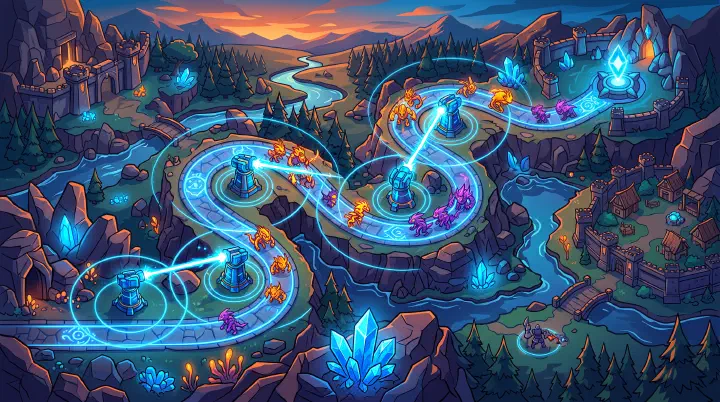
You’re on Wave 18 of Museum. You’ve been running the meta loadout — Farm, Minigunner, Commander, DJ, Accelerator. Your economy is healthy, your towers are maxed, and you watched three guides before queueing. The boss rolls around the final curve and… it just doesn’t die. It slides past your Accelerator with half its HP bar still full, reaches the exit, and the run is over. You lost a wave you were mathematically supposed to win.
The loadout wasn’t the problem. Your placement was.
This is the single most common way good TDS players lose runs. They treat placement like an afterthought. They copy a loadout from a tier list, memorize a tower order, then drop towers wherever there’s an empty square. And it costs them more runs than any boss mechanic ever will.
This guide fixes that. It gives you a map-reading framework that works on every map in Tower Defense Simulator — then applies it to the maps you’ll actually play in 2026, from Crossroads to Hardcore.
Why Placement Beats Loadout (The Math Nobody Shows You)
Here’s the fact nobody puts on a tier list: a tower’s real damage is not its DPS number. It’s DPS × contact time — how long each enemy spends inside that tower’s range.
Two Accelerators with identical stats can perform completely differently on the same map. One sits on the inside of a curve, where the path bends around its range and every enemy is exposed for a full second or more. The other sits on the outside of a straightaway, where each enemy crosses its small circle in a quarter of a second. Same tower, same upgrades, wildly different results. The second one looks nerfed. It isn’t — it’s misplaced.
This is why a veteran with a mid-tier loadout regularly out-clears a beginner with the current meta build. The veteran’s towers are connecting. The beginner’s are pointing at scenery.
Contact time is also why buff towers change your placement math. A Commander’s buff only helps towers inside its radius, and a DJ Booth’s fire-rate buff works the same way. If your damage towers are scattered across the map because each one grabbed the “best” curve, no single Commander or DJ can cover them all — so your loadout’s biggest multipliers quietly stop applying. Placement isn’t just about the path. It’s about keeping your damage cluster inside your buff radius.
The Five Rules That Read Every Map
You don’t need a map-specific guide for every layout if you learn to read maps. These five rules cover them all.
Rule 1: Inside curves before outside, always. A tower on the inside of a bend sees enemies longer because the path wraps around its range. A tower on the outside only catches them as they cross the far edge. When you load into any map, walk the path in your head and mark every inside corner before you place a single tower.
Rule 2: The merge point is where the fight happens. On any map where two paths join, enemies compress into a tight stream at the join. That’s the single best spot for AoE towers — Rocketeer, Pyromancer, Turret — because every enemy on both paths funnels through one tiny area. If a map has a merge, it’s your most valuable real estate.
Rule 3: Buffs go where the DPS is, not where the map is. Don’t center your Commander because it “feels balanced.” Center it on your damage cluster. A Commander covering six towers is worth three times a Commander covering two. Place your DPS first, then walk a Commander between them until it covers the most.
Rule 4: Farms live behind the fight line. Your economy towers should be in spots enemies never reach — the far side of the map, off the path entirely. If a Farm is taking hits, you’ve placed it wrong. On maps where the path loops back near itself, the loop’s inside pocket is often a safe Farm zone.
Rule 5: The last third of the path decides boss waves. Bosses and tanky elites die on the final stretch, where they’ve been slowed and softened by everything before it. Save at least one heavy DPS tower — your Accelerator or Turret — for the last curve before the exit. A boss that reaches the exit at 30% HP is a placement failure, not a damage failure.
Map by Map: Where It Actually Goes
Crossroads — The Grind Map
Crossroads is the classic TDS map: a short, gently winding path with only a couple of meaningful bends. It’s the first map most players see and the one you’ll farm forever.
- Best spots: the two inside curves near the middle, and the final curve right before the exit. On Crossroads there isn’t much map, so inside-curve discipline is the whole game.
- The trap: the long straight section near spawn looks like a great DPS lane. It isn’t. A straight gives you one contact window per enemy and nothing else. Straightaways are for Farms and support, not your damage carry.
- Why it’s the farming map: short path means fast waves and fast clears. Coins per hour beats coins per run — see the Fallen section below for the math.
Museum — The Inside-Curve Classroom
Museum is a long, winding single path with more curves than any beginner map. It’s the best map in the game for learning placement, because every mistake is visible.
- Best spots: every inside curve, in order from spawn to exit. Place your cheapest damage towers on the early curves and your boss-sitters on the last one.
- The trap: beginners zig-zag towers across the map, one per curve, then can’t buff any of them. Keep your cluster within one Commander radius, even if it means skipping a curve.
Lost Temples — The Center Trap
Lost Temples is an open map where enemies walk a loop around the rim. The whole middle of the map is empty ground.
- Best spots: the inside corners of the loop, and any point where two rim segments come close together (the “near-miss” gap) — towers there cover two sections at once.
- The trap: the center. It looks like a defensive position; no enemy ever walks through it. New players lose Lost Temples runs with a beautiful, completely useless ring of towers in the middle. If your towers aren’t on the path, they’re doing zero.
Harbor — The Convergence Test
Harbor is a larger map with multiple lanes that converge toward the exit. It rewards Rule 2 more than any other map.
- Best spots: the convergence point for your AoE stack, then inside curves on each lane feeding it.
- The trap: splitting damage evenly across lanes when your best towers are too slow to cover two. Put your single-target DPS on the lane with the heaviest enemy type, not an even split.
Winter Bridges — Split Coverage
Winter Bridges crosses water, splitting the path into distinct bridge segments. The bridge choke points behave like mini-merges.
- Best spots: both bridge approaches. Enemies bunch up crossing, which makes those approach curves the most efficient damage windows on the map.
- The trap: ignoring one bridge because it’s “the easy side.” Both sides feed the exit. Under-investing in one bridge is how a wave slips through.
Abandoned City — Two Paths, One Economy
Abandoned City runs two converging paths, which makes it the standard “learn multi-path defense” map.
- Best spots: the merge point, then the inside curve on whichever path spawns the tougher enemies.
- The trap: going 90/10 on one path. Keep roughly 50/50 early, then shift the merge. Rule 3 matters here — one Commander in the middle should cover DPS on both paths.
Autumn Hills, First Dawn, Wasteland, Rustbelt — The Mid Pack
These medium maps share a shape: one path, a few honest curves, no gimmicks. Run the five rules on each and you’ll find the same answer — inside curves, one merge if present, a final-stretch boss-sitter. On maps without a natural merge, your AoE towers go on the tightest curve instead.
Sandbox — The Underrated Practice Room
Sandbox is the free-build mode with no waves. Most players use it to test loadouts and never think about it again. Use it to test placement instead: drop a tower, put a dummy enemy on the path, and literally watch how long it’s in range at different positions. Ten minutes in Sandbox teaches more about contact time than fifty games of trial and error.
Picking Maps by Mode
Your map choice changes by mode, because each mode changes what you’re optimizing.
Fallen mode: pick the map you can clear blindfolded. Fallen is where the coin farming happens — roughly 800-1,200 coins per clear depending on speed. The efficiency math is simple: a 15-minute Crossroads clear at 900 coins is 3,600 coins/hour; a 35-minute Hardcore clear at 1,800 coins is barely 3,000/hour, and that’s if you never fail. For farming, clear time beats payout. Whatever map you win at near-100% consistency is your best farm map — for most players that’s Crossroads.
Hardcore mode: pick a map that gives you breathing room. Hardcore enemies have roughly 2-3x the HP of Fallen equivalents and the economy is tighter, so you want the longest path segments between waves you can manage. A map with generous curve coverage keeps every tower connecting, which matters when you can’t afford to rebuild. Don’t chase the “fastest” Hardcore map until your consistency is there.
The Counterintuitive Stuff (Do the Opposite)
The center of the map is a trap, not a stronghold. Everything about how we’re trained to play defense says “central position.” TDS doesn’t care. Enemies walk the rim; your towers must walk the rim with them. Every run lost on Lost Temples is a run lost to this instinct.
Screenshot placements are a lie without your range profile. A great spot for a Turret is a wasted spot for an Accelerator. Your loadout’s ranges and target priorities decide what “best” means. Learn the rule, then adapt the screenshot to your build.
The fastest map is rarely your best farm map. Speed is tempting, but a failed run pays zero coins and eats twenty minutes. The map you clear every time out-earns the map you clear sometimes.
Selling and rebuilding is a strategy, not a panic button. On waves 30+, enemy speed shifts make early-game spots obsolete. Selling at the 30% loss to reposition your carry onto the final stretch is frequently correct. The loss is a fee, and the fee buys contact time — which we established is the whole game.
The last curve’s outside edge can beat its inside. Inside curves win for general DPS, but your boss-sitter wants max forward reach toward the exit. If the inside of the final curve points your tower’s range away from where the boss walks out, the outside edge is the better sit. Geometry beats dogma.
The If-Then Placement Table
| If you see… | Then do this |
|---|---|
| One path, gentle curves | Inside curves for DPS, final stretch for boss-sitter, Farms off-path |
| Two paths joining | AoE at the merge, single-target on the heavy lane |
| Open map, enemies loop the rim | Rim corners + near-miss gaps, never the center |
| Path crosses bridges | Approach curves on both sides of each bridge |
| Waves 30+ on a long map | Sell weak-positioned towers, rebuild onto the final stretch |
| Loadout heavy on Pyromancer/Rocketeer | Longest straight section for burn/AoE contact |
| Loadout has an Accelerator | Choke point or last curve; beam holds bosses in range |
| Commander/DJ in your build | Cluster DPS within one buff radius before you place them |
| Trying to farm coins | Crossroads-style short map, at near-100% consistency |
Three Drills That Teach Map Reading
You can’t read this and suddenly see every spot. Train the eye.
Drill 1: The Pre-Wave Walk. For five games, pause at wave 1 and spend ten seconds walking the path in your head. Say out loud where the inside curves are, where the merge is (if any), and where the boss will walk out. Place nothing until you’ve said all three. This builds the habit of reading the map before the pressure starts.
Drill 2: The One-Buff Game. Run a full game where you force every damage tower inside one Commander radius, even when a “better” curve sits just outside it. You’ll feel the multiplier difference immediately, and you’ll learn how much map you can realistically hold as a cluster.
Drill 3: The Sandbox Range Test. In Sandbox, take one tower you use often — say, Accelerator — and test it at three spots: inside a curve, outside a curve, and on a straight. Watch the contact time with a dummy enemy at each. You now have a personal, loadout-specific map of where that tower actually performs, not where a guide says it does.
Putting It All Together
Next time you lose a run, don’t blame the loadout first. Ask the placement questions: Was every damage tower connecting? Were my buffs covering my DPS? Was my boss-sitter on the final stretch? The answer is usually “no,” and the fix is free.
Map knowledge is the highest-leverage skill in TDS because it multiplies everything else you own. A meta loadout on bad placement loses. A mid loadout on great placement wins. Learn to read the map and every tower you ever buy becomes stronger overnight.
Now load into Museum, walk the path, and mark those inside curves. That’s the whole game.
Frequently Asked Questions
What’s the best map to farm coins in TDS?
Crossroads, because its short path means the fastest clears, and coins per hour beats coins per run. See the Fallen section above for the exact efficiency math. Any short map you can clear consistently works.
What’s the easiest map for beginners?
Museum. One winding path, forgiving waves, and every inside curve is a visible placement lesson. Graduate to Autumn Hills, then Abandoned City for two-path practice.
Should my towers go in the middle of the map?
Almost never. Enemies walk the path, not the middle. On Lost Temples the center is actively a trap — towers there deal zero damage. Place on the path: inside curves, merges, final stretch.
Is selling towers ever worth it?
Yes, late game. The 30% sell penalty is a fee for repositioning your DPS onto the final stretch when enemy speed shifts. It frequently pays for itself in wave 30+ content.
Do my loadout’s ranges change where I place towers?
Yes, completely. A Turret stack wants a merge, a Pyromancer stack wants a straight, an Accelerator wants a choke or the last curve. Match the spot to your range profile, not to a screenshot.
More TDS guides?
See the Related Guides section below, or the TDS hub page for every guide in one place.
Disclaimer: Map layouts and strategies reflect TDS as of September 2026. Game updates occasionally change paths and map availability. Check the official TDS Wiki for the current map roster.