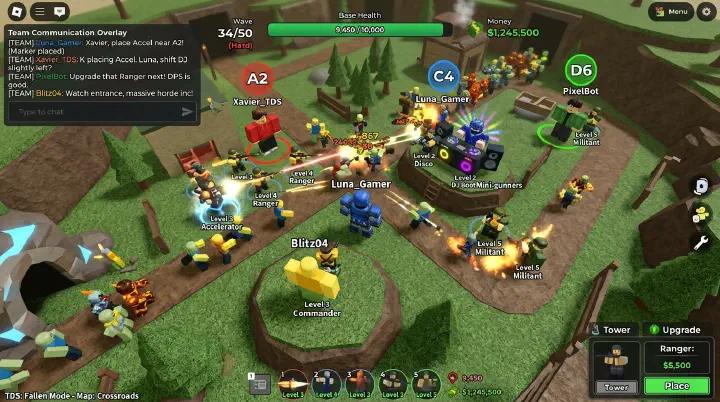
Last updated: August 26, 2026. This guide covers co-op strategies in Tower Defense Simulator, including team tower coordination, player role assignments, communication protocols, and optimal tower placement for 2-4 player groups across all difficulties.
Co-op Basics in Tower Defense Simulator
You load into Fallen with a random teammate. You both drop a Farm in the first thirty seconds, then realize nobody brought early DPS. Wave 3 leaks, and the run is over before it started. That is the co-op learning curve in one scene: every extra player multiplies your gold, but only if you don’t all build the same thing.
Tower Defense Simulator lobbies hold two to four players. Enemy count and health scale with your headcount, and each player keeps their own loadout and economy. A two-player duo is the easiest to coordinate — only two build orders to sync. A four-player lobby is harder to manage but packs the most combined damage when everyone does their job.
More players means more gold in circulation, but it also means four separate build orders that can clash. The core rule of co-op is simple: never duplicate a role without agreeing first. Two Farms early is fine. Two Accelerators in the same corner is wasted gold.
Team Role Assignments
You and your duo are on a hard map. Wave 18 hits and the left lane leaks. One of you is sitting on a maxed Commander while the other has no DPS down yet. The problem isn’t the wave — it’s that nobody agreed on who does what.
Every strong co-op team splits into four jobs: main DPS, support/buffer, crowd control, and economy. Main DPS carries the boss kills with heavy towers like the Accelerator, Minigunner, or Ranger. Support buffs everyone else with the DJ, Commander, or Scientist. Crowd control slows and stalls small enemies with towers like the Sledger or Cryomancer. Economy builds Farms early so the whole team can afford upgrades.
With two players, each of you covers two jobs. One runs DPS plus crowd control; the other runs support plus early game. With three or four, you can split more cleanly and let one player go full economy through the early waves.
A Quick “Who Builds What” Decision Table
| If… | Then you should… |
|---|---|
| Your teammate picks a heavy DPS tower (Accelerator, Minigunner) | Pick a Farm or support tower so gold and buffs cover them |
| Nobody has a Farm by wave 5 | Drop yours now and let economy lead, even if it means skipping early DPS |
| You are past wave 20 with spare gold | Shift economy into DPS or support instead of hoarding |
| The boss wave is next | Whoever holds buff towers saves abilities for that wave |
The Counter-Intuitive Truth
The player with the least damage is often the most important person on the team. A dedicated Farm-and-support player makes everyone else’s towers hit harder and level faster. Don’t judge contribution by the damage board. A support player who times a Commander or DJ ability on a boss wave swings the run more than a third DPS tower ever will.
Tower Placement Strategy for Co-op
Two of you build Minigunners on the exact same corner. One of them never gets a clean line of sight. That gold could have covered the empty far lane instead.
Placement in co-op is about coverage, not raw count. First, don’t overlap: two towers shooting the same stretch of path is redundant. Second, cover every lane — a leak on the far side is a wipe no matter how strong your choke point is. Third, keep buff towers inside range of the towers they boost; a DJ placed out of reach is just decoration. Fourth, spread your Farms so each player builds near their own economy. Fifth, funnel enemies through one boss-kill zone where your highest DPS towers sit.
The mistakes repeat every game. Players all build the same tower type. Buff towers end up too far from the damage. Nobody builds early game and wave 4 leaks. Towers block each other’s line of sight. Or an entire spawn point goes unguarded. Assign tower types before the first wave and check buff ranges before you commit.
For a deeper look at where to build, read our Tower Placement Theory.
Communication Strategies
Communication is the difference between a clean run and a slow leak that nobody notices. Before the game starts, settle four things: which map, which difficulty, who brings which towers, and who builds economy first. A thirty-second plan beats an entire run of guessing.
In-game, callouts should be short and specific: “boss next,” “left lane leaking,” “holding ability.” Voice chat is the best tool for Fallen and Hardcore runs because boss phases need instant reactions. Text chat is fine for setup but too slow mid-combat. Pings and markers are a good supplement, not a replacement.
If you can’t use voice, agree on a few pre-typed phrases before the wave starts. The goal is always the same: tell the team what is happening before it becomes a problem.
Build a short callout set before you start and stick to it. A workable four-message kit: “farm down” when your economy is placed, “boss next” one wave before the boss spawns, “leak left/right/mid” the second an enemy passes your line, and “holding” right before you pop a buff or a stun. Repeating the same four phrases makes them automatic — teammates react to the word, not the typing. The teams that wipe at wave 30 are not the ones without microphones, they are the ones who never agreed on what “help” means.
Wave-by-Wave Co-op Strategy
The run has three phases, and the decisions change at each one.
Early waves (roughly 1-10): build economy first. Farms and cheap towers come before anything expensive. Do not dump gold into a big DPS tower before your economy is running — a team with strong economy and mid-level towers outlasts a team with one maxed tower and no gold.
Mid waves (roughly 11-25): this is where damage comes online. Every DPS player should have a solid upgraded tower down, and the support player starts stacking buffs on the primary damage dealer. Crowd control fills in the gaps so nothing sneaks through the sides.
Late waves (roughly 26+): the economy player transitions into a second DPS role. All main towers go to max level, buffs stay running, and everyone focuses the boss spawn point when the big one arrives.
The through-line: never fall behind on economy. A team with level 2 towers and full gold outperforms a team with level 3 towers and nothing in the bank.
When a Teammate Drops Mid-Run
Someone disconnects on wave 22 and the lobby does not refill. Your build order is now wrong — you planned for four players of damage and you have three. The fastest recovery is to accept the loss of the missing role instead of trying to cover it. If the Farm player left, someone sells their weakest DPS and rebuilds economy; the gold gap will kill you slower than the missing tower. If the crowd-control player left, buy the cheapest slow you can afford and park it on the spawn side, because the summon-heavy waves will hit you first. Reset expectations too: a four-player build running on three players usually ends around wave 27-29, so push for a clean score rather than a desperate one. Most teams that panic and sell everything die on the very next wave.
Tower Synergies in Co-op
Some towers get far stronger when a teammate builds the other half of the pair.
The classic is the Accelerator with a Commander and a DJ. The Accelerator is your ramping boss killer; the Commander’s ability and the DJ’s beat push its damage and fire rate higher. Stack those buffs on one target and a hard boss melts noticeably faster than an unbuffed tower would manage on its own.
The Sledger plus Cryomancer is the crowd-control pair. The Sledger slows and damages a crowd, while the Cryomancer freezes enemies so every other tower on the field deals bonus damage to them. Slowed and frozen enemies spend more time in your kill zone.
Minigunner plus Ranger plus Scientist gives you sustained damage and single-target burst under one buff. The Minigunner holds the line while the Ranger focuses the biggest enemy, and the Scientist’s stim pushes both higher.
For a full breakdown of which pairs are worth building, see our Tower Synergy Combos guide.
Mode-Specific Co-op Strategies
Normal is forgiving. Two players with basic coordination clear it, and the priority is economy first, damage second. It’s a good place to practice role assignments before harder modes.
Hard and Molten demand real specialization. Molten enemies resist slows, so lean harder on pure DPS and less on crowd control. Buff towers stop being optional here — a team without a Commander or DJ is working with one hand tied.
Fallen is where a four-player team earns its keep. Fallen bosses carry huge health pools and summons, so you need max buff stacking on your best DPS tower plus dedicated crowd control for the extra enemies. Designate one shot-caller, usually the main DPS player, and call out boss phases as they happen.
Hardcore is the level-gated extreme. It pushes everything harder and punishes a missing role immediately. Bring a practiced four-player setup. We cover it in our Hardcore Mode Guide, and the Fallen specifics live in the Fallen Mode Guide.
Boss Wave Coordination: Splitting Jobs Mid-Fight
The Fallen boss spawns. Your team has thirty seconds to get every ability on cooldown in the right order, and nobody has time to discuss it. This is where a pre-agreed job split pays for itself.
Give each player one job before the wave starts. The shot-caller, usually your main DPS player, watches the boss’s HP and calls the moment its shield breaks. The buffer holds Commander or DJ ability for that call, not for random early waves. One crowd-control player ignores the boss entirely and handles the summon wave — those small enemies are what actually kills a team, because everyone is staring at the boss and nobody sees the summons flanking. The economy player either finishes a tower or pre-places a second DPS near the boss path so damage is already coming online.
The sequence should be mechanical: summons spawn, the CC player stuns the pack, the shot-caller says “buff,” the buffer pops Commander and DJ, and everyone focuses the boss head. If the CC player panics and burns the stun on the boss itself, the summon pack walks through and the run ends at 85%. Practice the order on Normal first so the muscle memory is there before Fallen.
What Went Wrong: The Wave 24 Leak
Our first serious Fallen run fell apart at wave 24, and it was our own fault.
The mistake: all four of us built heavy DPS towers and skipped a dedicated crowd-control tower. The early waves died fast, so we felt strong and kept spending on damage.
Why it failed: the small, fast enemies arrived in a wave our single-target towers couldn’t clear quickly. They streamed through the gap between two Minigunners, and by the time anyone called the leak, three of them were already through. We had the gold to fix it, but no tower was in position to cover the gap in time.
The recovery: we restarted, put one player on a Sledger near the spawn, and agreed that the crowd-control player calls out the moment anything reaches the halfway point. That one adjustment turned the leak into a non-event on the next attempt. The lesson stuck: a role you skip to afford more damage is a leak waiting to happen.
Cross-References
- For general strategy and tower rankings, see our TDS Strategy Guide
- For loadout recommendations, see our TDS Loadout Guide
- For tower rankings and tier data, see our TDS Towers Tier List
- For economy setup and gold generation, see our Coin Farming Guide