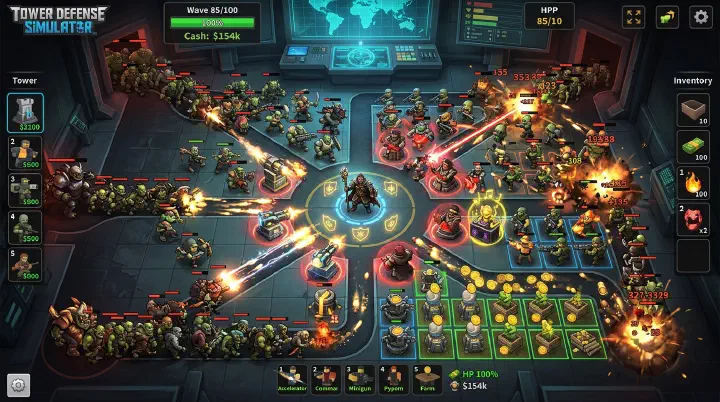
You queue Fallen Mode solo because your friends are offline and random lobbies feel like playing roulette with three strangers who might AFK by Wave 10. The map loads. It’s four lanes funneling into your single base. In a team, each player would own one lane. Tonight, all four lanes are yours.
Wave 1 through 10 are smooth. You place a Golden Scout near the front, it chips down the normals, and you start your first Farm in the back corner. Wave 15 rolls in — you’re holding fine, your Accelerator’s beam locked onto a Fallen Hero and it’s melting. Wave 25, still holding. You’re thinking, “Maybe this solo thing isn’t so bad.” You even start to relax.
Wave 31 hits. The announcer drops “Fallen Guardians” and your screen floods with bulky green shields marching down the path in a tight cluster. Your Accelerator? Still single-target, drilling one Guardian while three more slide past. Your Djinn? Sitting there buffing a tower that’s already maxed, its aura wasted on empty air. In a four-player lobby, your buddy’s Mortar would’ve carpet-bombed that entire cluster. Your other friend’s Turret would’ve chipped away from a different angle. A third player’s Engineer sentries would’ve caught the leaks.
But you’re alone. The Guardians waltz past your choke point, your base health ticks down from 100 to 0 in about four seconds, and the defeat screen pops.
You brought a team loadout to a solo game. That’s the mistake almost everyone makes.
Why Solo Players Keep Failing (And It’s Not Skill)
Let’s be honest — solo TDS isn’t necessarily harder. It’s different. The problem is that most guides, most YouTube videos, and most loadout advice assume you’ve got four players covering four corners of the map. When you strip that away, the whole math changes.
Here’s what actually goes wrong.
Team loadouts rely on role specialization. In a squad, someone runs pure DPS. Someone else runs Farm to feed the team. Another player handles early-game with Golden Scout spam. In solo, you ARE all four players. If your loadout doesn’t cover early, mid, AND late game by itself, you’re dead before Wave 20.
Support towers lose half their value. Djinn, Commander, and even Medic are built around buffing other players’ towers or splitting responsibility. Commander’s Call to Arms is great, but if you’re only buffing two towers instead of eight, the slot efficiency tanks. In solo, every tower slot has to pull its own weight.
Map coverage becomes YOUR problem alone. In a team, you can afford to stack towers near your assigned entrance. Solo? Every enemy on the map is heading to YOUR base. You can’t delegate the back path to someone else. If your towers only cover the front half of the map, the back half becomes a free express lane to your death.
You can’t afford dead rounds. In team play, if you have a bad wave and leak a few enemies, your teammates probably clean it up. Solo? Every leak is permanent damage. There’s no safety net. Your build order has to be tight enough that there are zero weak waves, not just “manageable” ones.
Why Solo Players Die Before Wave 30
Most solo runs don’t end on Wave 50 because of a late-game collapse. They end on Wave 12, Wave 18, or Wave 28 because of a decision made ten waves earlier. Here are the specific mistakes that kill solo players before they ever see the real challenge.
Trying to cover all lanes equally. In a team, each player handles one entrance. Solo players see four lanes and instinctively place one tower per lane. That spreads your damage so thin that nothing dies fast enough. By Wave 15, each lane has a level 2 Scout doing tickle damage while bulky enemies walk through. The correct play is to stack a strong front choke on one or two lanes first, then expand — not to divide your power like you’re still playing with teammates.
Not prioritizing economy towers over damage. Every minute you delay your first Farm is a minute you’re falling behind the exponential curve. Solo players often place three damage towers before their first Farm, thinking they need the firepower. By Wave 20, the player with two maxed Farms has enough cash to drop an Accelerator. The player with three early damage towers is still scraping together upgrade money while enemies leak through.
Using team-oriented loadouts with buff dependencies. Commander, Djinn, and Medic are built for squads. A solo Commander buffing two towers is just a very expensive cheerleader. If your loadout includes a support tower that needs four other towers nearby to justify its slot, you’ve built a team comp for a solo queue. That missing DPS slot catches up with you around Wave 25 when the wave density spikes and you simply don’t have enough bullets in the air.
Placing towers only at the front spawn. Teams can afford to stack at the front because other players cover mid and back. Solo players who do this have zero depth. The moment a fast enemy slips past the front line — and it will, by Wave 18 at the latest — there is nothing to stop it. One leaked Fallen Hero at Wave 22 takes off 20 base health. Three leaks and you’re done before Wave 30.
Ignoring the cash reserve. Team players can spend every dollar because someone else can cover emergencies. Solo players who spend to zero after every wave have no answer for surprises. The hidden enemy type on Wave 19, the unexpected air unit on Wave 24 — these require an emergency placement. If your balance is $0, that leak becomes permanent damage. Keep a reserve of at least $1,000 after Wave 15.
The Mental Shift: You’re Not Playing Harder, You’re Playing Smarter
Solo TDS rewards a completely different mindset. In teams, you can afford to greed — skip a round of defense to upgrade your Farm early because someone else has your back. Solo greed gets you killed. You need defensive stability before you scale your economy.
You also need to stop thinking about “best towers” and start thinking about “best coverage.” A tower that does 80% of its damage in one small area is fine in a team where someone else covers the gap. Solo, you need towers that can either cover multiple paths or be repositioned to handle shifting threats.
And here’s the counter-intuitive part some players miss: some modes are actually easier solo than with randoms.
Seriously. Random teammates split the cash four ways, often place towers in useless spots, and sometimes AFK. Solo, every dollar of income goes into YOUR build. Every tower is exactly where YOU want it. If you know what you’re doing, you can optimize tighter than any disorganized pub lobby.
The Solo Survival Loadout Framework
Picking towers for solo TDS isn’t about bringing your favorites. It’s about solving a math problem with five slots. Every tower must answer at least one of these questions: Does it earn me money? Does it kill early waves cheaply? Does it kill late waves reliably? Does it cover multiple lanes?
Here is the decision framework for every mode you queue.
For Fallen solo → use Accelerator, Farm, Engineer, Golden Scout, Ranger. Fallen mode sends tanky bosses in clusters. You need Accelerator for the big HP bars, Engineer to distribute damage across lanes with sentries, and Ranger for the range to cover awkward map angles. Golden Scout carries Waves 1–10 so you can afford Farms. This is the “boss melter” framework.
For Golden solo → use Turret, Farm, Golden Scout, Rocketeer, Ranger. Golden Mode is shorter and spammier. Turret gives you cheap, reliable DPS without buff dependencies. Rocketeer punishes clustered waves. The focus here is concentrated firepower on a compact map rather than distributed coverage. This is the “cluster shredder” framework.
For Hardcore solo → use Accelerator, Farm, Engineer, Golden Scout, Militant. Hardcore demands immediate DPS. Militant’s faster fire rate and lower cost beat Ranger here because you cannot afford to wait for big upgrades. The early game is the entire game in Hardcore — if you survive Wave 12, your scaling will carry you. This is the “early pressure” framework.
For event modes solo → use Accelerator or Turret, Farm, Engineer, Golden Scout, and one flex slot. Events change, but the framework stays: versatile towers over hyper-specialized ones. The flex slot answers the event gimmick — Rocketeer for spam, Ranger for bosses, Demoman for shields. Scout the first wave before you commit your full build.
Solo Loadout by Mode: What Actually Works
Not every mode demands the same approach. Here’s what to bring when you’re flying solo.
Fallen Mode Solo
Fallen is the big one everyone asks about. Can you beat it solo? Yes. Should you bring the same loadout you use in squads? Absolutely not.
The loadout: Accelerator, Farm, Engineer, Golden Scout, Ranger.
Accelerator is your boss melter. It handles the big threats — Fallen Kings, Fallen Guardians, the stuff that otherwise walks through your entire setup. Engineer is the secret weapon most solo players skip. The sentries give you distributed damage across multiple lanes, which matters when you’re the only one covering the whole map. Golden Scout carries your early game cheaply. Ranger gives you the range to hit enemies from awkward angles when your map placement isn’t perfect.
Placement strategy: Don’t stack everything at the front. That’s a team habit. In solo, you need a front choke for early waves and a mid-map backup line for anything that slips through. Put your Accelerator near the middle of the map where it can reach the longest stretch of path. Engineer goes near a corner so sentries spawn covering two directions. Farm goes in the back corners where it won’t steal space from your damage towers.
Farm priority: In Fallen solo, you want max Farms by Wave 20. That sounds aggressive, but Engineer and Golden Scout handle the early waves cheaply, freeing up cash. If you aren’t maxing economy by mid-game, you won’t afford the Accelerators and Rangers you need for the late 30s.
Golden Mode Solo
Golden Mode is shorter but spammier. The enemies come fast and in clusters rather than one big tanky boss.
The loadout: Turret, Farm, Golden Scout, Rocketeer, Ranger.
Turret is criminally underrated in solo. It’s cheap, it has solid DPS for its price, and it doesn’t need buffs to perform. Rocketeer handles clustered waves that would otherwise overwhelm your single-target towers. Golden Scout again covers early waves. Ranger is your safety net for anything that gets through.
Placement strategy: Golden Mode maps are usually compact. Abuse that. Overlap your Turrets’ ranges so every enemy gets hit by multiple towers at once. Put Rocketeer where it can hit the densest part of the path — usually a straight section or a loop. You don’t need map-wide coverage as much as concentrated firepower.
Hardcore Mode Solo
Hardcore is where solo gets nasty. The enemies are faster, tankier, and the waves don’t give you breathing room.
The loadout: Accelerator, Farm, Engineer, Golden Scout, Militant.
You might notice this looks similar to Fallen. That’s because Hardcore demands the same core tools — but Militant replaces Ranger here. Militant’s faster fire rate and lower cost matter more in Hardcore because you need DPS now, not later. You can’t always afford to save for an Accelerator when Wave 12 sends a rush that’ll end your run.
Placement strategy: Hardcore punishes lazy placement. Put your early Militants where they cover the spawn point. As waves progress, add Engineer near the center and Accelerator covering the longest line of sight. Never leave a path segment uncovered — in Hardcore, even three leaked enemies can cost you the game.
Event Modes Solo
Event modes are weird because they change. But the solo principle stays the same: bring versatile towers, not hyper-specialized ones.
General event loadout: Accelerator or Turret (whichever fits the event’s enemy types), Farm, Engineer, Golden Scout, and one flex slot.
The flex slot should answer the event’s specific gimmick. If the event spams fast weak enemies, bring Rocketeer or Demoman. If it sends massive bosses, bring Ranger. If it’s got shielded enemies, you need something with pierce or high burst.
Placement strategy: Event maps often have unusual pathing. Before you place a single tower, watch the first wave and note where enemies actually walk. Many event maps have split paths or loops that aren’t obvious from the preview. Place one cheap Golden Scout first, observe, then build your actual setup around the real pathing.
Counter-Intuitive Solo Advice
These are the lessons that break team habits and save solo runs.
You don’t need to cover every lane — you need to kill enough to survive. Four lanes does not mean four towers. One strong choke that kills 90% of enemies is better than four weak towers that kill 25% each. Let a few weak enemies leak early if it means your economy is online. Health is a resource you can spend.
The best solo tower is the one that does two jobs. Engineer isn’t just DPS — it’s distributed DPS across multiple lanes. Ranger isn’t just damage — it’s damage plus air coverage plus extreme range. In solo, a tower that fills two roles is worth more than two specialized towers because you only have five slots.
Support towers get worse, not better, in solo. In a four-player lobby, Commander buffs eight towers and Djinn buffs four. The same towers in solo might buff two. The efficiency per slot drops by 50-75%. A “good” team tower becomes a bad solo tower. If it doesn’t deal damage directly, it needs to justify its existence with massive multipliers — and most don’t.
Sometimes you should let enemies walk past your front line. A tower placed at the back of the map gets more total time to shoot as enemies travel the full path. Front-loading everything is a team instinct. Solo players who place their highest-DPS tower in the middle of the map, where enemies pass twice on a loop, get double the value from that slot.
Late-game waves are easier solo than in a random lobby. This sounds wrong until you do the math. In teams, wave bonus is split four ways and random players place inefficient towers. Solo, you keep 100% of the wave bonus and every tower is optimally placed. If you survive to Wave 35, you often have more cash than in a team because you’ve been compounding un-split income for half an hour.
Placement Tricks That Only Matter in Solo
In teams, you can get away with sloppy placement because four players create overlapping coverage by accident. Solo, you need intentional tricks.
The double-back. On maps with a U-turn or loop, place your highest-DPS tower where it can shoot enemies entering AND exiting the turn. That’s two passes on the same tower’s range. In a team, someone else probably already claimed that spot. Solo, it’s yours and it’s the best real estate on the map.
Farm zoning. In solo, you don’t have teammates to cover for you while you greed. So place your first Farm before Wave 5, but position it in the absolute corner where no tower would ever go. Don’t let Farms steal prime damage real estate. Every tile matters when you’re the only builder.
The bait tower. Place one cheap Golden Scout slightly ahead of your main line. Its job isn’t to kill — it’s to make enemies stop or slow down so your main towers get extra shots. In teams, this is a waste. Solo, that extra half-second of exposure can be the difference between a leak and a clean wave.
Diagonal coverage. Most players place towers parallel to the path. Angle them diagonally. A tower placed at 45 degrees to a corner can sometimes cover two path segments at once. This is especially strong with Engineer, where the sentry spawn logic benefits from hitting multiple approach vectors.
Why Farm Is Twice As Important in Solo (And Nobody Talks About It)
Here’s the counter-intuitive truth that changes everything.
In a four-player team, Farm is nice. In solo, Farm is mandatory and you need more of it than you think.
Here’s why. Team income is split. Four players with level 1 Farms each generate less total cash than one player with maxed Farms. But more importantly, team players can rely on each other’s towers to handle waves while they upgrade economy. Solo, you need your defense AND your economy online simultaneously.
That means your early game can’t just be “place damage towers and hope.” It has to be “place the minimum damage needed to survive, then pour everything into Farm upgrades until they’re maxed.” In Fallen Mode solo, you want your first max Farm by Wave 12. In Golden Mode, by Wave 10. In Hardcore, by Wave 14 because the pressure starts earlier.
If you’re finishing a solo run and thinking “I had great towers but ran out of money for the final waves,” your Farm timing was wrong. Not your tower choice. Your economy.
Another non-obvious point: you keep 100% of the wave bonus in solo. In teams, the bonus is split. That means late-game waves actually give you MORE effective income per player than in a squad. Solo players who survive to Wave 35+ often find they have more cash than they know what to do with — because they’ve been compounding un-split bonuses for thirty minutes.
Common Solo Mistakes to Stop Making Right Now
Bringing buff towers without the troops to buff. A solo Commander buffing two towers is a waste of a slot. If you’re running support, you need at least four towers in range to justify it. Otherwise, replace it with another damage dealer.
Over-investing in early defenses. Yes, you need to survive. But if you spend 5,000 on Wave 8 defenses that become irrelevant by Wave 20, you’ve stalled your economy for nothing. Build “just enough” early, then pivot hard to Farms.
Ignoring air units. In teams, someone always has a tower that incidentally hits air. Solo, if you don’t specifically plan for flying enemies, you’re dead the moment they show up. Ranger, Accelerator, and Turret all handle air. Make sure at least two of your towers can target flyers.
Placing everything at the spawn. I get it — you want to kill stuff early. But if your entire defense is stacked at the front and a fast enemy slips through, you’ve got nothing. Solo builds need depth. Front line, mid line, back line. Even a single cheap tower at the base has saved more solo runs than most players want to admit.
Not adapting mid-run. Team players can specialize and stick to their role. Solo, if Wave 18 reveals a weakness in your build, YOU have to fix it. Keep a small cash reserve for emergency placements. The best solo players aren’t the ones with perfect plans — they’re the ones who notice a leak on Wave 14 and place a stopgap tower before Wave 15 repeats the same problem.
Final Thoughts: Solo Is a Different Game
Tower Defense Simulator doesn’t officially have a “solo mode.” But it might as well. The strategy, the economy timing, the placement logic — it’s all fundamentally different when you’re the only player on the map.
Stop copying team loadouts. Stop assuming random teammates make the game harder. Sometimes they do, but a well-optimized solo build will always outperform a chaotic lobby because every dollar, every tile, every decision is yours alone.
Start with the right mindset: stable early defense, aggressive economy, full map coverage, and zero reliance on support towers that need a team to function. Master that, and you’ll stop staring at defeat screens on Wave 31.
You’ll be the one laughing when the Fallen Guardians spawn — because your Engineer sentries, your backup Ranger, and your carefully planned double-back coverage are already waiting for them.
Now queue up solo. You’ve got a Fallen Mode to beat.
Related Guides
- TDS Tower Tier List — Every tower ranked, with solo viability notes for each pick
- TDS Tower Placement Theory — Advanced placement logic for double-backs, diagonal coverage, and lane prioritization
- TDS Hardcore Mode Guide — Deep dive into the hardest mode, with wave-by-wave survival tactics
- TDS Beginner’s Guide — New to TDS? Start here before you queue solo
- TDS Fallen Mode Guide — Full breakdown of Fallen Mode mechanics, enemy types, and late-game threats