Last updated: August 3, 2026.
The Wave 28 Leak That Shouldn’t Have Happened
Jake had done everything right. He’d watched the tier list videos. He’d saved up for Accelerator. He’d even prestiged his Commander. So when he loaded into Fallen Mode on Crossroads, he dropped his Accelerator at the center intersection — the “obvious” best spot — surrounded it with DJ and Commander, and sat back.
Wave 28 hit. The Fallen King stomped onto the track. Jake’s Accelerator shredded the first half of the wave… then leaked. Not because he ran out of damage. Three Hidden enemies slipped past on the far side of the map where his coverage didn’t reach. His Accelerator had been firing at the main blob the entire time, never turning to catch the stragglers.
Jake’s “perfect” placement was actually a one-zone trap. He’d put his best tower where it looked good instead of where it actually controlled the map.
That’s the gap between owning S-tier towers and getting S-tier value from them. Placement isn’t decoration. It’s the multiplier that turns good towers into game-winning towers.
Two Players, Same Towers, Different Results
Two players load into Fallen Mode on Crossroads. Both use the exact same loadout: Militant, Farm, Commander, DJ, Minigunner. Both follow the same upgrade order. Both survive to wave 35.
Player A’s Minigunner dealt 84,000 damage. Player B’s Minigunner dealt 121,000 damage — 44% more. Same tower. Same upgrades. Same buffs from Commander and DJ. The only difference: Player B placed their Minigunner 2 tiles to the left of where Player A placed theirs.
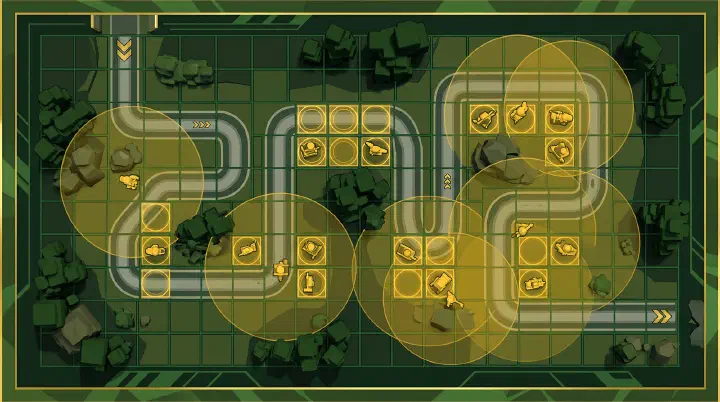
Those 2 tiles changed how many track segments the Minigunner’s range covered. Player A’s Minigunner covered 2 segments. Player B’s covered 4. Same tower, same cost, 44% more value — because of placement.
This is tower placement theory. It’s the most under-taught skill in TDS and the reason two players with identical loadouts can have completely different win rates.
Failure Mode 1: The One-Zone Illusion
This is the most common placement mistake in TDS, and it’s invisible until you know what to look for. A player drops their best tower in a spot that feels central. The range circle looks huge. It touches the track in multiple places. They feel great about it.
Then the wave comes. And the tower fires for about 3 seconds, then sits there idle while enemies walk through a completely different part of the map. The tower’s range technically touches the track, but in the wrong place — it’s covering a tiny sliver of one segment instead of the full length of multiple segments.
The one-zone illusion happens because the human eye is drawn to the center of the map, not the geometry of the track. Players think “center” means “best.” But in TDS, “best” means “the spot where the range circle intersects the maximum number of straight track segments.”
How to spot it: Before you finalize any tower placement, zoom out and trace the enemy path with your eyes. Count how many straight segments fall inside the tower’s range circle. If the answer is 1, you’re in a one-zone trap. Move the tower.
The fix: Walk the entire track from entrance to exit before you place anything. Find the intersections, corners, and U-bends. Those are your multi-zone positions. The center of the map is only good if it’s also a track intersection.
Failure Mode 2: The Rotation Tax
Every tower in TDS has a facing direction. When enemies leave a tower’s range on one side and new enemies enter from the opposite side, the tower has to physically rotate. That rotation takes time — fractions of a second per turn. Over a 40-wave match, a poorly positioned tower can spend 15-20% of its total time rotating instead of firing.
This is invisible damage loss. You don’t see the tower failing. It’s still shooting. It’s just shooting less often than it could be.
The rotation tax hits hardest on corner placements. A tower placed at a 90-degree bend has enemies approaching from the west and leaving to the north. Every time a new group enters, the tower spins 90 degrees. Double that if the next group comes from the opposite direction. On maps with winding paths, the rotation tax can steal a third of your tower’s effective DPS.
How to spot it: Watch your tower during a wave. Does it spin back and forth between groups? If yes, you’re paying the rotation tax.
The fix: Align your tower’s position with the longest approach vector on the map. If enemies spend 80% of their time walking east-to-west on a long straightaway, place your tower so it faces that direction. The tower will spend most of the wave firing, not turning.
Failure Mode 3: The Buff Cascade Collapse
This failure mode is a chain reaction. It starts with one small placement mistake and cascades into a complete support breakdown by wave 30.
Here’s how it happens. A player places their Commander first — in a spot that looks good for Commander. Then they place DJ nearby. Then they drop their Minigunner where it fits. On wave 25, they realize their Minigunner isn’t getting Commander’s fire rate buff. The Commander is just barely out of range. They can’t move the Commander without selling it. They can’t move the Minigunner without losing the spot. They’re stuck.
The buff cascade collapse happens because players place support towers without checking which DPS position they’re actually buffing. Commander’s radius is smaller than DJ’s. If you place Commander first, you’re anchoring your entire defense to a smaller circle. Everything else has to squeeze into that circle — and often, the best DPS position doesn’t fit.
The fix: Change the placement order. Always place DJ first — its radius is the largest constraint. Then place Commander inside DJ’s radius. Only then do you place your DPS tower where both buffs overlap. This order guarantees that your DPS tower gets both buffs, because you built the support infrastructure around the DPS position, not the other way around.
The Placement Decision Framework
When you load into a map, don’t place anything for the first 10 seconds. Instead, run through this checklist.
Trace the full path. Walk the entire track from entrance to exit. Count the straight segments and the corners. Mark the longest straightaway and the tightest chokepoint.
Identify the “spine” — the longest contiguous track section. This is where enemies spend the most time. Your main DPS tower belongs somewhere along this spine.
Find the 3-zone position. Look for a spot where a single tower’s range circle covers three straight segments. This is usually near an intersection, a T-junction, or a tight corner. If you can’t find a 3-zone spot, find the best 2-zone corner.
Place DJ first. DJ has the largest buff radius. Put DJ where its circle reaches the 3-zone position you found in step 3. DJ’s placement determines where everything else goes.
Place Commander inside DJ’s radius. Now you’ve created an overlap zone that gets both buffs.
Place your main DPS tower in the overlap zone at the 3-zone position. This is your anchor. Everything else supports this tower.
Fill gaps with secondary DPS. Place your second-best tower where it covers the track segment your main DPS misses — usually the approach to the main DPS zone or the exit after it.
Place Farms last, in the safest back corners. Never compromise DPS placement for Farm safety, but never risk a Farm near the track either.
Most players do the opposite: they place their DPS tower first, then try to squeeze DJ and Commander nearby. That works sometimes, but it’s backwards. DJ’s radius is the largest constraint. Anchor DJ, then build around it.
5 Counter-Intuitive Placement Truths
Truth 1: The Dead Zone Beats the Center
Players instinctively hug the track. They think, “If I’m closer, I hit sooner and harder.” But a tower like Accelerator has 25+ range. It doesn’t need to be close. It needs to be alive.
Placing Accelerator at the back edge of the map — far from the track, with its range circle just grazing the path — lets it reach forward to hit multiple distant segments while staying completely safe. Enemies can’t damage what they can’t reach. A tower hugging the central intersection might cover 4 zones, but it’s also exposed to every enemy that makes it past your front line. One leaked boss and your “perfect” tower is dead.
The dead-zone placement costs you maybe 5% coverage. It buys you 100% survivability. On Hardcore mode, where one leaked enemy can end your run, that trade isn’t even close.
The real placement meta isn’t maximum coverage. It’s maximum sustainable coverage — the most track segments your tower can cover without dying.
Truth 2: The Back of a Straightaway Beats the Front
New players always place towers at the front of a straight segment. The logic seems sound: “I’ll hit them as early as possible.” But front-placement is a trap. Enemies spend 2 seconds in your range before they’re past you. A tower at the back of the same straightaway hits enemies for the entire length of the segment — 8, 10, sometimes 12 seconds of continuous fire.
The math is simple. A tower’s total damage on a wave equals (DPS) x (time enemies spend in range). Front-placement minimizes time-in-range. Back-placement maximizes it. You’re not losing damage by placing further back. You’re gaining it.
Place DPS towers at the middle-to-back of straight segments. Not the front.
Truth 3: Sell Your Best Early Tower for a Mediocre Late Tower
This one hurts. You’ve invested 3,000 coins into your level 3 Militant. It’s served you well through wave 20. Now you want to place a Minigunner. But you’re short on coins. The instinct is to keep the Militant and save up.
Don’t. A level 0 Minigunner in a 4-zone position does more damage than a level 3 Militant in the same spot. The 30% sell penalty on the Militant stings. But the performance gap between an early-game tower at wave 25 and a late-game tower at wave 25 is 3x or more. The math favors selling.
Sell your early tower, place the late tower, and use the freed coins to fund the first upgrade. The net damage output jumps immediately.
Truth 4: Spread Your DPS or Lose Everything
The overlap zone is valuable. But if you put all three of your DPS towers inside it, you’ve created a single point of failure. One enemy with AOE damage, one stun from a Fallen, one boss ability — and your entire damage output goes offline.
Keep your two best DPS towers at least 4-5 tiles apart. Put one in the main overlap zone. Put the second in a secondary strong position covering a different track segment. If one goes down, the other keeps firing. Diversification isn’t just for stocks.
Truth 5: A B-Tier Tower in a 4-Zone Spot Beats an S-Tier Tower in a 1-Zone Spot
Tier lists rank towers in a vacuum. They assume perfect placement. In real matches, placement is the multiplier. A Militant in a 4-zone position on Crossroads will out-damage an Accelerator placed in a 1-zone side pocket. Every time.
This means your placement priority should be: find the best position first, then put your best tower in it. Don’t put your best tower in a mediocre spot just because you had the cash for it sooner. Wait. Save. Place the S-tier tower in the S-tier position.
The Coverage Zone Concept
Every track in TDS can be broken into “coverage zones” — straight-line segments where enemies walk in a single direction without turning. A tower placed at the right position covers multiple zones simultaneously. A tower placed poorly covers one zone and spends half its time idle, waiting for enemies to enter its range.
How to Count Coverage Zones
Look at the track from above. Every time the track bends or turns a corner, a new coverage zone begins. Count how many straight segments fall within your tower’s range circle.
- 1 zone: The tower covers one straight segment. It’s active about 60% of the time. Acceptable for early-game towers you’ll replace.
- 2 zones: The tower covers a corner — enemies approaching from one segment AND enemies leaving on the next. Active ~80% of the time. Good for mid-game towers.
- 3 zones: The tower is at a T-junction or complex intersection. Active ~95% of the time. Optimal for your main DPS tower.
- 4+ zones: The tower covers a major intersection. Constantly firing. Best possible placement — this is where your Minigunner or Accelerator goes.
The 2-Tile Rule
Moving a tower 2 tiles along the track often adds or removes an entire coverage zone. Here’s why: tower ranges are circular, and track corners create coverage zone boundaries. A tower placed 2 tiles toward a corner might capture both the approaching segment AND the departing segment. A tower 2 tiles away from the corner might only capture one.
Example on Crossroads: The central intersection has 4 track segments converging. A tower placed exactly at the intersection covers all 4 segments — but it’s exposed, and enemies can walk right up to it. A tower placed 2 tiles back from the intersection, behind a small piece of cover, covers 3 segments and is protected. The 2-tile sacrifice costs one coverage zone but keeps the tower alive through wave 35. This is the placement tradeoff: coverage vs survivability.
The 2-tile rule also applies to buff placement. Commander’s buff radius is smaller than DJ’s. If DJ is placed 2 tiles too far from the DPS position, Commander might fit inside DJ’s radius but the DPS tower falls outside Commander’s reach. Always check both radii, not just DJ’s.
Commander & DJ: The Overlap Zone
Commander and DJ aren’t damage towers, but their placement matters just as much. Both provide buffs in a radius around them. The “overlap zone” — where both Commander’s fire rate buff and DJ’s range buff overlap — is where your DPS towers should go.
The optimal layout on most maps:
- Place DJ first (larger radius, range buff + discount)
- Place Commander inside DJ’s radius (gets the range buff too)
- Place DPS towers where Commander’s radius and DJ’s radius OVERLAP
- The overlap zone gets both buffs simultaneously — fire rate AND range
A Minigunner in the overlap zone with Commander level 3 and DJ level 2 does roughly 50% more total damage than the same Minigunner outside both buffs. Placement is a force multiplier.
But here’s the nuance most guides miss: the overlap zone doesn’t have to be at the exact center of the map. If the best 3-zone DPS position is off to one side, place DJ and Commander asymmetrically so their overlap zone lands on that DPS spot. Don’t force your DPS tower into a worse position just to center your buffs.
Map-Specific DPS Positions
The coverage zone theory applies universally, but each map has a known optimal DPS position that experienced players use.
Crossroads
The central intersection covers 4 track segments. Place your Minigunner 2 tiles back from the exact center, on the side closest to the entrance. This captures 3 segments (approaching, leaving-left, leaving-right) while keeping the tower protected behind the small barrier at the intersection.
Harbor
The U-bend at the bottom of the map is the best DPS position. Enemies walk toward it on one straight segment, turn around the bend, and walk away on a parallel segment. A tower placed at the curve of the U covers both segments. Add Commander and DJ inside the U-bend for overlap.
U-Turn
Similar to Harbor but longer. The turn at the far end covers enemies on both the approach and departure. The straightaway in the middle is a trap — it looks like a good spot but only covers one long segment. One-coverage-zone towers are wasted on long straightaways.
Winter Bridge
The bridge center covers enemies from both ends — they approach from the left and right simultaneously. A tower at the exact center of the bridge covers both approach segments plus the bridge crossing. This is rare: a 3-zone position on an otherwise linear map.
Badlands
The figure-8 layout creates two natural chokepoints at the crossing points. Place your main DPS at the intersection where the track crosses itself. The tower covers enemies on both loops simultaneously. Place secondary DPS at the outer bend of the second loop.
Grass Isle
The island’s circular path means enemies loop around the entire perimeter. The best position is on the inner edge of the island, facing outward. Your range circle covers enemies on the near side of the loop and the far side — effectively two zones from a single position.
Farm Placement: The Exception
Farm towers don’t need coverage zones — they need to be as far from the track as possible. Farms placed near the track get destroyed by leaked enemies, and a destroyed Farm costs you all the coins it would have generated for the rest of the match. Place Farms in the back corners of the map, as far from enemy paths as possible.
The 10% coin loss from placing them outside DJ’s discount radius is less than the 100% loss from a destroyed Farm. Safety over optimization for Farms. The DJ discount saves you about 10% on upgrades. Losing a Farm costs you 100% of its future income. Don’t optimize Farms into danger.
Related Guides
- TDS Beginner Guide — Towers, Waves & First Win
- TDS Towers Tier List — Every Tower Ranked
- TDS Timing Decision Guide — When to Place, Upgrade & Sell
- TDS Mode Comparison — Golden vs Fallen vs Hardcore
- TDS Tower Synergy Combos — Best Pairings for Every Mode
- TDS Loadout Guide — Building the Perfect Team
- TDS Complete Loadout Strategy & Optimization Guide