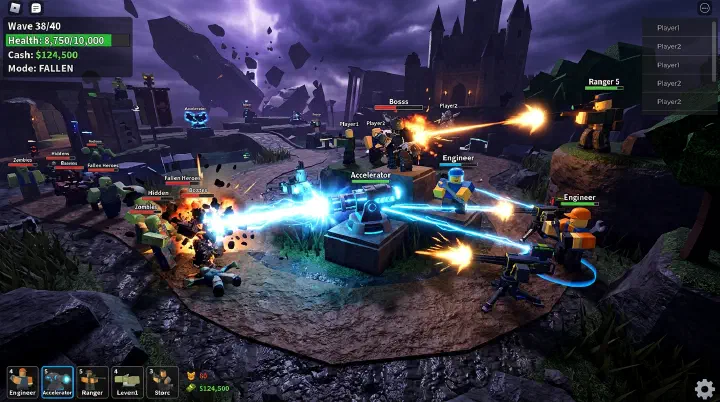
You’ve got Accelerator maxed. Engineer spitting out sentries. Pursuit flying overhead. You’ve watched the tier list videos. You’ve got the “best” towers in the game.
Wave 40 hits. The Fallen King strolls through your entire map like it’s a sidewalk.
What happened? You placed every tower right. You upgraded on time. Your solo towers are S-tier on paper — but paper doesn’t stop bosses. Synergy does. And you didn’t build any.
This guide breaks down why individual tower power is a trap, which combos actually multiply your damage, and the placement rules that make synergy work instead of cancelling itself out.
Why Solo Towers Fail on Wave 40
Tier lists rank towers in a vacuum. Accelerator deals massive DPS. Engineer covers lane width. Ranger hits from across the map. Each one looks unbeatable alone.
But TDS isn’t a single-target dummy test. It’s waves of mixed enemies — fast hidden scouts, tanky slow bosses, flying units that dodge ground towers, enemies that stun your best pieces. One tower can’t cover all of that. Two towers that cover each other’s blind spots beat two S-tiers that overlap and waste coverage.
Here are the five mechanical failure patterns that wipe solo-tower players on Wave 40:
Failure Pattern 1: Overlapping Coverage Wastes Tower Slots
When you place two high-damage towers side by side at the entrance, they both fire at the same group of enemies. The first tower kills them. The second tower sits idle, its DPS completely wasted. You’ve spent 2,000+ cash on a tower that contributed nothing because its coverage overlapped with your first tower.
Solo players do this constantly — cluster the “best” towers at the first turn and assume more damage equals better results. In reality, two overlapping S-tier towers produce less effective damage than one S-tier and one A-tier placed at different choke points.
Failure Pattern 2: Anti-Synergy — Towers Working Against Each Other
Some towers actively reduce each other’s effectiveness. Rocketeer and Demoman both use splash damage. Place them too close and they both target the same cluster. The first explosion kills the group; the second explosion hits empty ground.
Freezer and Frost Blaster slow enemies. Stacked slows have diminishing returns — an enemy at 50% speed from Freezer gains almost nothing from Frost Blaster’s additional slow. You’re running two slow towers but getting the effect of one and a half.
Failure Pattern 3: The Hidden Detection Gap
Hidden enemies appear on Wave 24, Wave 28, and again in the late 30s. If your only hidden detection is a Level 0 Crook Boss you forgot to upgrade, or a single Golden Scout placed at the back of the map, your Accelerator watches them walk past. Hidden detection isn’t a “nice to have.” It’s a hard requirement, and solo loadouts often skip it because it doesn’t look like DPS on the stat sheet.
Failure Pattern 4: Buff Range Misplacement
A DJ Booth outside your core tower’s range is a dead slot. A Commander placed at the back of the map where its ability only touches your leak catcher is a waste. Solo players treat buff towers as afterthoughts — place them wherever there’s space.
Buff towers are your highest-priority real estate. A DJ Booth that misses your Accelerator by one tower-width is the difference between 1,200 DPS and 3,400 DPS. The mechanical failure isn’t the tower. It’s the placement.
Failure Pattern 5: Stun Clustering
Enemies that stun towers target areas, not individual pieces. When you cluster six towers at the first turn, one stun bomb disables your entire damage output. A single stun on your Engineer costs you 15 seconds of sentry production. A stun on your DJ Booth drops the buff on every tower in its circle.
Spreading your towers isn’t just about coverage. It’s about risk distribution. One stunned tower in a spread layout is a 15% DPS loss. One stunned tower in a cluster is a 60% DPS loss.
Here’s the math that tier lists ignore:
- Accelerator melts bosses but misses hidden enemies entirely without hidden detection support.
- Engineer’s sentries shred groups but can’t focus a single fast target.
- Ranger has range for days but fires slowly; alone, it leaks rush waves.
A solo Accelerator on Wave 40 outputs about 1,200 DPS. An Accelerator backed by a DJ Booth (firing faster) and a Commander (ability bursts) hits closer to 3,400 effective DPS. That’s not a small buff. That’s the difference between a win and a wipe.
The gap isn’t the tower. It’s the lack of a system around the tower.
The Combo Priority System
Not every pair works. Some towers step on each other — two splash towers in the same lane waste overlap. Some combos are overkill — you don’t need Ranger AND Pursuit AND Turret covering the same straight line.
Build your combos in this order. Priority one comes first. Don’t build priority three until priority one is locked in.
Priority One: The Core + Hidden Detection Pair
Every loadout needs one heavy damage core and one hidden detection tower that doesn’t steal the core’s job.
- Accelerator + Crook Boss (hidden detection, doesn’t compete for placement space)
- Engineer + Golden Scout (hidden detection that earns cash while covering leaks)
- Turret + Minigunner (both need DJ Booth support, but cover hidden and ground together)
Why this matters: Hidden enemies appear on Wave 24, Wave 28, and again in the late 30s. If your only hidden detection is a Level 0 Crook Boss you forgot to upgrade, you’re leaking half the wave before your Accelerator even targets them.
Priority Two: The Buff Bridge
Buff towers don’t deal damage directly. They multiply damage from your cores. Two buffs stacked on one core beats three unbuffed cores.
- DJ Booth: Range and fire rate for everything in its circle. Place it where it touches your two highest-DPS towers, not where it looks pretty.
- Commander: Ability-based fire rate bursts. Stack its ability with DJ’s passive for 5-second windows where your Accelerator turns into a laser hose.
- Medic: Cleans stuns. Critical on Hardcore mode where a single stun on your Engineer costs you 15 seconds of sentry production.
Placement rule: DJ Booth’s circle is your most important real estate. I’d rather move a damage tower to stay inside DJ range than place it in a “perfect” solo spot outside.
Priority Three: The Leak Catcher
Late waves throw fast enemies past your main kill zone. You need one tower whose job is specifically catching leaks, not contributing to main DPS.
- Pursuit: Helicopter follows enemies down the lane. Place it near the exit, not the entrance.
- Electroshocker: Slows groups that slip through. Not your main damage, but buys 3 extra seconds for your Accelerator to finish the job.
- Ace Pilot: Circular path covers multiple lanes. Weak alone, decent as a mop.
Priority Four: The Economy Engine (If Space Allows)
In modes like Golden Mode, you need cash fast. In Fallen Mode, economy matters less because waves start hard immediately.
- Farm: Standard. Drop two Farms by Wave 6 or skip them entirely — a late Farm never pays back.
- Crook Boss / Golden Scout: Dual-purpose economy + light damage. Better in loadouts where you can’t spare a pure Farm slot.
The Synergy Loadout Framework
Use this priority system every time you build a loadout. Don’t skip steps.
Step 1: Pick Your Boss-Killer This is your primary DPS tower. It handles the big single targets — Fallen King, Molten Boss, Grave Digger. You need one tower whose job is pure damage on a single target.
- Accelerator: Best single-target melt. Requires hidden detection support.
- Engineer: Sustained sentry DPS. Needs stun protection.
- Turret: Consistent, no special gimmicks. Solid fallback.
Step 2: Pick Crowd-Control That Covers Its Weakness Every boss-killer has a weakness. Your second tower fixes that weakness, not adds more of the same damage.
| Boss-Killer | Weakness | Crowd-Control Fix |
|---|---|---|
| Accelerator | Hidden enemies, slow fire rate | Crook Boss (hidden) + DJ Booth (fire rate) |
| Engineer | Stuns, fast single targets | Medic (stun cleanse) + Electroshocker (slow) |
| Turret | Low range, no splash | DJ Booth (range) + Rocketeer (splash groups) |
Step 3: Pick Support That Amplifies Both Now add the buff that makes both previous towers stronger. The support is never an afterthought — it’s the multiplier.
- DJ Booth: Range + fire rate. Place it where it touches your Step 1 and Step 2 towers.
- Commander: Burst ability. Sync its cooldown with your boss-killer’s max level.
- Medic: Only if you’re running Engineer in Hardcore. Otherwise, skip for more DPS.
Step 4: The Leak Catcher After your core is locked, add one tower near the exit that catches what slips through.
- Pursuit: Follows enemies down the lane. Best for long maps.
- Electroshocker: Slows groups. Best for choke-point maps.
- Ace Pilot: Circular path. Best for multi-lane maps.
Step 5: Economy or Flex If the map has space and the mode rewards early cash, add Farm or a dual-purpose eco tower.
- Farm: Only if you can place two by Wave 6. A late Farm never pays back.
- Crook Boss / Golden Scout: Dual-purpose. Better in tight loadouts.
This framework produces a complete system: boss-killer + weakness cover + amplifier + leak catcher + economy. That’s five jobs for six slots. Your sixth slot is your flex — second buff, second leak catcher, or emergency Medic.
Proven Synergy Pairs That Actually Work
These aren’t theory. These are combos that clear Wave 40 consistently in Fallen and hold ground in Hardcore Mode.
Accelerator + DJ Booth + Commander The classic burst core. Accelerator handles single targets. DJ gives it range to reach earlier in the lane. Commander’s ability turns Wave 40’s boss phase into a 10-second melt instead of a 45-second slugfest. Without DJ, Accelerator sits idle on too many enemies that enter just outside its reach.
Engineer + Medic + Electroshocker Engineer’s sentries do the work, but Engineer gets stunned. Medic prevents that. Electroshocker slows enemies so sentries have more time to apply damage. This trio doesn’t have one massive DPS number — it has sustained DPS that never drops to zero. That’s often better than burst that goes offline at the wrong second.
Ranger + DJ Booth + Pursuit Ranger covers the map. DJ fixes its slow fire rate. Pursuit mops up anything that Ranger’s single-target shots miss. In maps with multiple lanes or curved paths, this pair covers ground that Accelerator can’t reach without awkward placement.
Golden Minigunner + Golden Scout + Farm Pure gold economy comp. Golden Scout gives hidden detection and early cash. Farm accelerates your Minigunner upgrades. By Wave 30, you’ve got three maxed Minigunners that cost you nothing in ongoing maintenance. This comp struggles in Hardcore where early waves hit too hard for the Farm delay, but dominates Golden Mode.
The Placement Spacing Rule Nobody Talks About
Here’s the counter-intuitive part: closer is not better.
Most players cluster towers near the entrance. It feels safe — kill everything early. But synergies break when towers are too close together.
- DJ Booth’s circle is fixed size. Cluster four towers inside it and you’re wasting potential range on towers that could be further forward or back.
- Splash towers like Rocketeer or Demoman damage each other’s targeting when placed side by side. They compete for the same group of enemies instead of covering consecutive segments of the lane.
- Stun effects from enemies hit clustered towers simultaneously. One stun bomb takes out three of your towers instead of one.
The 3-2-1 spacing rule:
- 3 tower-widths between your frontline damage towers (entrance area)
- 2 tower-widths between your buff towers and the towers they’re buffing
- 1 tower-width minimum between your leak catcher and the exit
This spreads your coverage across the entire lane. Your frontline softens enemies. Your midline buffs multiply damage at the optimal range. Your backline catches what slips through. The result is consistent clears instead of one strong choke point that fails the moment a fast enemy sneaks past.
I learned this the hard way on Crossroads. I had six maxed towers clustered at the first turn. Wave 36’s fast hidden enemies split left while my towers all fired right. Total wipe. Spreading the same six towers across the lane — same total damage, better coverage — cleared Wave 40 with towers to spare.
The Loadout Framework That Beats Every Mode
Your loadout isn’t six towers. It’s a job list. Every slot has a role. If two towers do the same job, one is wasted.
The six jobs:
- Primary DPS — Accelerator, Engineer, or Turret. One tower. Max it.
- Secondary DPS / Hidden — Crook Boss, Golden Scout, or Minigunner. Covers what your primary can’t hit.
- Buff — DJ Booth or Commander. Non-negotiable. A DPS tower without a buff is 40% weaker than it looks.
- Stun / Slow Support — Electroshocker, Freezer, or Frost Blaster. Buys time.
- Leak Catcher — Pursuit or Ace Pilot. Placed near exit, not entrance.
- Economy or Flex — Farm, Medic, or a second buff if the map demands it.
Before you start a match, label each tower in your loadout with its job. If you’ve got two primary DPS and no buff, you’re losing. If you’ve got Farm and no leak catcher, you’re leaking Wave 35 while you’re still saving for upgrades.
For mode-specific loadout tweaks, check the full TDS loadout guide and the Fallen mode breakdown. Hardcore swaps economy for early defense. Golden Mode leans into cash generation. But the six-job framework stays the same.
Counter-Intuitive Advice
These three principles break the instinct that “bigger number = better.” They also win more games.
1. Two A-Tier Towers With Synergy Beat Two S-Tier Towers Without It
A Golden Minigunner paired with a DJ Booth and a Commander outperforms an unbuffed Accelerator and an unbuffed Turret placed side by side. The S-tier pair has higher base stats. The A-tier pair has higher effective damage because the buffs multiply every shot.
Tier lists don’t show this because they rank towers in isolation. In practice, an A-tier tower inside a full synergy system clears Wave 40 while a solo S-tier leaks on Wave 35.
2. The Best Synergy Tower Is Often the One That Does Nothing on Its Own
DJ Booth deals zero damage. Commander deals zero damage. Medic deals zero damage. But a loadout without them is 40–60% weaker than it looks on paper.
Players skip these towers because they don’t see numbers on the damage tracker. That’s exactly why they’re undervalued — and exactly why bringing one gives you an advantage over players who stack six damage towers that all compete for the same targets.
3. Don’t Upgrade Your Best Tower First — Upgrade the Support That Makes It Better
Most players max their Accelerator first. It feels right — bigger number, visible damage.
Buff towers at low levels have weak coverage or long cooldowns. A Level 2 DJ Booth barely reaches your core. A Level 0 Commander’s ability is a 10% bump instead of a 50% bump.
I upgrade my DJ Booth to Level 3 before I max my primary DPS. That means my core tower is hitting faster and further while I’m still upgrading it. The total damage output during the upgrade phase is higher than if I’d maxed DPS first with a weak buff behind it.
Same with Commander. Get it to Level 3 so the ability cooldown drops. Then sync your primary DPS max with the ability windows. The burst phases line up with the hard waves instead of firing on cooldown during easy cleanup.
This feels backwards. It wins more.
What to Do Right Now
Open your current loadout. Label each tower’s job. Do you have two towers doing the same thing? Is your DJ Booth touching your best DPS tower, or is it buffing a Farm and a leak catcher while your Accelerator sits outside the circle?
Fix one synergy this week. Move one tower into DJ range. Swap one duplicate DPS for a buff or a stun. Run Fallen Mode and watch Wave 40. If the Fallen King dies before the exit, you’ve found your combo.
Synergy isn’t about having the best towers. It’s about building a system where every tower makes the others better. That’s the difference between tier lists and victories.